
Starting a recruitment agency means choosing a niche, registering a legal business, setting a pricing model, building a candidate database, and placing your first hire typically achievable within 60 to 90 days of launch. No formal HR degree is required, but relevant industry experience and a focused business plan are essential.
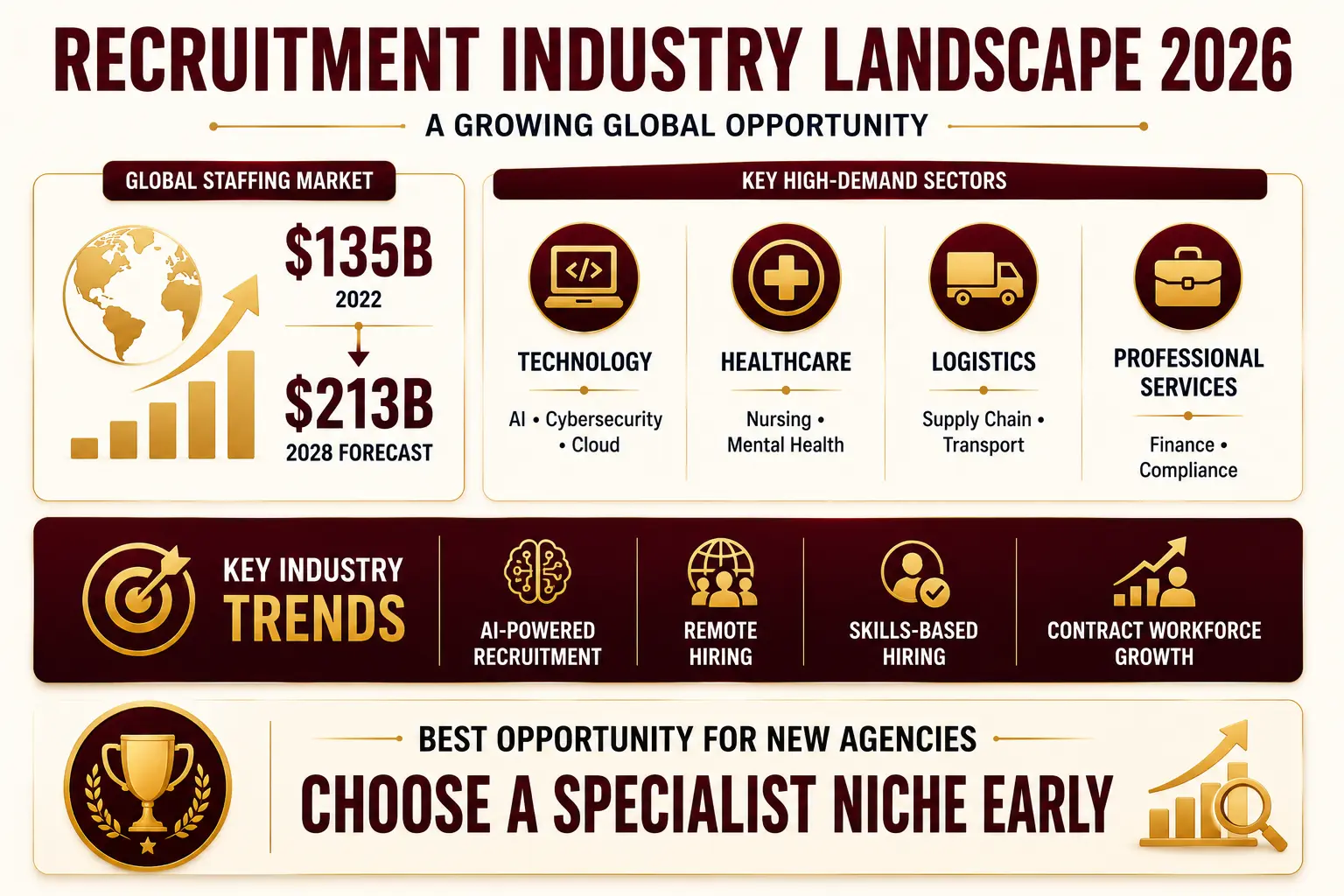
The global staffing market was valued at USD 135 billion in 2022 and is forecast to reach USD 213 billion by 2028, growing at a CAGR of 7.86%. Demand for qualified candidates is accelerating in technology, healthcare, logistics, and professional services, making 2026 one of the most favourable times on record to start a staffing agency or recruitment firm.
This guide walks you through every step: from choosing your recruitment business model and writing a business plan, to registering your company, opening a business bank account, staying legally compliant, marketing to clients, and scaling your team. Whether you are learning how to start a recruitment company for the first time or expanding an existing operation into Europe, this is your full roadmap.
Step 1: The Recruitment Industry Landscape
Before investing time and money in setting up a recruitment company, it pays to understand how the industry actually works. Too many aspiring agency owners assume they can apply broad recruitment experience to any sector. In practice, the most profitable agencies are those that operate with surgical precision in one part of the market.
The recruitment industry is split into two broad categories:
- Permanent recruitment: You find and place candidates in full-time roles. The employer pays a fee, usually 15–25% of the hired candidate’s first-year salary, when a successful placement is made. This is sometimes called contingency recruitment.
- Temporary and contract recruitment: You supply workers on a short-term or project basis. You remain the employer of record, paying the worker a wage and billing the client a marked-up rate. This model requires more working capital but generates recurring weekly revenue.
There are also hybrid models, executive search firms, and large outsourced Recruitment Process Outsourcing (RPO) providers. Each has different capital requirements, sales cycles, and margins. Understanding which segment fits your experience, network, and resources is the foundation of everything else.
The Staffing Market in 2026
The global staffing market has rebounded strongly following the disruption of 2020–2022. Key trends shaping the recruitment business landscape include:
- AI-assisted sourcing tools are becoming standard agencies that do not adopt them will lose competitive ground on speed-to-shortlist.
- Remote and hybrid work has expanded the geographic reach of most recruiters, opening up cross-border placement opportunities.
- Skills-based hiring is displacing degree-based screening, particularly in technology and finance, a shift that favours specialist recruiters who understand competency frameworks.
- The rise of freelance and contract work has boosted demand for temp and contract staffing agencies, particularly in creative, technology, and logistics sectors.
- Diversity, equity, and inclusion (DEI) requirements from corporate clients are becoming a formal requirement in placement briefs, not an afterthought.
Understanding these trends positions you to pitch to clients with confidence and build a recruitment business that stays relevant as the staffing market evolves.
Step 2: Choose Your Recruitment Niche
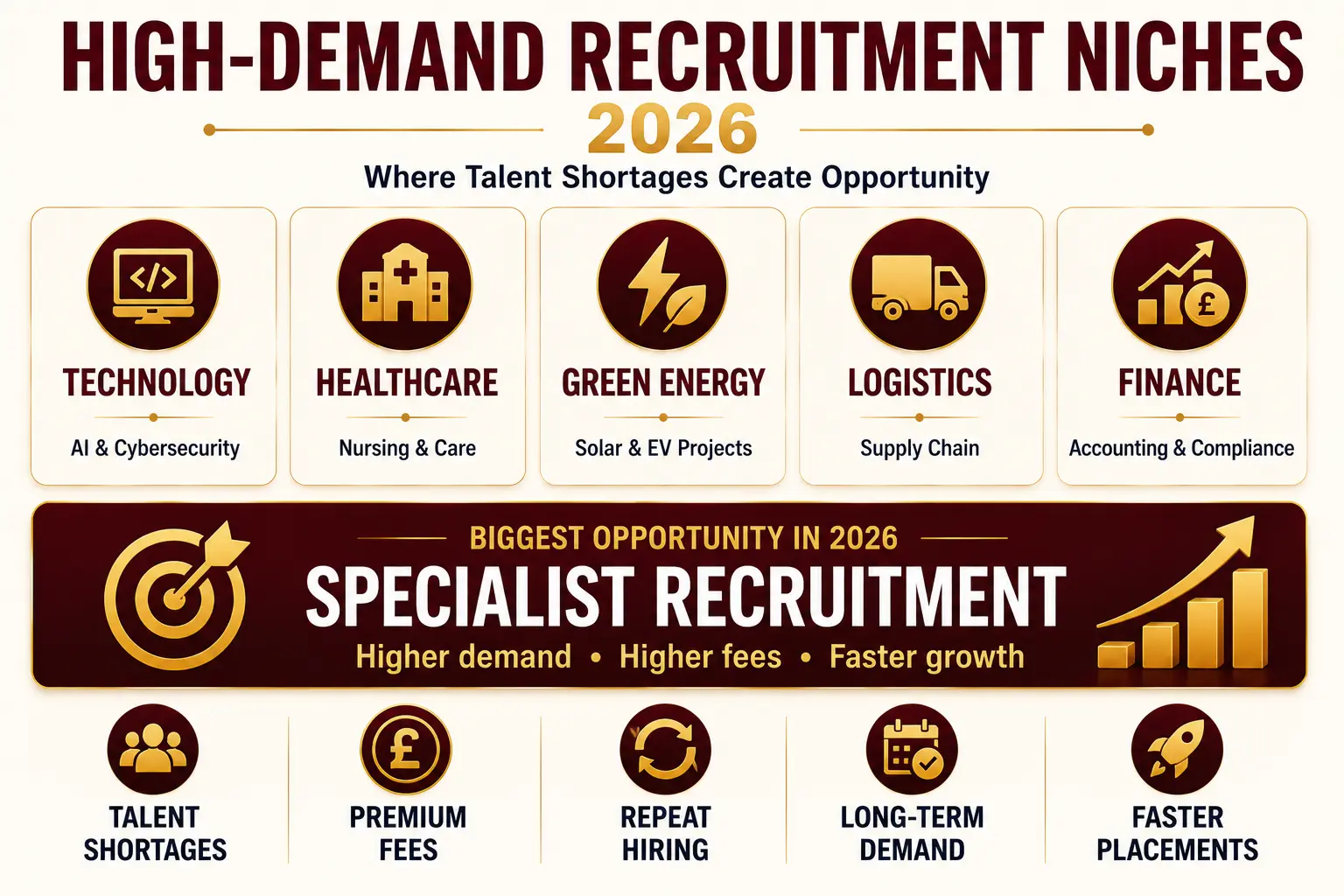
The most consistent piece of advice from experienced staffing agency owners is this: specialise early. A generalist recruitment firm competing against established players has no natural advantage. A specialist recruitment firm serving a narrow niche, say, DevOps engineers in financial technology, or theatre nurses in the NHS, becomes the go-to agency for that market segment and can charge premium fees to match.
Your niche should sit at the intersection of three things:
- A sector where you have direct personal experience or a strong existing professional network.
- A market with genuine hiring demand and talent shortages in sectors where employers consistently struggle to find qualified candidates.
- A space that is not already saturated with large, well-funded competitors at the specific level you plan to operate.
Use LinkedIn to validate your niche before committing. Search for job postings in your target sector, note which companies are hiring repeatedly, and check how many specialist agencies are already active. If you can name 10 target client companies on Day 1, your niche is viable.
Recruitment Agency Types at a Glance
|
Agency Type |
Best For |
Typical Fee Model |
Average Margin |
|
Permanent / Contingency |
Mid-level hires across most sectors |
15–25% of annual salary |
High one-off fees |
|
Temporary / Contract |
Short-term or project-based roles |
Hourly markup on pay rate |
Lower per placement, high volume |
|
Executive / Retained Search |
Senior leadership and niche specialists |
3-stage retainer + success fee |
Very long sales cycle |
|
Embedded / RPO |
High-volume or ongoing client hiring |
Monthly fee or cost-per-hire |
Predictable recurring revenue |
|
Managed Service Provider (MSP) |
Large enterprises managing multiple vendors |
Vendor-neutral management fee |
Lower margin, very high volume |
High-Demand Recruitment Niches in 2026
Certain sectors are experiencing significant talent shortages, making them particularly attractive for new staffing agencies:
- Technology: cybersecurity, cloud engineering, AI/ML, and data engineering are consistently underserved.
- Healthcare and social care: nursing, allied health professionals, and mental health workers remain critically short across Europe and the US.
- Green energy and sustainability: solar, wind, and EV infrastructure projects are creating large demand for skilled trades and project managers.
- Logistics and supply chain: post-pandemic restructuring has created sustained demand for warehouse managers, HGV drivers, and supply chain analysts.
- Finance and accounting: qualified accountants, financial controllers, and compliance professionals are in persistent short supply in most European markets.
Case Study: The Power of Niche Focus
Hays plc began as a broad business services company before pivoting to specialist recruitment in accounting, IT, and construction. The niche focus is widely credited as the strategic turning point that enabled Hays to grow into a business operating in 33 countries and generating over £1.1 billion in annual net fees. For a new recruitment firm, the lesson is clear: narrowing your focus accelerates credibility, referrals, and fee rates all at once.
Step 3: Write a Recruitment Business Plan
A business plan is not a formality it is the document that forces you to test every assumption before spending money. Recruitment businesses that launch without a plan tend to underestimate cash flow requirements, overspend on overheads, and fail to define a sales strategy before they urgently need clients.
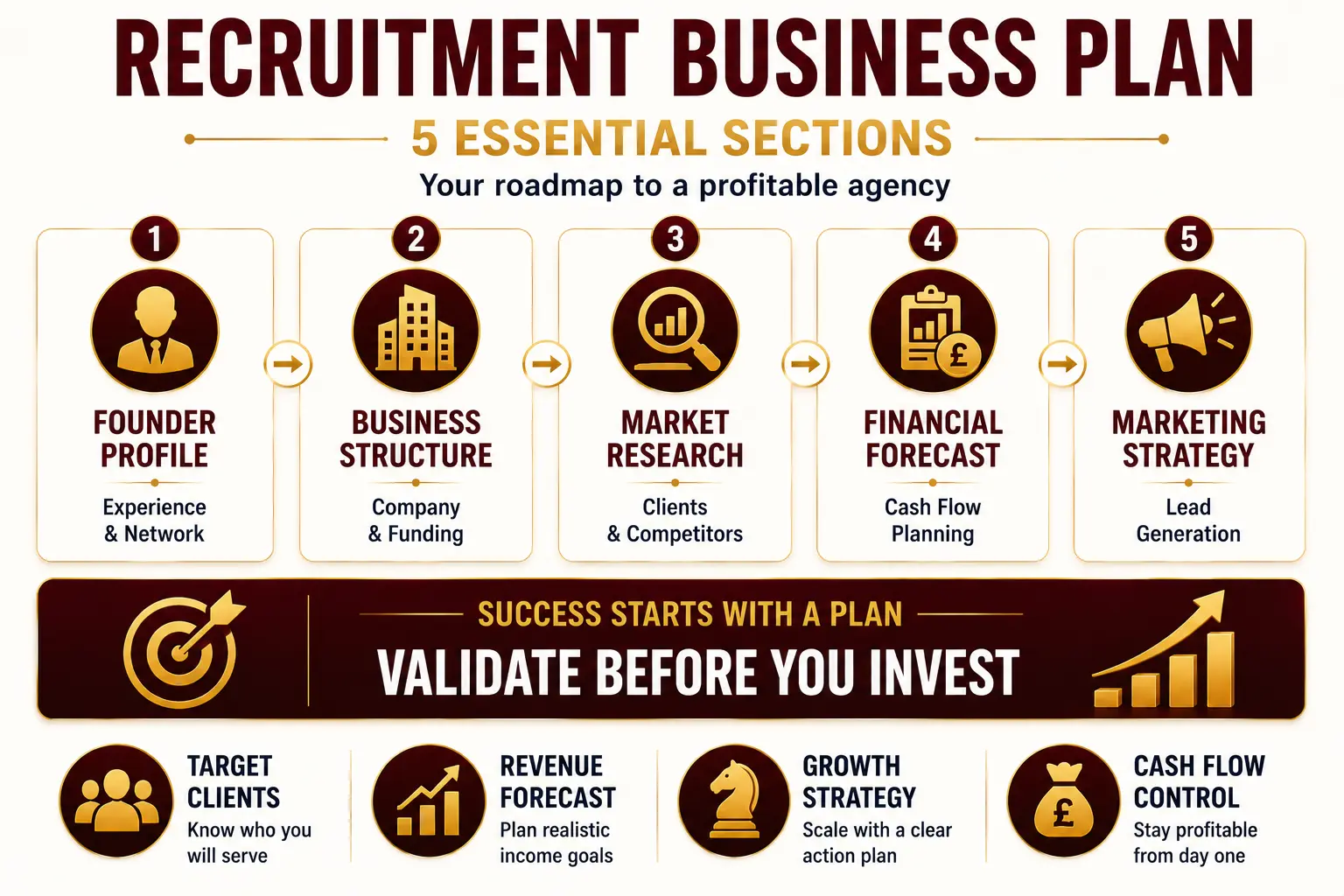
Your plan does not need to be long. A focused 10-page document covering the following five areas is more useful than a 40-page report that collects dust. HubSpot offers a free marketing plan template that integrates well with business planning for service businesses
1. Personal and Professional Profile
Explain why you are the right person to run this recruitment firm. Cover your years of experience in the sector, any formal qualifications (such as CIPD or REC accreditation), your client and candidate networks, and the specific competitive advantage you bring. Investors and lenders assess the founder before they assess the business your profile section needs to be honest, specific, and compelling.
2. Business Profile and Structure
Define your legal structure (sole trader, limited company, or LLP), your co-founder arrangements if relevant, your operating location, and whether you will work from a home office, a hot desk, or a rented office space. Set out your funding plan: will you self-fund, take a business loan, or seek investment? Most new recruitment agencies are self-funded in Year 1, relying on a combination of personal savings and a business overdraft or credit line.
Also define your service delivery model here traditional (external agency) or embedded (on-site at clients). The embedded model commands higher fees but typically requires you to have strong existing relationships before approaching clients with the proposition.
3. Market Research
Your market research section should answer three questions precisely:
- Who are your target clients? Name 10–20 specific companies, identify the hiring manager or HR Director at each, and note their typical hiring volume and frequency.
- Who are your competitors? List the five agencies most active in your niche. Identify their fee structures, their strengths, and crucially, where their service falls short. This gap is your opening.
- What does the talent pool look like? Use LinkedIn to estimate the number of candidates with the skills you plan to place. A niche with fewer than 5,000 candidates in your geography may be too thin to sustain a business.
4. Financial Forecasts and Cash Flow
This is the section most first-time recruitment firm founders get wrong. Recruitment revenue is unpredictable month to month, and cash flow management is critical, particularly for temp agencies, which pay workers weekly before the client invoice is settled.
Build a 12-month cash flow forecast. Include:
- Monthly fixed costs (subscriptions, insurance, software, bank fees).
- Estimated monthly placement fees start conservatively (one placement per month in Months 1–3 is realistic for a solo recruiter).
- Invoice payment terms: Most recruitment invoices are paid on 30-day terms; budget for this lag.
- A contingency buffer of at least three months of fixed costs before you take a salary.
5. Marketing and Business Development Strategy
Your marketing strategy needs to specify how you will generate both client leads and candidate applications. Outline your LinkedIn outreach plan, your content marketing approach, your SEO strategy for your website, and any paid advertising budget. Be specific. ‘Use LinkedIn’ is not a strategy; ’50 targeted outreach messages per week to HR Directors in FinTech, with a follow-up sequence over 10 days’ is a strategy.
Content scaling, publishing consistent, niche-relevant articles and guides, is one of the most cost-effective long-term marketing channels for recruitment agencies. Backlinko’s research on content scaling shows that focused topic clusters drive compounding organic traffic over time
Step 4: Understand and Plan Your Start-Up Costs
One of the most common reasons new recruitment agencies struggle in Year 1 is underestimating the time between incurring costs and receiving fees. A permanent placement typically takes 4–12 weeks from first contact to invoice. Temp placements generate faster cash flow but require you to fund weekly payroll before the client settles their invoice.
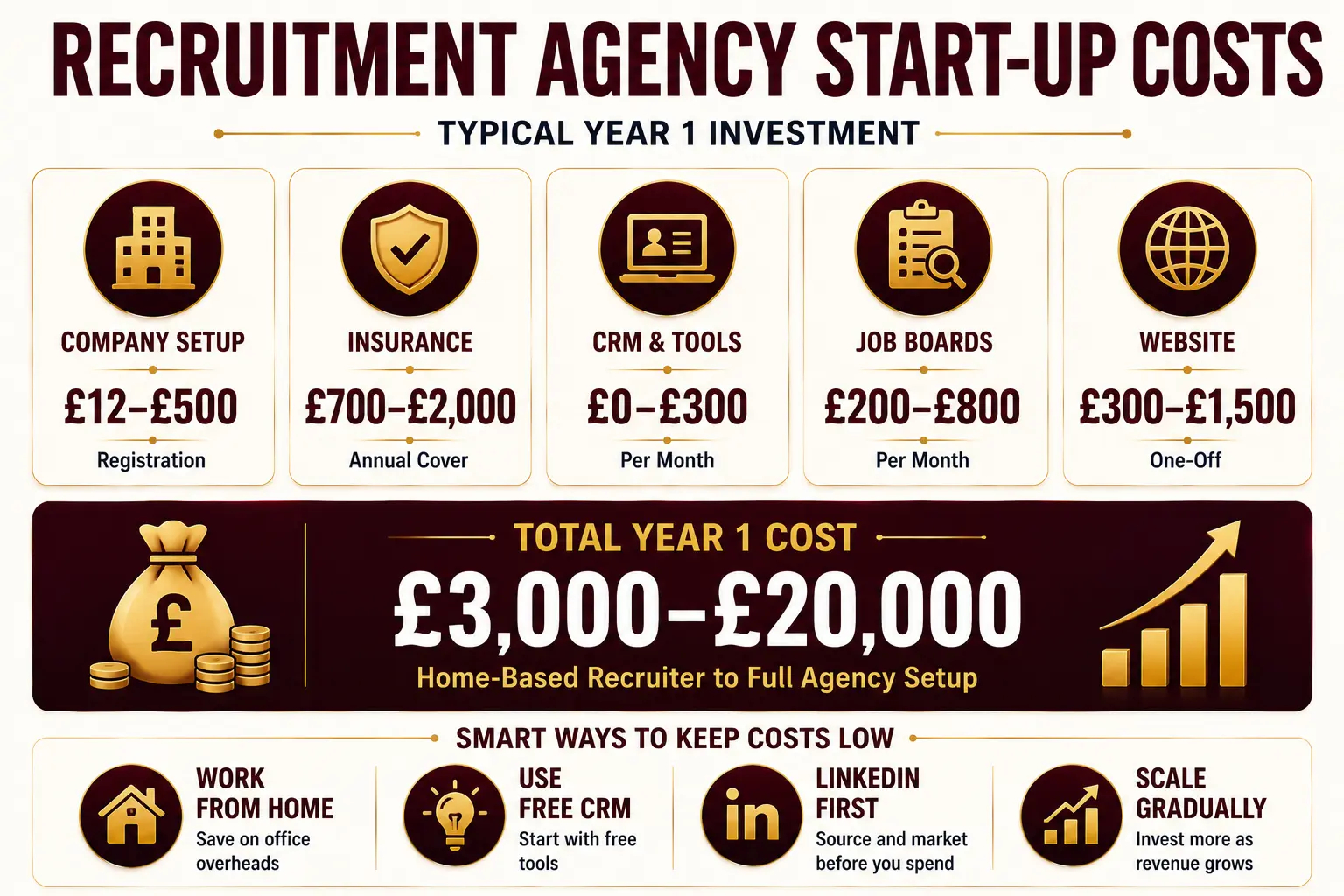
The table below provides a realistic breakdown of what you will need to budget for in the first year of operating a recruitment firm.
Recruitment Agency Start-Up Cost Breakdown
|
Cost Category |
Estimated Range |
Notes |
|
Company registration |
£12–£500 |
UK Ltd = £12 online via Companies House; EU varies by jurisdiction |
|
Business bank account |
£0–£25/month |
Starling and Tide are free; traditional banks charge monthly fees |
|
Professional indemnity insurance |
£500–£2,000/year |
Required before placing candidates; get quotes from Hiscox or Simply Business |
|
General liability insurance |
£100–£600/year |
Covers third-party property damage and personal injury claims |
|
Recruitment CRM software |
£0–£300/month |
Start with free Airtable; upgrade to Bullhorn or Vincere as you scale |
|
Job board subscriptions |
£200–£800/month |
LinkedIn Recruiter Lite £119/month; Indeed and CV Library vary by sector |
|
Website + domain name |
£300–£1,500 one-off |
WordPress or Webflow; domain approx. £10–£15/year |
|
Office space (optional) |
£200–£1,200/month |
Virtual office or hot desk is sufficient for the first 12 months |
|
Accounting software |
£14–£40/month |
Xero Starter or QuickBooks Simple Start |
|
Marketing and paid ads |
£0–£500/month |
LinkedIn Ads or Google Ads; optional in Year 1 if doing outreach manually |
|
Total estimated (Year 1) |
£3,000–£20,000 |
Lower end = home-based solo recruiter with minimal overheads |
Pro Tip: Keep Fixed Costs as Low as Possible in Year 1
The most successful solo recruiter launches are deliberately lean. Working from home, using free or low-cost CRM tools, and relying on LinkedIn Recruiter Lite rather than expensive job boards keeps your break-even point at one or two placements per month achievable for almost any experienced recruiter with an existing network.
Funding Your Recruitment Business
Most recruitment agencies are self-funded at launch. However, if you need additional capital, consider the following options:
- Start-up business loans: In the UK, the British Business Bank’s Start Up Loans programme offers loans of £500–£25,000 at a fixed interest rate of 6% per annum (https://www.startuploans.co.uk/). Comparable schemes exist across the EU.
- Invoice financing: If you are operating a temp or contract desk, invoice financing allows you to draw down cash against unpaid client invoices immediately rather than waiting 30–60 days. This is particularly important for staffing agencies running payroll weekly.
- Business overdraft: A pre-agreed overdraft facility with your business bank provides a buffer for cash flow dips without requiring formal lending approval for each use.
- Angel investment: For recruiters with an ambitious growth plan and a documented track record, angel investors active in the HR tech or professional services space are a realistic option.
Step 5: Choose Your Business Model and Pricing Strategy
How you charge clients is one of the most important commercial decisions you will make when starting a recruiting business. Your pricing model affects everything: your cash flow, your client relationships, your risk exposure, and your ability to scale.
There are two layers to your business model decision: how you price your services, and how you deliver them.
Pricing Your Services
Recruitment Pricing Models Compared
|
Pricing Model |
How It Works |
Typical Rate |
Best Suited To |
|
Contingency |
Fee paid only on successful hire; no upfront cost to client |
15–25% of annual salary |
SMEs, first-time clients, most perm roles |
|
Retained |
Client pays in three stages: on engagement, at shortlist, on placement |
25–35% of salary + retainer |
Executive search, C-suite, specialist niches |
|
Hourly / Time-and-materials |
Agency bills per recruiter hour worked |
£50–£150/hour |
Project-based or embedded models |
|
Flat fee |
Fixed price per vacancy, regardless of time taken |
£500–£5,000 per role |
Startups and budget-conscious clients |
|
Temp markup |
Agency charges a percentage above the worker’s hourly pay rate |
15–40% markup on pay rate |
Temporary, contract, and seasonal roles |
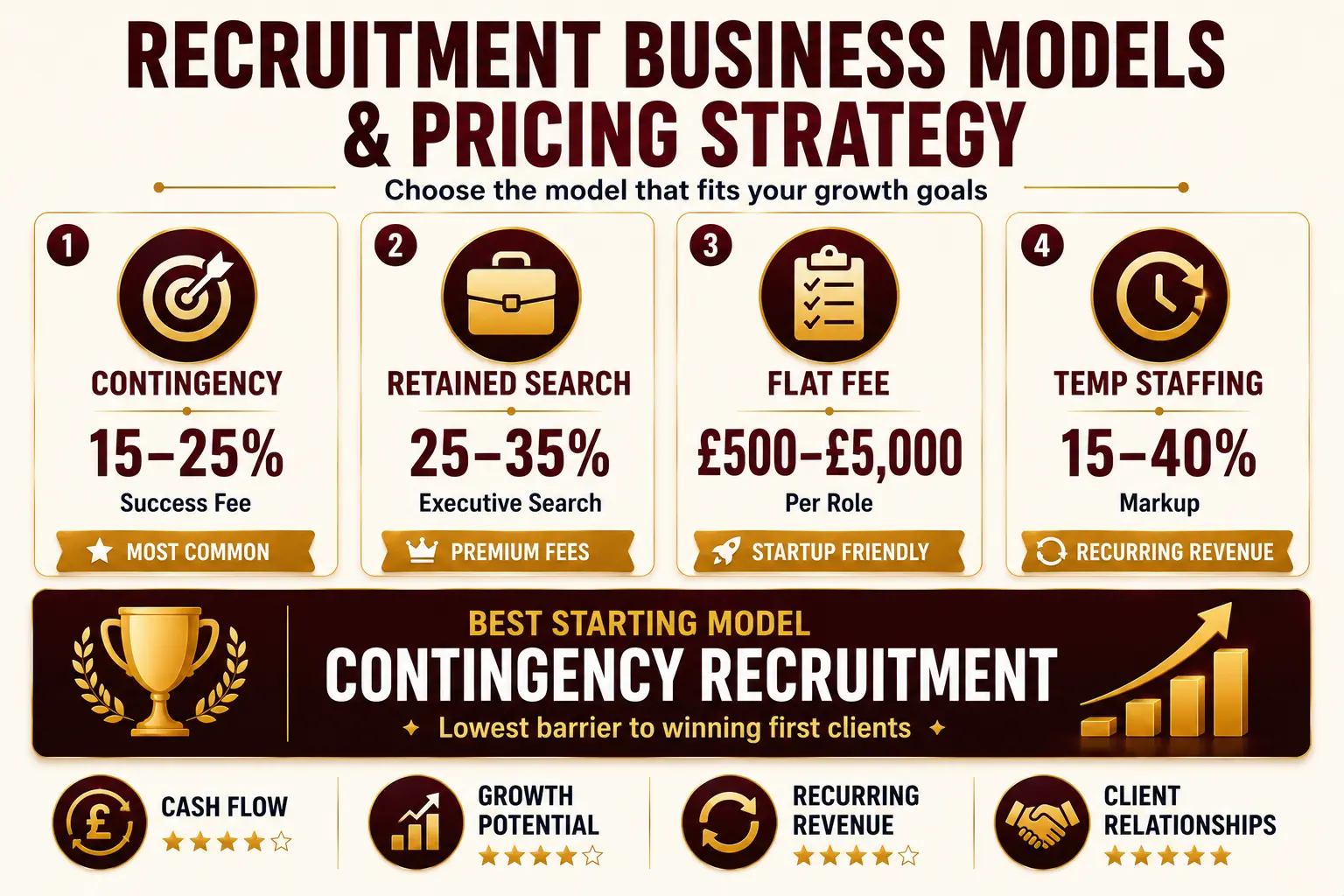
For most new recruitment firms, contingency pricing is the right starting point. It removes the upfront cost barrier for clients, which makes it easier to win your first mandates. As you build a track record and a reputation in your niche, you can move toward retained search, which provides better cash flow and gives you exclusivity on each role.
Setting Your Fee Rate
Fee rates vary significantly by sector, seniority, and market conditions. As a general guide:
- Junior and mid-level roles: 12–18% of annual salary for contingency placements.
- Senior and specialist roles: 20–25%, sometimes higher in deeply specialist niches.
- Executive and C-suite search: 25–35%, almost always on a retained basis.
- Temp and contract markup: 15–40% above the worker’s hourly pay rate, depending on sector and competition.
Do not undercut the market to win your first clients. Discounting signals desperation, attracts low-quality clients, and creates a fee expectation that is almost impossible to reverse. Compete on speed, quality, and specialist knowledge, not price.
Delivery Models: Traditional vs Embedded
- Traditional model: Your agency operates externally, supplying candidates without direct involvement in the client’s internal processes. This is the standard model for most independent recruitment firms and is the simplest to set up and scale.
- Embedded / RPO model: One or more of your recruiters works on-site at the client’s premises, integrated into their HR or talent acquisition function. This model is increasingly popular with mid-market companies that want the expertise of an agency without the per-placement fee structure. It generates predictable monthly recurring revenue but requires a stronger existing client relationship to sell.
Step 6: Register Your Company and Set Up Your Legal Structure
Getting your legal and financial foundations right is not optional. Operating a recruitment business without the correct legal structure, insurance, and tax registrations exposes you to personal liability, regulatory fines, and in worst cases, criminal prosecution under employment agency legislation.
Choosing the Right Legal Structure
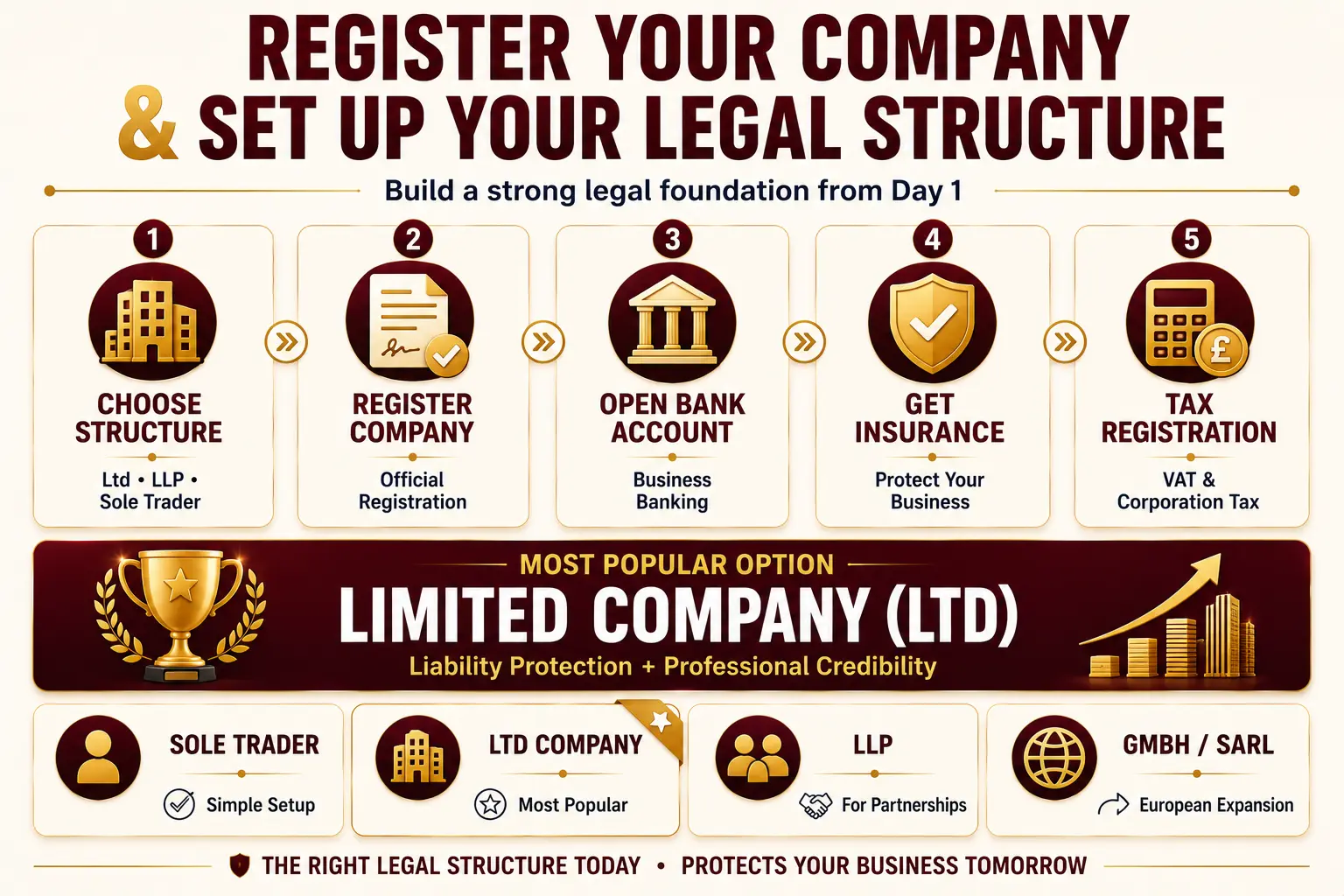
The right legal structure for your recruitment agency depends on your country of operation, your personal financial situation, and your growth plans. In the UK and most European jurisdictions, the main options are:
- Sole trader (self-employed): The simplest and cheapest structure. You register with HMRC and file a Self Assessment tax return. However, there is no separation between personal and business assets if your agency is sued, your personal finances are at risk.
- Limited Company (Ltd): The most widely used structure among staffing agency owners. Your company is a separate legal entity, which protects your personal assets. You pay Corporation Tax on profits (currently 19–25% in the UK, depending on profit level) and pay yourself a salary and dividends. Set up in the UK for £12 online at Companies House.
- Limited Liability Partnership (LLP): Useful when co-founding with one or more partners, as it provides liability protection while distributing profits flexibly. Common in legal and financial sector recruitment firms.
For EU markets, legal structures vary. In Germany, the GmbH (Gesellschaft mit beschränkter Haftung) is the equivalent of a UK Ltd. In France, it is the SARL (Société à responsabilité limitée). Open A European Company handles registrations across 30+ European jurisdictions and can advise on the most tax-efficient and operationally appropriate structure for your target market.
Registering Your Company
- UK: Register at Companies House for £12 online. Your company is usually registered within 24 hours.
- Ireland: Register with the Companies Registration Office (CRO) typically takes 5–10 business days.
- EU jurisdictions: Processing times and costs vary from £50 in Estonia (the most entrepreneur-friendly EU country for company formation) to £1,000+ in some Western European countries.
Choosing and Registering Your Agency Name
Your agency name is a long-term brand asset. Changing it later is expensive and disruptive. Apply these four rules before settling on a name:
- Check it is not already registered: Search Companies House (UK), EUIPO (EU trademarks), and the relevant national trademark register in your target market.
- Verify the domain is available: Before committing to a name, confirm that the .com and relevant country-code domain (.co.uk, .de, .fr, etc.) are available. A name without a matching domain is a brand liability.
- Keep it simple and memorable: Short names (one or two words) are easier to brand, easier to say over the phone, and more searchable online.
- Reflect your niche if possible: A name like ‘Apex Technology Recruitment’ or ‘MedStaff Partners’ signals specialism immediately and builds relevance in search results.
Opening a Business Bank Account
Opening a dedicated business bank account is one of the most important steps in setting up a recruitment business and one that many first-timers delay, to their cost. Mixing personal and business finances creates accounting headaches, puts your personal assets at risk in the event of a dispute, and signals unprofessionalism to clients who check your payment details.
Practical options for new recruitment firms in the UK:
- Starling Bank Business: Free, fully featured, and highly rated by small business owners. Opens in minutes via the app.
- Tide Business: Free tier available; useful for very early-stage businesses. Charges for some transactions.
- Barclays Business Account: Traditional bank; useful if you need an overdraft or invoice financing from launch. Monthly fee applies.
- HSBC Kinetic: Good for sole traders and small Ltd companies; includes integrated accounting features.
For European operations, consider Wise Business (multi-currency) or N26 Business for companies operating across multiple EU jurisdictions. Both are significantly cheaper than traditional bank accounts for international payments.
Setting Up Business Accounting
From Day 1, track every business income and expense separately from your personal finances. Cloud accounting software makes this straightforward and affordable:
- Xero Starter (£16/month): Ideal for solo recruiters and small agencies. Integrates with most UK banks.
- QuickBooks Simple Start (£14/month): Good alternative with strong invoicing features.
- FreeAgent (free with some business bank accounts): Good option if you bank with NatWest, Royal Bank of Scotland, or Mettle.
Hire an accountant before you file your first tax return, even if you are using accounting software. The cost of an annual accountancy package (typically £500–£1,500 for a small Ltd company) is trivial compared to the risk of filing incorrectly.
Getting the Right Insurance
Before you place a single candidate, obtain the following minimum insurance cover:
- Professional indemnity insurance: Protects you if a client claims that your recruitment advice or a candidate you placed caused financial loss. Most clients will require evidence of this before signing a terms of business agreement.
- General liability insurance: Covers third-party property damage and personal injury claims relevant if you visit client sites or host candidates at your office.
- Employers’ liability insurance: Legally required in the UK as soon as you employ a single member of staff. Minimum cover is £5 million.
- Cyber liability insurance: Increasingly important for recruitment businesses, which hold large volumes of personal candidate data. A data breach involving candidate CVs can result in significant ICO fines under GDPR.
Registering for Tax
UK requirements for a new Ltd recruitment company:
- Register with HMRC for Corporation Tax within 3 months of starting to trade.
- Register for VAT if your annual turnover exceeds or is expected to exceed £90,000 (2024/25 threshold). Many recruitment agencies voluntarily register for VAT earlier to reclaim input tax.
- Register as an employer and set up PAYE if you take on staff or place temp workers on your payroll.
- Apply for an Employer Identification Number (EIN) if operating in the US.
Step 7: Understand Recruitment Laws and Compliance
Employment law and recruitment regulation is one of the most overlooked areas for new agency founders and one of the costliest to get wrong. The fines for non-compliance range from civil penalties to criminal prosecution, depending on the nature of the breach.

Key UK Legislation for Recruitment Agencies
- Conduct of Employment Agencies and Employment Businesses Regulations 2003: The primary legislation governing how recruitment agencies must operate in the UK. Covers contract terms, work-seeker rights, and agency obligations.
- Employment Agencies Act 1973: Sets out licensing and conduct requirements for agencies placing workers in certain sectors, including domestic work.
- Working Time Regulations 1998: Governs maximum working hours, rest periods, and annual leave entitlements for temporary workers placed through your agency.
- IR35 (Off-Payroll Working Rules): Critical for agencies placing contractors through limited companies. Under IR35, some contractor relationships are treated as employment for tax purposes. Incorrect classification can result in significant HMRC penalties for you as the agency, the end client, or both.
- GDPR and UK Data Protection Act 2018: You will process large volumes of sensitive personal data CVs, employment histories, references, and DBS checks. You must register with the ICO (fee: £40–£60/year), maintain a privacy policy, and have lawful bases for all data processing.
Industry Bodies and Accreditation
Joining an industry body is not compulsory, but it signals professionalism to clients and gives you access to legal helplines, template contracts, and compliance updates:
- Recruitment & Employment Confederation (REC): The UK’s primary trade body for recruitment agencies. Membership includes a legal helpline, compliance guidance, and the right to display the REC logo, which many large clients require.
- Association of Professional Staffing Companies (APSCo): Specialist body for professional staffing. Particularly relevant for technology, finance, legal, and life sciences recruiters.
Important: Sector-Specific Licences
Certain recruitment sectors require additional regulatory approval before you can trade. Healthcare staffing in England requires CQC (Care Quality Commission) registration. Security staffing requires workers to hold a valid SIA licence. Education recruitment requires enhanced DBS checks and compliance with Keeping Children Safe in Education guidelines. Research the specific requirements for your niche before trading
Case Study: Building a Specialist Recruitment Firm from Scratch
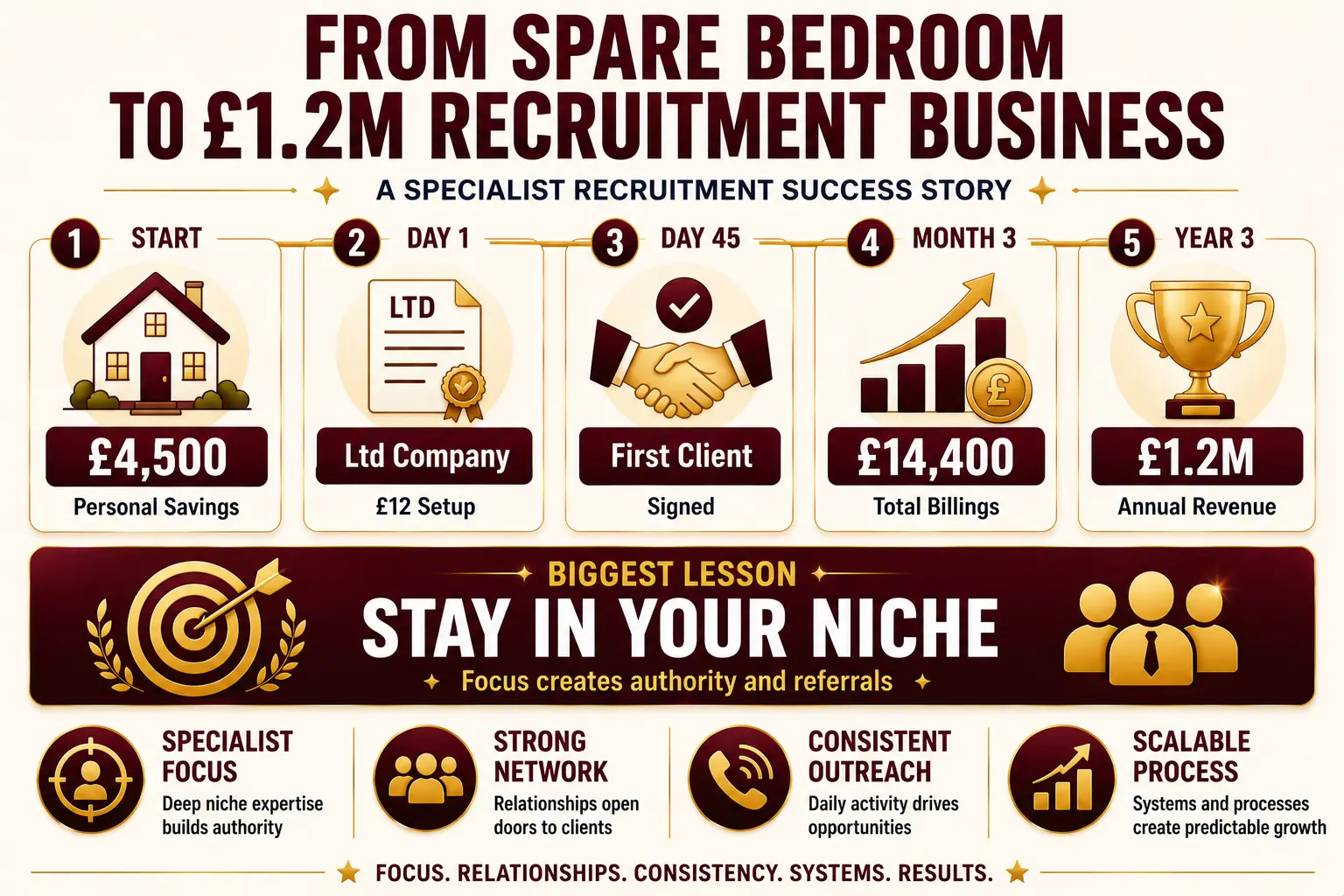
James started a logistics and supply chain recruitment agency from his spare bedroom in Manchester in 2021 with £4,500 in personal savings. He had 8 years of experience as an in-house talent acquisition manager for a major UK retailer, which gave him a deep network of both hiring managers and qualified candidates.
His launch checklist:
- Registered a UK Ltd company online at Companies House on Day 1, cost: £12.
- Opened a Starling Business bank account the same week, cost: £0.
- Purchased professional indemnity and general liability insurance through Hiscox, cost: £840/year.
- Subscribed to LinkedIn Recruiter Lite, cost: £119/month.
- Registered on CV Library as a new agency cost: £150/month.
- Signed his first client within 45 days through a former colleague who had moved to a new logistics firm.
Month 3 results: 2 permanent placements at an average fee of £7,200 each. Total billings: £14,400. Monthly costs: approximately £340. Net profit before tax: over £14,000.
By Year 3, James had grown to a team of 12, relocated to shared office space in Manchester city centre, and turned over £1.2 million. His biggest lesson: ‘I said no to every sector outside logistics for the first 18 months. Every enquiry outside my niche went to a referral partner. That discipline is what made me the go-to logistics recruiter in the North West.
Step 8: Build Your Marketing and Business Development Strategy
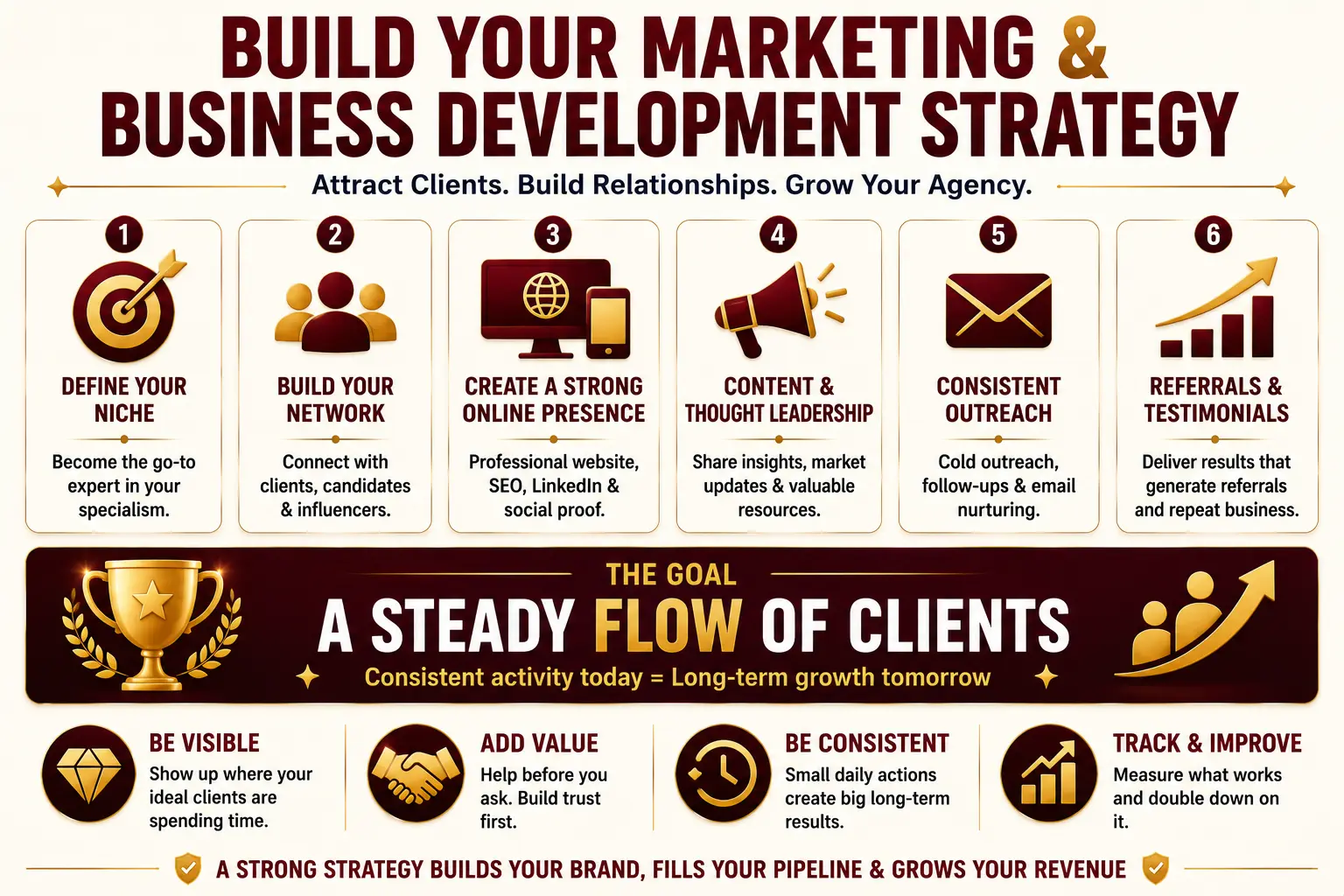
A recruitment agency needs two marketing engines running simultaneously from Day 1: business development (attracting clients) and talent attraction (attracting qualified candidates). Neglecting either one creates a bottleneck that throttles revenue.
Attracting Clients
For a new recruitment firm, the most cost-effective client acquisition channels are, in order of ROI:
Leveraging your existing network
Former colleagues, managers, and clients who have experienced your work are your most likely first customers. Do not wait for them to come to you. Send personalised messages to your top 20 contacts in the first week, explaining that you have launched your agency and asking who they know who is currently hiring.
LinkedIn outreach
LinkedIn is the highest-ROI digital channel for new recruitment agencies targeting professional or specialist roles. The approach that works: connect with hiring managers and HR directors in your niche with a short, personalised note referencing something specific about their company or a recent hire they made. Follow up with value a market insight, a salary benchmark, or a candidate brief before asking for a meeting.
Content marketing and SEO
Publishing short, niche-relevant articles on your website and LinkedIn positions you as a market expert. A quarterly salary survey for your niche, a ‘State of the Market’ report, or a hiring manager’s guide to attracting candidates in your sector all generate inbound enquiries over time. According to Backlinko’s research on content scaling, the agencies that build compounding organic traffic are those that focus on a narrow topic cluster rather than publishing broadly
Cold email
A personalised cold email campaign targeting 50–100 companies per month can generate consistent client meetings. The key is specificity: reference the company’s current open roles, their recent growth, or a specific challenge in their sector. Generic ‘we are a recruitment agency’ emails are ignored. Tools like Apollo.io or Hunter.io can help you find the right contact at each company.
Referral partnerships
Build relationships with complementary service providers, such as employment lawyers, HR consultants, business coaches, and payroll providers. They regularly encounter companies that need to hire and can refer you directly.
Attracting Candidates
Your candidate pipeline is your product. Clients pay for access to candidates they cannot find themselves. Build your talent database systematically from the first day you trade.
- Post roles on LinkedIn, Indeed, and sector-specific job boards relevant to your niche.
- Use LinkedIn Recruiter to proactively headhunt passive candidates. The most valuable hires are usually not actively searching.
- Build a referral scheme: a candidate you place who refers another typically becomes your most cost-efficient source of new talent.
- Attend sector-specific events, conferences, and meetups both to find candidates and to be found by them.
- Create a candidate experience that stands out: fast response times, honest feedback, and genuine career advice build a reputation that generates organic referrals.
SEO and Website Strategy
Your website is your 24/7 business development asset. A well-optimised recruitment website generates inbound client and candidate enquiries without ongoing manual effort. Focus on:
- Targeting long-tail keywords specific to your niche: ‘technology recruitment agency London’ or ‘logistics recruiter Manchester’ will drive more relevant traffic than ‘recruitment agency’.
- Meta descriptions: Each page’s meta description should be compelling and include your target keyword. Well-written meta descriptions measurably increase click-through rates from Google search results. Neil Patel’s guide on meta descriptions is an excellent practical reference
- Fast page load speed: Google’s Core Web Vitals are a confirmed ranking factor. A slow website costs you rankings and increases bounce rate.
- Mobile optimisation: Google uses mobile-first indexing. Your website must perform well on mobile before anything else.
- Regular content: Publish at least one article or guide per month on topics relevant to your niche hiring market. This builds topical authority over time.
Conduct a technical SEO audit at launch and every quarter thereafter. Search Engine Journal’s guide on website auditing provides an excellent practical framework
Social Media Strategy
LinkedIn is the only social media platform that most B2B recruitment agencies need to invest in heavily. Supplement this with:
- Twitter/X: Useful for sector commentary and building a public-facing thought leadership profile.
- Instagram and TikTok: Only relevant if you are recruiting in creative, media, or consumer-facing sectors where candidates actively use these platforms.
- Facebook Groups: Niche sector groups on Facebook can be a useful candidate sourcing channel, particularly in trades, logistics, and care sectors.
Step 9: Set Up Your Recruitment Technology Stack
The right tools enable a lean team to operate at the speed and quality of a much larger agency. The wrong tools or no tools at all create administrative bottlenecks that eat up the time you should be spending on clients and candidates.
Essential Tools for a New Recruitment Firm
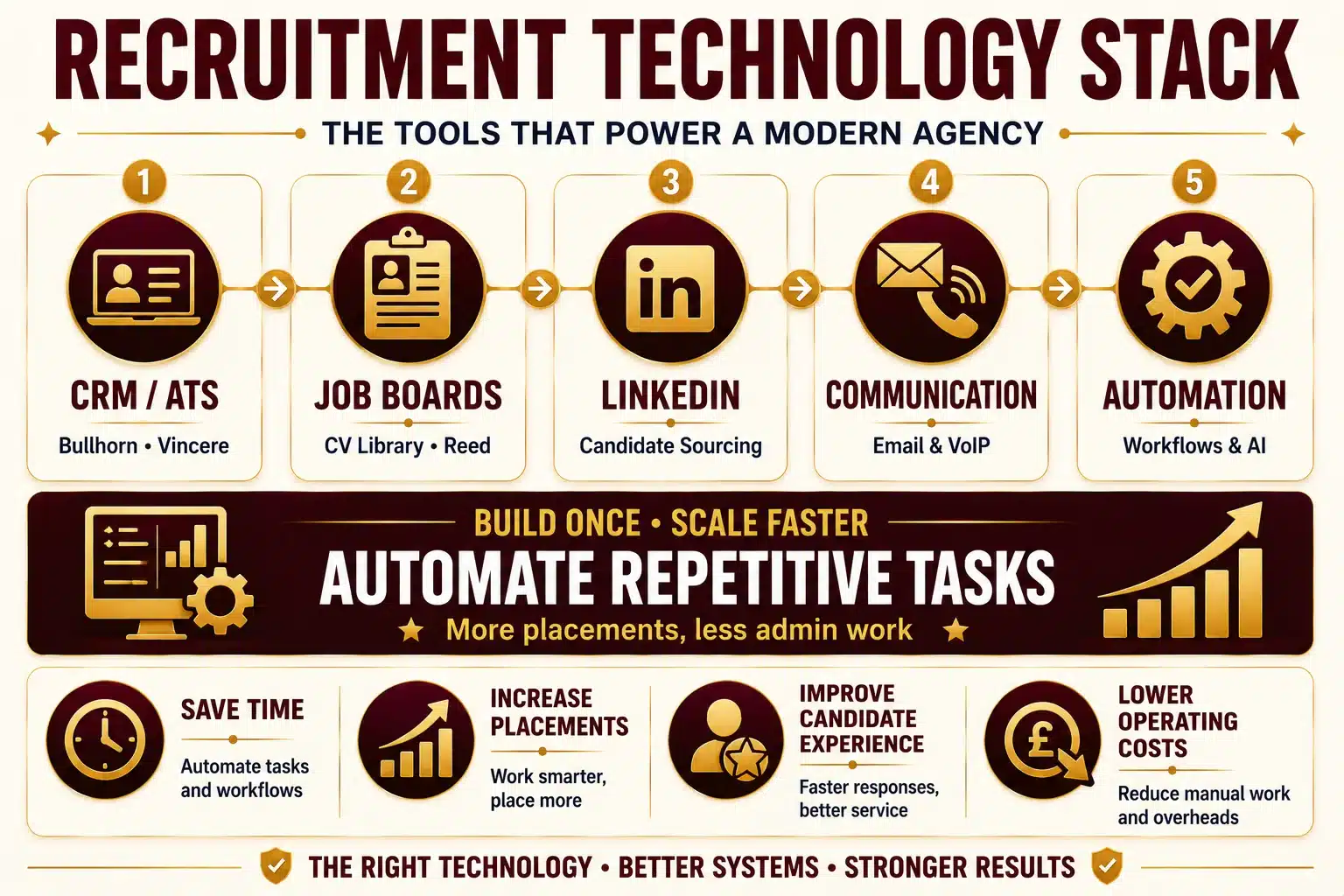
Start lean. The following stack is all a solo recruiter or small team needs to launch and place their first 10 candidates:
- LinkedIn Recruiter Lite (£119/month): The single most important sourcing tool for professional roles. Access to InMail credits, candidate searches beyond your first-degree network, and applicant tracking functionality.
- Recruitment CRM: Start with Airtable or Notion (both free) as a basic candidate and client database. Upgrade to a purpose-built CRM, Bullhorn, Vincere, Mercury, or Tracker when volume justifies the cost (typically 20+ active roles simultaneously).
- Job boards: LinkedIn Jobs, Indeed, and one sector-specific board. Avoid subscribing to multiple boards before you know which one generates candidates in your niche.
- Email and calendar: Google Workspace (£5.20/user/month) or Microsoft 365 (£5.10/user/month) gives you professional email, shared calendar, and document storage.
- Video interviews: Microsoft Teams or Zoom (both have free tiers) for initial candidate screening.
- Electronic signatures: DocuSign or Adobe Sign for client terms of business and candidate consent forms. Both have starter plans under £20/month.
- Accounting software: Xero or QuickBooks (see Step 6). Non-negotiable from Day 1.
AI and Automation Tools for Recruitment Agencies
AI-assisted recruitment tools are no longer a future trend they are becoming a competitive baseline for professional staffing agencies. The most impactful AI applications in recruitment in 2026:
- AI sourcing tools: Platforms like HeroHunt.ai (https://www.herohunt.ai/) and Fetcher automate candidate sourcing across LinkedIn and other databases, significantly reducing time-to-shortlist.
- AI-assisted job descriptions: Tools like Textio and Ongig analyse and improve job adverts for inclusivity and conversion rate, which improves candidate response rates.
- CV screening and ranking: AI-powered ATS platforms can shortlist CVs by relevance score, reducing manual screening time by 60–80% on high-volume roles.
- Outreach personalisation: AI writing tools can personalise candidate and client outreach messages at scale a significant advantage for agencies running large contact databases.
For a comprehensive overview of AI tools specifically evaluated for SEO and content marketing in recruitment, the Mangools blog provides a useful comparison
Use Case: Lean Tech Stack at Launch
A solo recruiter launching a technology staffing agency in 2025 used the following minimal setup from Day 1: LinkedIn Recruiter Lite, a free Airtable CRM, a £300 WordPress website optimised for her niche keyword (‘Python developer recruitment London’), a Starling Business bank account, and Google Workspace. Total monthly overhead: approximately £260. She placed her first IT contractor within 6 weeks, billing £8,400 in fees. By the end of Month 6, she had placed 11 candidates and billed £67,000, all from her spare room
Step 10: Place Your First Candidates and Build a Repeatable Process
The goal in the first 90 days is not to build the perfect agency, it is to place your first candidate and prove the business model works. Everything else can be refined later.
The Basic Recruitment Workflow
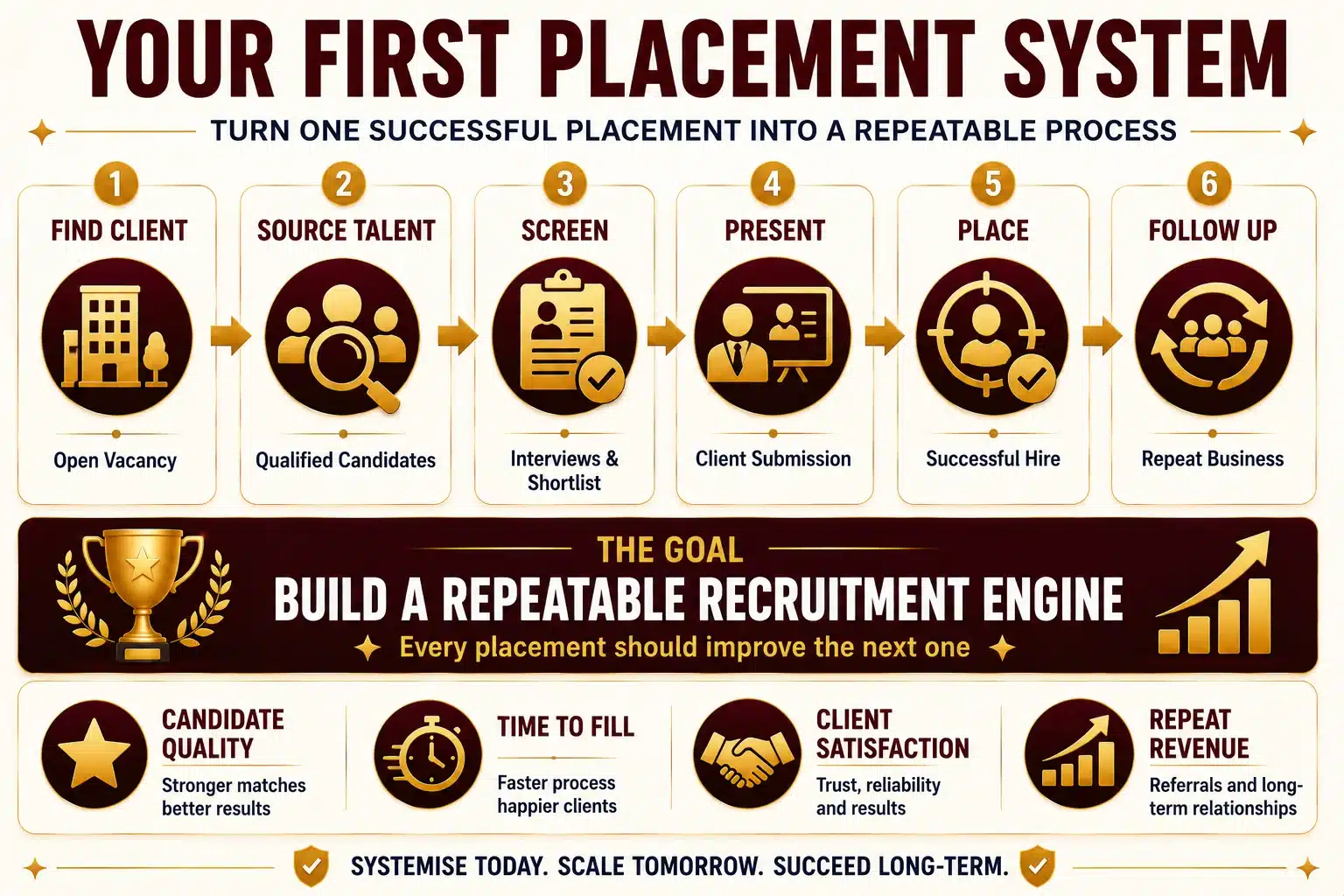
Every successful placement follows the same core sequence. Mastering this process and making it repeatable is what separates recruiters who build sustainable businesses from those who burn out chasing individual deals.
- Client briefing: Take a detailed brief from the hiring manager. Understand not just the job specification but the team culture, the management style, the career path for the successful candidate, and why the role is open. The more you understand the brief, the better your shortlist.
- Candidate sourcing: Use LinkedIn Recruiter, your CRM database, job board CV searches, referrals, and proactive headhunting. Aim to have a qualified longlist of 8–12 candidates before shortlisting.
- Candidate screening: Interview every candidate before presenting them to a client. Understand their motivations, notice period, salary expectations, and the specific reasons they are interested in this role. Do not present anyone you would not be comfortable recommending personally.
- Shortlist submission: Submit 3–5 carefully selected candidates with a structured profile for each one. Explain why you have selected each candidate and how they meet the client’s specific requirements.
- Interview management: Arrange client interviews, brief candidates beforehand, debrief both parties afterwards, and manage feedback clearly and promptly. Slow feedback loops kill placements.
- Offer management: When an offer is made, manage the negotiation proactively. Counteroffers are common, particularly for candidates in high demand. Prepare candidates for this possibility in advance.
- Post-placement follow-up: Check in with both the client and the candidate at 2 weeks, 1 month, and 3 months after the start date. This reduces early leavers, protects your fee, and generates future business.
Building Your Candidate Database
Your candidate database is your most valuable long-term business asset. Every candidate you speak to, assess, or place should be added to your CRM with detailed notes. A well-maintained database of 500 highly qualified, engaged candidates in your niche is worth more than any job board subscription.
Under GDPR, you must obtain explicit consent from candidates to store and process their personal data for recruitment purposes. Include a clear privacy notice in all candidate communications and in your website’s privacy policy. ICO registration is mandatory for any business processing personal data in the UK.
Step 11: Scale Your Recruitment Business
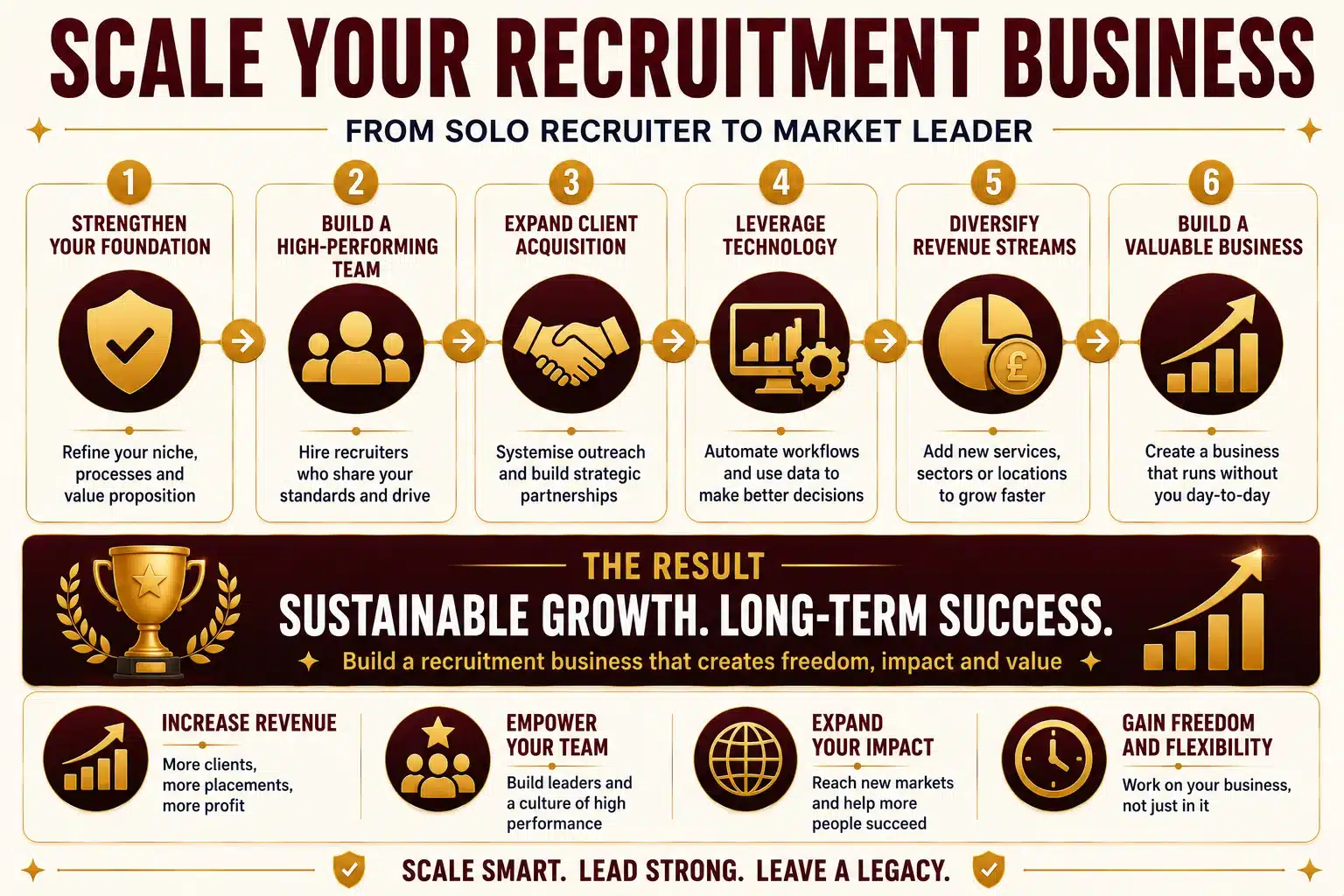
Once you have proven the model’s consistent placements, growing client base, and reliable cash flow, it is time to think about scaling. Scaling a recruitment agency well requires three things: the right people, the right processes, and the right infrastructure.
When to Hire Your First Employee
Most solo recruiters reach a natural ceiling at 15–20 active vacancies simultaneously. Beyond this point, the quality of your service starts to decline, and you begin losing opportunities you cannot service. This is the right time to hire your first consultant.
Hire a consultant, not a researcher or administrator, as your first employee. A billing consultant who can manage their own client relationships generates revenue immediately, rather than adding overhead without a corresponding revenue contribution.
Moving into Office Space
Most recruitment agencies do not need a formal office until they have 4–5 employees. Before that point, a combination of home working and hot desks at a co-working space is more flexible and significantly cheaper. Shared office space in major UK cities ranges from £200 to £600 per person per month. Avoid committing to a long-term lease until you are confident in your revenue trajectory.
If you are expanding into European markets, a registered virtual office address allows you to establish a legal presence in a new jurisdiction without committing to physical office space. Open A European Company provides virtual office solutions across Europe.
Expanding into New Niches or Geographies
Once you have established dominance in your first niche, the most common growth paths are:
- Adjacent specialisms: If you recruit software developers, an adjacent niche might be DevOps engineers or product managers close enough that your candidate and client network overlaps significantly.
- Geographic expansion: If you recruit in London, expanding to Manchester, Birmingham, or Dublin uses your existing brand and network in a new market.
- Service line expansion: Adding a temp or contract desk alongside your perm desk diversifies revenue and creates more frequent client touchpoints.
- European expansion: The EU’s free movement of labour and large, well-developed staffing markets make European expansion a natural step for ambitious UK recruitment firms. Open A European Company facilitates this process across 30+ jurisdictions.
Benchmark: When to Consider Expansion
Most recruitment agency founders who successfully scale to 10+ employees recommend establishing at least £500,000 in annual billings from your core niche before expanding into a new specialism or geography. Expanding too early dilutes focus and risks the client relationships that took years to build
Case Study: Expanding a UK Recruitment Firm into Europe
Sarah co-founded a healthcare recruitment agency in Bristol in 2019, specialising in placing NHS-trained nurses into private hospital groups across England. By 2022, the business was generating £2.1 million in annual fees with a team of 8.
In 2023, responding to increased demand from German private hospital groups for English-speaking nurses, Sarah registered a German GmbH through Open A European Company. The process took 3 weeks. Within 6 months of opening the German entity, it was generating €180,000 per quarter in placement fees.
Key lessons from Sarah’s European expansion:
- Registering a local legal entity built immediate credibility with German clients, who were reluctant to contract with a UK company post-Brexit.
- Understanding German employment law, particularly around works councils and co-determination rights, required local legal advice before signing client contracts.
- German data protection law (enforced by state-level DPAs) required a separate GDPR-equivalent compliance framework for the German entity.
- The most efficient route to finding initial German clients was through a referral from an existing UK client who had a German parent company.
Final Thoughts: Is Starting a Recruitment Agency Worth It in 2026?
The global staffing market is large, growing, and structurally fragmented, meaning there is room for well-positioned specialist firms at every level of the market. The barriers to entry are low: you can register a UK company for £12, open a bank account in a day, and place your first candidate with nothing more than LinkedIn and a phone.
What separates the recruitment agencies that build lasting, profitable businesses from those that fail within 18 months is not capital, technology, or luck. It is a niche discipline, consistent execution, and a relentless focus on the quality of every placement. The recruiters who say no to roles outside their specialism in Year 1 are the ones running thriving businesses in Year 5.
If you have relevant industry experience, an existing professional network, and the discipline to follow the steps in this guide from choosing your niche and writing a business plan, through legal registration, compliance, marketing, and your first placement, starting a recruitment firm is one of the most accessible and potentially lucrative entrepreneurial paths available in 2026.
If you are ready to register your recruitment company in the UK, across Europe, or in multiple jurisdictions simultaneously Open A European Company’s specialist team can handle the entire process, from company formation and bank account setup to ongoing accounting and compliance support.