Looking to take your business to new horizons and explore international markets? Continue reading to gain invaluable insights and actionable advice about initial considerations to successfully launch your business abroad.
Are you considering expanding your business internationally to enhance sales or to establish a more robust global presence? Whether you aspire to tap into new markets, broaden your product range, or build an exceptional team, global expansion presents a compelling opportunity. However, it is essential to acknowledge that this will take work.
We have meticulously compiled the definitive guide to global expansion to assist you throughout this intricate process.
From initial planning to launching your business in foreign countries, this comprehensive resource provides all the essential Information required to ensure the success and longevity of your expansion venture. This will help you understand it better and have access to the Information you need to make intelligent decisions and create a robust plan of action.
Continue reading to find precisely what you are searching for and embark upon a journey toward fruitful global expansion.
What is Global Expansion?
Global expansion refers to organisations’ strategic initiative to extend their operations beyond domestic boundaries and enter international markets. It involves establishing a presence in foreign countries through various means, such as opening subsidiaries, forming partnerships, or acquiring existing businesses. This expansion aims to tap into new customer segments, access untapped markets, and leverage economies of scale. However, global growth also presents challenges, including cultural differences, legal and regulatory complexities, and competition from local players.
One great example of global expansion is Red Bull. Red Bull is a trendy energy drink that is known all around the world. It has the largest market share, with 43 percent of the market. Some people think it is a brand from North America, but it is a collaboration between Thailand and Austria. It was founded in Salzburg, Austria. Red Bull stands out because of its unique way of promoting itself. It sponsors extreme sports events, owns football teams, and uses regular commercials.
Why Should You Expand Your Business Internationally?
In today’s dynamic business landscape, many companies, regardless of size, are venturing into international markets and achieving remarkable outcomes. Your industry counterparts and rivals are contemplating this expansion, prompting you to explore the same possibilities.
Expanding your business internationally can be a significant step towards growth and success. It offers numerous benefits that can elevate your company to new heights. Here are some compelling reasons why you should consider expanding your business internationally.
Access to New Markets
Expanding internationally allows you to tap into untapped markets and reach a broader customer base. By diversifying your target audience, you can reduce reliance on a single market and mitigate risks associated with economic fluctuations in a specific region. According to a survey conducted by McKinsey, companies that expand internationally are 1.5 times more likely to experience faster revenue growth.
Increased Revenue and Profitability
Entering new markets can lead to increased revenue streams and improved profitability. The international expansion enables you to capture new customers, exploit different consumer behaviors, and capitalize on emerging trends.
Competitive Advantage
Expanding your business internationally allows you to gain a competitive edge. By entering new markets, you can differentiate your products or services and offer unique value propositions. This can enhance your brand reputation and position you as a global player in your industry. According to a study by Harvard Business Review, companies that expand internationally achieve a 10% higher valuation than those that do not.
Economies of Scale
International expansion can lead to economies of scale, resulting in cost efficiencies and improved operational performance. Increasing production volumes and spreading fixed costs over a more extensive customer base can reduce per-unit costs and boost profitability. The United Nations Conference on Trade and Development (UNCTAD) reports that multinational enterprises achieve higher productivity and operational efficiencies through international operations.
Essential Things to Do When Going Global
Embarking on a global expansion journey for your business is an exciting and potentially rewarding endeavour. However, it requires careful planning and consideration of various factors to ensure a successful transition. To help you navigate through this process, here are some essential things to keep in mind:
Be well-informed
Before making any strategic decisions, gathering comprehensive Information about the country you intend to do business in is crucial. Understand the local culture, customs, political and economic situation, spending habits, entry requirements, business environment, and foreign trade regulations. This knowledge will lay the foundation for your expansion strategy.
Study the market
Conduct thorough research on your target market and analyse the local competition. This will help you determine if there is sufficient demand and interest for your company, products, and services in the country you plan to expand into.
Find the right partner
A key element for international success is finding a reliable and knowledgeable partner who understands the local market dynamics. Establishing a mutually beneficial structure with such a partner is vital for long-term success. Avoid treating international sales as merely transactional, as this approach may undermine your brand’s reputation in the long run.
Evaluate the economic and political landscape
Look beyond the product’s demand and consider the country’s economic and political stability. Research the historical and current affairs, economic conditions, political risks, employment rate, GDP, and consumer purchasing power. Avoid expanding into countries with significant financial risks. To make informed decisions, gain a comprehensive understanding of the economic and political landscape.
Analyse the cost structure
Evaluate the costs involved in expanding your business abroad. Consider staffing, marketing, insurance, and other business expenses. Be mindful of potential restrictions when hiring temporary workers, as regulations vary in each country. Additionally, take into account any permits or licenses required to operate locally.
Language, culture, and norms
Entering a new market means encountering language and cultural barriers that can significantly impact your performance. Invest in translating all relevant materials into the local language and develop highly localised marketing and branding strategies that resonate with the culture and vocabulary of the target market. Thoroughly study the local culture to ensure you effectively navigate social norms, values, religious sentiments, office culture, and everyday routines.
Tax and employment guidelines
Ensure compliance with the target country’s legal guidelines governing tax and employment. Familiarise yourself with the regulations related to recruiting workers and accurately documenting your tax obligations. Understand how your home country treats income acquired internationally, which can affect your overall profits. Researching and considering these guidelines early in the decision-making process is essential to mitigate any risks.
Seek Funding and Insurance Options
Explore government funding programs specifically designed to support businesses venturing into international markets. Determine whether your business qualifies for such support and utilise available resources. Additionally, it is crucial to find suitable insurance solutions to safeguard your business against trade and political risks associated with global operations.
Create a Brand Standard to Share with International Teams
Before expanding globally, develop a comprehensive brand book that outlines your brand standards. This document should cover essential elements from your company’s mission to approved logos and fonts. Creating a brand book serves as a valuable exercise for internal purposes and ensures that your international partners consistently adhere to your brand standards.
Hiring an international team
When building a globally recognised brand, seek local resources to understand, enter, and grow in the foreign market. Explore partnerships, alliances, and direct hiring options to assemble an international team. Connect with country-specific industry associations and engage with leaders in their executive boards to leverage their expertise and networks.
Be Aware of Additional Procedures
Remember that additional procedures and requirements may be specific to your project and the country you intend to invest in. These could include setting up a bank account abroad, applying for visas and work permits, or registering a trademark in the target country. Be prepared to address these tasks to comply with local regulations and facilitate a smooth expansion process.
Strategies for International Expansion in European Countries
While there is no one-size-fits-all approach to entering a foreign market, several effective methods can pave the way for successful international expansion. It is important to note that companies often begin with one form and may transition to others as they grow and adapt to the changing global landscape.
We will explore some critical modes of international business expansion, particularly for multiple European countries.
Traditional Expansion
A traditional global expansion approach involves establishing a new business unit in a foreign country rather than acquiring an existing business or licensing products. This method offers advantages such as increased control and potentially higher profit margins. However, building operations from scratch in a new territory can be costly and time-consuming, making it a riskier option than other expansion methods.
Managing an Expansion Process In-house
Another method of global expansion is to develop an in-house approach, where you create your framework tailored to your specific goals and limitations. This approach requires extensive research, preparation, and commitment. Factors to consider when planning a global mobility framework include employment options, physical presence versus partnering with in-country entities, financial regulations, and employee management. Setting clear goals and charting a path toward achieving them is crucial.
Exporting
Exporting is a standard and straightforward method of entering international markets. It allows organisations to avoid the costs of establishing a subsidiary in a foreign country. Exporting typically involves contractual agreements with marketing agencies, distributors, or retailers to effectively promote and sell products or services in the target market. However, it still requires a significant investment, including transportation costs and potential impacts from tariffs.
Trade Agencies
Suppose your company originates from a developed international market, such as the USA, Germany, the UK, Australia, or Singapore. In that case, you can leverage the assistance of trade agencies to facilitate your global business expansion. These government bodies often provide valuable support at little to no cost or lower rates than private service providers. However, it’s important to note that less developed countries may have limited resources and may not offer extensive assistance through their trade agencies.
By employing these methods, companies can pursue global expansion while considering factors such as control, cost, and available support. Each approach has advantages and challenges, requiring careful evaluation and planning to ensure successful international growth.
Licensing
Licensing agreements are a common way for businesses to enter new markets. In this arrangement, a company grants another company in the target market the right to use or sell its intellectual property in exchange for payment. The agreement can be exclusive, non-exclusive, or limited to specific locations or use cases. The hospitality industry often uses licensing agreements, where restaurants and cafes allow third parties to operate under their brand in different regions.
Licensing enables businesses to quickly enter a new country and promote their products without investing large amounts of capital. However, navigating licensing legislation can be complex and may involve legal fees. Thorough research and expert advice are necessary to determine if licensing suits your business in the target region.
Partnerships & strategic alliances
Partnerships and strategic alliances are mutually beneficial models for international expansion. This approach involves forming partnerships or alliances with local firms in the new market. Both businesses can achieve their goals by establishing a strategic alliance or partnership with a local firm. For instance, you can easily access market information while the local firm benefits from your resources. It is a two-way deal that benefits both parties.
Merger and Acquisitions
Mergers and acquisitions refer to the combination of two businesses. A merger occurs when two companies join forces, while an acquisition happens when one company takes control of another. This method is considered one of the most effective ways for businesses to expand internationally.
You can swiftly enter a new market by engaging in mergers and acquisitions. However, companies undertaking mergers and acquisitions must carefully assess the target country’s regulations. Some nations impose restrictions on foreign ownership. For instance, a foreign company cannot own more than 25% of an American airline in the United States.
Mergers and acquisitions serve as advantageous entry strategies, particularly when establishing a presence promptly is crucial. They are also beneficial for large organisations seeking to consolidate their industry. Nonetheless, these endeavours carry risks, with a failure rate ranging between 40% and 60% in terms of increasing market value.
Setting up A Company in Multiple European Countries
Europe is a highly favoured region for expanding businesses for several reasons, such as regional trade agreements and a well-educated workforce. However, expanding into Europe can be complex. The European Union’s Single Market is the largest internal market globally. You can often establish your business in one country and sell throughout the EU without encountering excessive bureaucratic procedures.
Moreover, Europe excels in various aspects, including the highest living standards, minimal corruption, and the lowest average corporate tax rates among regions. Nonetheless, determining the most suitable European country to establish their business remains a crucial question for foreign entrepreneurs.
Essential Documents for Company Registration in Europe
Several mandatory documents are required when registering a company in any European country, irrespective of the business type. These documents include the following:
Articles of Association, Formation, or Incorporation
These legal documents outline the company’s internal rules, structure, and regulations. They define the rights and responsibilities of the shareholders, directors, and other key personnel.
Official Business Name
A distinctive and legally recognised name is essential for your company. It should not conflict with existing trademarks or violate any regulations related to business naming conventions in the respective European country.
Official Business Address
A registered address is necessary to establish the company’s physical presence. It should be where official correspondence can be sent and legal documents can be served.
Identifying Information about the Company Owner(s)
You will need to provide the identifying details of the company owner(s), which may include their names, addresses, nationalities, and passport or identification numbers.
Certain countries have specific financial requirements for individuals looking to start a business. For instance, if you plan to establish a business in the UK, you must have a minimum investment of £50,000 and an additional £200,000 to cover your living expenses and support your family until your business becomes profitable.
Similarly, European countries typically mandate that you have a controlling or equal stake in your business (in case of a partnership), commit full-time involvement, and refrain from seeking public assistance or engaging in other employment while running your business.
Some countries do not stipulate the number of jobs your business needs to create to operate, while others have specific job creation requirements. In the UK, for example, your business must make at least two new full-time positions for UK residents or citizens.
What Are The Best Countries To Set Up A Business In Europe?
Denmark
Company Formation in Denmark is highly ranked for ease of doing business. You must provide proof of sufficient funds and have specific Danish business interests outlined in a formal business plan. Once established, you can operate your business freely. Entrepreneurs may also qualify for a one-year residence permit, extendable upon renewal.
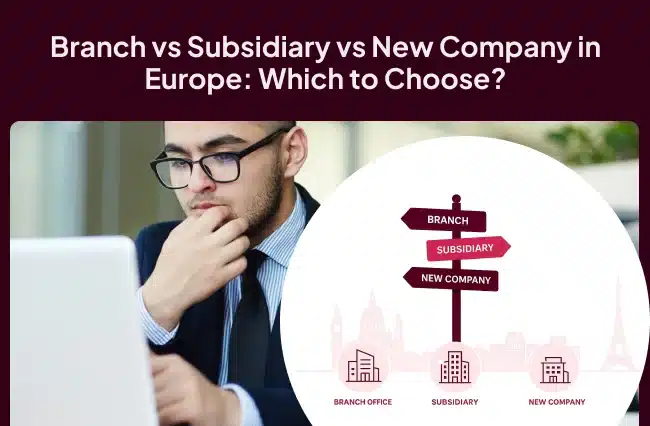
EU residency is not required for owners of private companies, but directors of public companies must be EU residents. You can also explore options for opening a Branch in Denmark or setting up a Subsidiary if expansion is the focus.
Tax Rate: 22%
United Kingdom
Despite no longer being part of the EU, Company Formation in the UK remains attractive due to its large market and international tax agreements. A minimum £200,000 investment is required, along with creating at least two full-time jobs for UK residents.
The UK also offers flexibility for opening a Branch or registering a Subsidiary, depending on business strategy.
Tax Rate: 25%
Sweden
Setting up a Company in Sweden requires obtaining a personal identity number (personnummer) and registering for F-skatt, the entrepreneur tax status. Sweden’s strong links to global markets make it attractive for international entrepreneurs.
Alternative options include opening a Branch or forming a Subsidiary.
Tax Rate: 20.6%
Germany
Company Formation in Germany requires evidence of economic interest, local demand, and secured funding. Entrepreneurs may obtain residence permits if their business benefits the economy.
Businesses can also consider opening a Branch in Germany or establishing a Subsidiary for expansion.
Tax Rate: 15%
Austria
With its proximity to Central and Eastern Europe, Company Formation in Austria is popular among international businesses. EU citizens can register with minimal hurdles, while non-EU entrepreneurs may face more formalities.
Austria also supports Branch Offices and Subsidiaries for foreign investors.
Tax Rate: 20%
Estonia
Known as Europe’s digital leader, Company Formation in Estonia offers fast incorporation and a favorable tax regime. However, its small domestic market may limit growth.
Expansion can also be achieved through Branches or Subsidiaries.
Tax Rate: 20%
Norway
Starting a Company in Norway requires a Norwegian ID number, a local business address, and minimum share capital. Non-EU owners must ensure board compliance with residency requirements.
Options include Branch Offices and Subsidiaries.
Tax Rate: 22%
Netherlands
Entrepreneurs can pursue Company Formation in the Netherlands with no restrictions on nationality. Self-employed permits require demonstrating business value to Dutch society.
For expansion, consider opening a Branch or setting up a Subsidiary.
Tax Rate: 25.8%
Switzerland
Although not part of the EU, Company Formation in Switzerland provides access to European markets through bilateral agreements. The low tax rate and stable economy are highly attractive.
Businesses may also expand by opening a Branch or registering a Subsidiary.
Tax Rate: 11.9%
Spain
Company Formation in Spain requires sufficient capital, qualifications, and residency permits for non-EU nationals. Despite economic debt challenges, Spain remains a strong market for expansion.
Explore Branches and Subsidiaries for growth.
Tax Rate: 25%
Italy
Company Formation in Italy is commonly done through an SRL (società a responsabilità limitata). Italy offers access to one of Europe’s largest consumer markets but has bureaucratic complexities.
Options include opening a Branch and establishing a Subsidiary.
Tax Rate: 24%
Greece
Company Formation in Greece is attractive for sectors like tourism, shipping, and energy. Tax incentives support startups, though administration can be slow.
Businesses may also explore Branches or Subsidiaries.
Tax Rate: 22%
Malta
Starting a Business in Malta is popular due to its tax refund system, reducing effective rates to ~5%. Malta’s strategic location makes it ideal for gaming and financial services.
Expansion paths include Branches and Subsidiaries.
Tax Rate: 35% (effective ~5% with refunds)
Romania
Company Formation in Romania benefits from low taxes and affordable, skilled labor. It is a hotspot for IT and manufacturing sectors.
Consider opening a Branch or registering a Subsidiary for local expansion.
Tax Rate: 16%
Lithuania
Company Formation in Lithuania is streamlined, with a focus on fintech and startups. Fast incorporation and digital infrastructure make it attractive.
Expansion routes include Branches and Subsidiaries.
Tax Rate: 15%
Hungary
With the lowest corporate tax rate in Europe, Company Formation in Hungary is appealing for cost efficiency. Its central location offers access to major European markets.
Companies may also expand via Branches or Subsidiaries.
Tax Rate: 9%
Comparison between Different European Countries
Updated Comparison Between Different European Countries
| Country | Tax Rate | Pros | Cons |
|---|---|---|---|
| United Kingdom | 25% | Most attractive markets with the highest returns | Need a heavy investment to begin with |
| Sweden | 20.6% | Strong connections with international markets | Not a favourable economic state |
| Germany | 15% | Strong economic state of the country | Complicated registration process |
| Netherlands | 25.8% | No restrictions on registration | Higher tax rate |
| Norway | 22% | Higher education, productivity, innovation | Board composition restrictions |
| Switzerland | 11.9% | Low tax, stable economy | More formal business admin |
| Austria | 20% | Proximity to international markets | Non-EU residents face complexities |
| Estonia | 20% | Favourable tax, digital-first | Small market size |
| Spain | 25% | Easier for foreigners to set up | High debt and limited investment flows |
| Italy | 24% | Large market, strong industrial base | Bureaucratic delays, high compliance |
| Greece | 22% | Attractive for tourism, energy, shipping | Economic volatility, red tape |
| Malta | 35% (effective ~5%) | Investor-friendly tax refunds, English-speaking | Small domestic market |
| Romania | 16% | Low tax rate, competitive workforce | Regional infrastructure challenges |
| Lithuania | 15% | Startup-friendly, fintech hub | Small domestic market |
| Hungary | 9% | Lowest corporate tax rate in Europe | Complex VAT system, bureaucracy |
What Is The Expense Involved In Registering A Business In Europe?
The cost of registering your business in Europe varies depending on factors such as the type of entity you decide to write, the country where you choose to incorporate, and the amount of money you invest in the business.
The expenses associated with registering a business in Europe may consist of:
An appropriate government agency, such as the Chamber of Commerce or trade registry charge registration fees.
- Fees are necessary to acquire any required licenses or permits.
- Legal fees for creating articles of association or other documents.
- Notary fees for authenticating documents.
- Accounting and tax consulting services fee.
Ultimately, there are pros and cons with any business expansion, and international growth is no exception. With careful forethought and planning, your business can go to the next level and take advantage of a whole world of opportunities. For help and advice on multiple company incorporations or one-off setups, please don’t hesitate to call us on +44 (0)208 421 7470 or contact us via the website.