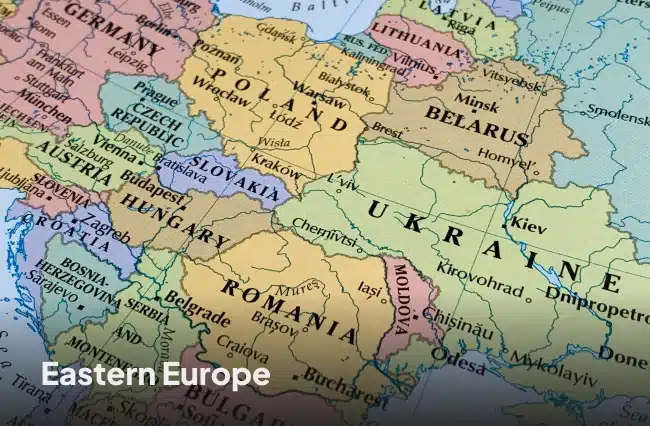
Since the collapse of the Soviet Union, Eastern Europe has undergone a remarkable transformation. Countries once closed off to international markets have embraced trade, innovation, and investment, firmly integrating themselves into the European Union and the wider global economy.
For businesses and investors, Eastern Europe represents both opportunity and growth. Once overlooked by many in the West, the region has become a hub for technology, manufacturing, tourism, and energy.
From Communism to Capitalism
The early 1990s brought dramatic changes to Eastern Europe. Nations across the region embraced open markets, privatization, and democratic governance. While the transition was often turbulent, the payoff has been significant:
-
Trade liberalisation allowed Western goods to flow eastward.
-
Labour mobility gave workers access to new skills and qualifications.
-
Foreign investment modernised industries that had stagnated under communism.
(Source: World Bank – Transition Economies)
Rising Stars of the European Union
Several Eastern European countries have emerged as standout performers within the EU.
Czech Republic
The Czech Republic has built a reputation for advanced manufacturing, engineering, and technology. Prague has also become a hub for startups and IT outsourcing.
Learn more: Company Formation in the Czech Republic
Poland
Poland is often hailed as Eastern Europe’s economic success story. With a large domestic market, competitive labour costs, and robust GDP growth, it attracts manufacturing, logistics, and financial services.
Learn more: Company Formation in Poland
Hungary
Hungary has leveraged its natural beauty and rich history to develop a thriving tourism industry, while also attracting foreign investment in automotive and pharmaceuticals.
Learn more: Company Formation in Hungary
Romania
Romania is another rising player, combining a fast-growing IT sector with booming tourism. Bucharest is home to one of Europe’s largest pools of skilled software developers.
Learn more: Company Formation in Romania
Ukraine: A Market with Potential
Despite ongoing political turmoil, Ukraine has shifted its orientation firmly toward Europe. Its association agreement with the EU has created stronger trade links, and the western regions of the country remain relatively stable.
-
Opportunities in agriculture, infrastructure, and technology outsourcing are drawing cautious but interested investors.
-
EU and international financial institutions, such as the IMF, continue to provide support packages.
Russia: An Energy and Trade Powerhouse
While politically complex, Russia has flourished as a global energy superpower since the fall of communism. With vast reserves of oil and gas, and industries spanning heavy machinery, technology, and defence, Russia remains influential on the world stage.
-
Recent trade deals with China and the EU have further boosted its standing.
-
Its geographical position at the crossroads of Europe and Asia makes it an essential trade partner.
Opportunities for Entrepreneurs
For savvy entrepreneurs, Eastern Europe offers:
-
Cost advantages: Competitive labour markets with high skill levels.
-
Access to EU markets: Full integration for EU members and preferential access for neighbours.
-
Government incentives: Many Eastern European states offer tax breaks and subsidies for foreign investors.
-
Growing consumer demand: Rising middle-class populations are driving demand for Western goods and services.
(Source: European Commission – Enlargement and Neighbourhood Policy)
Key Sectors Driving Growth
-
Technology & IT Outsourcing: Romania, Poland, and the Czech Republic are leaders in software development and tech hubs.
-
Manufacturing & Logistics: Poland and Hungary are major bases for automotive and electronics.
-
Tourism: Hungary and Romania are rapidly expanding their tourism economies.
-
Energy: Russia remains central in oil and gas, while Ukraine is exploring renewables.
Challenges to Consider
While Eastern Europe presents opportunities, investors should remain aware of:
-
Political risks in countries like Ukraine and Russia.
-
Bureaucracy and regulation which can still be cumbersome in some markets.
-
Regional disparities exist, where rural areas may lag behind major cities.
Nonetheless, the rewards often outweigh the risks for businesses willing to adapt.
Setting Up in Eastern Europe
For companies looking to establish a presence in the region, options include:
-
Company Formation – Create a legal entity for full local operations.
-
Opening a Branch Office – Expand your existing company into Eastern Europe.
-
Registering a Subsidiary – Establish a legally independent entity with strategic advantages.
At Open a European Company, we help investors navigate local regulations, tax regimes, and compliance requirements.
Conclusion
Eastern Europe has come a long way since the fall of the Soviet Union. From Poland’s booming economy to Romania’s IT sector and Russia’s global energy dominance, the region is now a vital part of Europe’s economic engine.
For investors and entrepreneurs, ignoring Eastern Europe could mean missing out on one of the world’s most dynamic emerging markets. With strategic locations, skilled workforces, and growing consumer bases, the East has truly emerged as a land of opportunity.