Choosing where to incorporate your company could save you £2,000-£5,000 in your first year alone and potentially £10,000+ over five years when you factor in tax structure decisions.
Most guides tell you the government registration fee and call it a day. That number is almost irrelevant. The real cost of company formation lies in professional fees, accounting, software, banking, and the hidden cost of choosing the wrong tax structure. A founder who pays £100 to register in the UK but picks the wrong accounting arrangement could easily lose £5,000/year in avoidable tax. A founder who pays £3,000 to form in Germany but structures their salary correctly could recover that cost within six months.
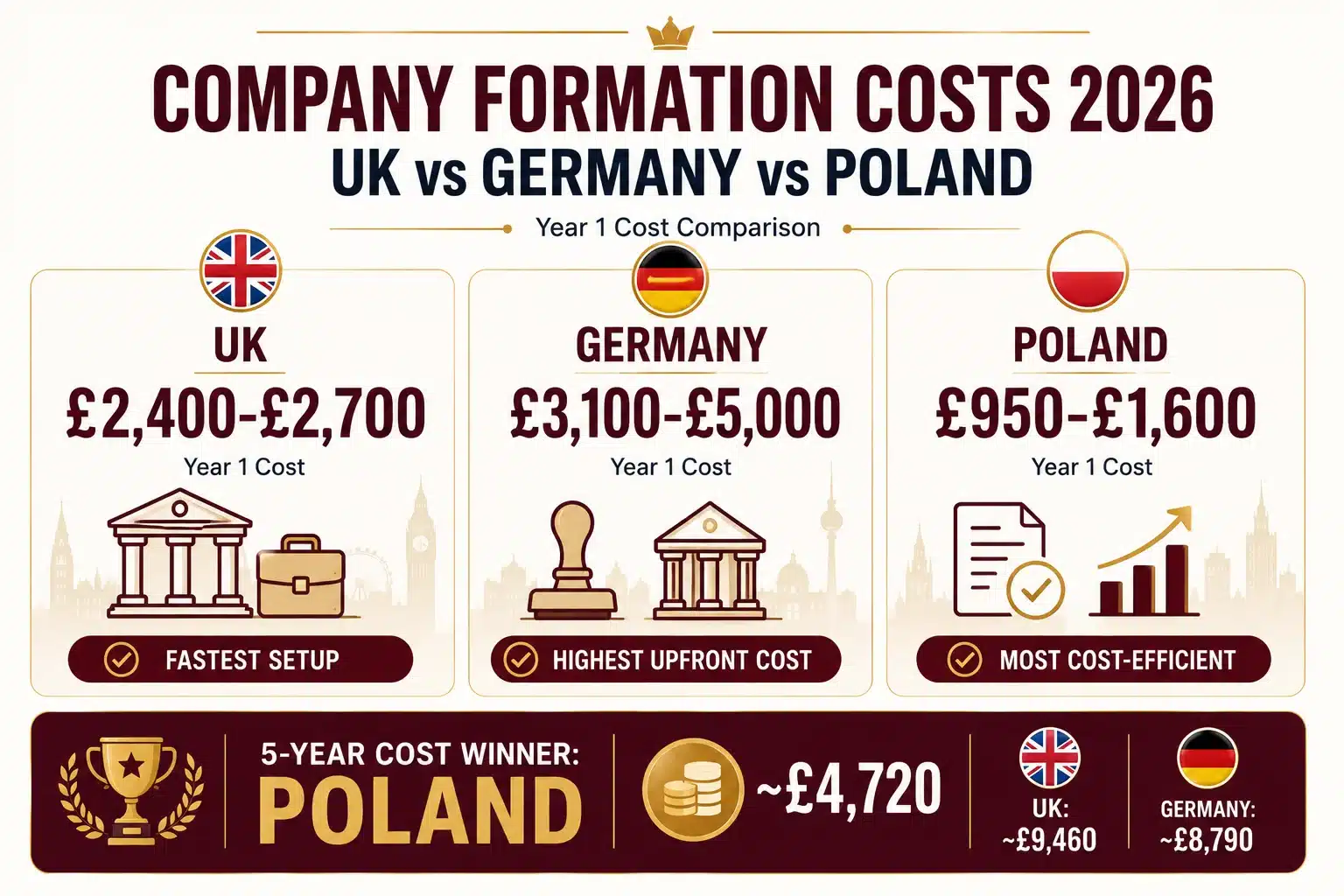
This guide gives you the complete 2026 picture: exact cost breakdowns for the UK, Germany, and Poland with real founder scenarios, a 5-year cost comparison, and a downloadable calculator to run your own numbers. In short: UK formation costs approximately £2,400-£2,700 in Year 1, Germany runs £3,100-£5,000, and Poland is the most cost-efficient at £950-£1,600. But formation costs are rarely the deciding factor annual costs and tax structures matter far more.
Key Takeaways
- UK: Fastest and simplest. Year 1 total: ~£2,400. Best for speed, non-residents, and founders planning to raise capital.
- Germany: Highest upfront cost (mandatory notary fees + €25,000 capital requirement). Year 1: ~£3,100-£5,000. Best for EU B2B and certain investors.
- Poland: Most cost-efficient. Year 1: ~£950-£1,600. 5-year total ~50% cheaper than UK. Best for bootstrapped founders and cost-conscious setups.
- Hidden costs beat formation costs every time. Wrong tax structure = £3,000-£10,000/year extra. Wrong accountant = £1,000-£3,000 wasted annually.
- 5-year total cost is the only number that truly matters for a business decision.
UK Limited Company Formation Costs
The UK has long been the go-to choice for founder-friendly incorporation in Europe. It’s fast, flexible, and administratively straightforward, but the 2026 fee changes at Companies House mean you need to update your numbers if you’re working from older guides.
Government Fees
As of 1 February 2026, the digital incorporation fee at Companies House increased to £100 (up from £50). This is part of a broader reform package under the Economic Crime and Corporate Transparency Act, which also introduced mandatory identity verification for directors and more robust anti-fraud powers. The same-day digital service now costs £156, and paper incorporation costs £124.
On top of the one-off registration fee, every active UK company must file an annual confirmation statement. This now costs £50 digitally (up from £34). Think of it as the annual “we still exist” filing it’s mandatory and missing it can trigger enforcement action.
What the government fee includes
- Certificate of Incorporation
- Official entry on the public Companies House register
- Company Registration Number (CRN)
What it does NOT include
- Business bank account
- HMRC registration (Corporation Tax, VAT, PAYE all separate processes)
- Accounting software or bookkeeping setup
- Registered office address if you don’t have a UK address
Professional and Formation Fees
This is where costs vary most, depending on your approach.
- Option 1: DIY via Companies House (£0 extra) You can incorporate directly through the Companies House online portal with no third-party service. The process takes 2-3 hours, and your registration is typically confirmed within 24-48 hours. The risk is documentation errors, particularly in your Memorandum and Articles of Association, which can cause problems later, especially if you have investors or multiple shareholders. Best suited to experienced founders who have incorporated before.
- Option 2: Formation Service (£100-£400, most common route) Services like 1st Formations, Rapid Formations, and Companies Made Simple handle document preparation, submission, and guidance. You invest 1-2 hours of your own time; they handle the rest. Formation typically completes in 3-5 days. This is the right route for the majority of founders, the cost is modest, and the protection against documentation mistakes is worth it.
- Option 3: Solicitor (£400-£800) Required for complex structures: multiple shareholders, different share classes, custom articles of association, founder vesting schedules, or any situation involving external investment. If you’re incorporating with other people and there’s meaningful equity involved, a solicitor who understands startup structuring is worth every penny. Getting the cap table wrong at formation can cost £5,000-£20,000 to unwind later.
Real example
Marcus is a solo marketing consultant ready to incorporate. He uses Companies House directly (£100) and a mid-range formation service (£200). Total formation cost: £300. He’s trading within 4 days.
Accountant Setup and Annual Fees
This is the single biggest variable in UK formation costs, and the one most founders underestimate before they incorporate for the first time.
Running a UK limited company without an accountant is technically possible but practically risky. HMRC expects Corporation Tax returns, annual accounts filed with Companies House, and payroll submissions (if you pay yourself a salary) all to specific formats and deadlines. Missing these triggers automatic penalties.
- Annual accounting (full service): £600-£1,500/year
- First-year cost: Often higher at £800-£1,800 due to initial setup, bringing your records into order, and strategic advice on your tax structure
- Bookkeeping setup (one-time): £200-£400 if your accountant handles it; £0 if you use accounting software and do it yourself from day one
A common mistake is hiring the cheapest accountant available. A £500/year accountant typically covers the minimum: filing your accounts and Corporation Tax return. A £1,200-£1,500/year accountant typically includes quarterly reviews, proactive dividend and salary planning, VAT advice, and year-round availability. That £700 annual difference very often returns £2,000-£5,000 in tax saved. The maths strongly favours the better accountant.
Realistic annual accounting costs by business type
| Business Type | Annual Accounting Cost |
|---|---|
| Simple service or consulting business | £600-£900/year |
| Growing startup (£50K+ revenue) | £1,000-£2,000/year |
| Multi-entity or international operations | £2,000-£3,500/year |
Real example: A freelance designer converting to a limited company typically pays £1,200-£1,500 in Year 1 of accounting, then £700-£900/year from Year 2 once the setup work is done.
Software and Tools
- Accounting software (Xero, FreeAgent, QuickBooks): £10-£30/month £120-£360/year. Most accountants have a preferred platform; ask before choosing.
- Payroll software (if you have employees): £15-£50/month. Some accounting software includes payroll.
- Contracts and legal documents: £0-£200 one-time (templates from platforms like Docue or Rocket Lawyer)
- First-year software total: ~£300-£500
Banking and Insurance
Business bank account: Free to open with neobanks. Starling Business, Monzo Business, Tide, and Revolut Business are popular choices for new UK companies, all of which offer free basic accounts. Traditional banks (Barclays, HSBC, Lloyds) charge £5-£20/month but offer broader credit facilities and relationship managers, which matters more as you grow.
Insurance: Not legally required in most cases, but commercially essential.
- Public liability insurance: £300-£600/year
- Professional indemnity insurance (for service businesses): £200-£500/year
- Employers’ liability (mandatory if you have employees): £400-£800/year
UK Company Formation: Total Cost Summary
| Cost Item | One-Time | Annual (Ongoing) |
|---|---|---|
| Companies House registration | £100 | £50/year (confirmation statement) |
| Formation service | £200 | – |
| First-year accounting | £1,200 | £800/year |
| Software/bookkeeping | £300 | £240/year |
| Banking/insurance | £600 | £600/year |
| TOTAL | ~£2,400 | ~£1,690/year |
UK Real-World Scenarios
- Scenario A: Bootstrapped solo founder (bare minimum) Formation: £300 | DIY accounting software: £120 | Free bank account: £0 Year 1 total: ~£420Trade-off: No accountant means risk of tax mistakes. Fine for very early stage or very simple setups.
- Scenario B: Growing business with full-service accountant Formation: £300 | Accounting: £1,500 | Software: £300 | Banking/insurance: £600 Year 1 total: ~£2,700 This is the realistic cost for most founders in their first year of properly operating as a limited company.
- Scenario C: Startup with one employee. Formation: £300 | Accounting + payroll: £2,000 | Software: £400 | Banking/insurance: £1,000 Year 1 total: ~£3,700 Adding an employee meaningfully increases accounting complexity and cost.
Year 1 is always the most expensive year due to setup. From Year 2 onward, ongoing costs typically settle at £1,600-£1,700/year for a straightforward business.
German GmbH Formation Costs
Germany’s GmbH (Gesellschaft mit beschränkter Haftung) is the country’s primary limited liability structure. It carries significant credibility in European business culture, particularly in B2B, manufacturing, finance, and professional services, but the formation process is substantially more complex and more expensive than in the UK.
Understanding why costs are higher in Germany is as important as knowing the numbers. It’s not bureaucratic inefficiency, it’s a deliberate legal framework designed to ensure companies are properly capitalised and their formation documents are legally verified.
Government Fees
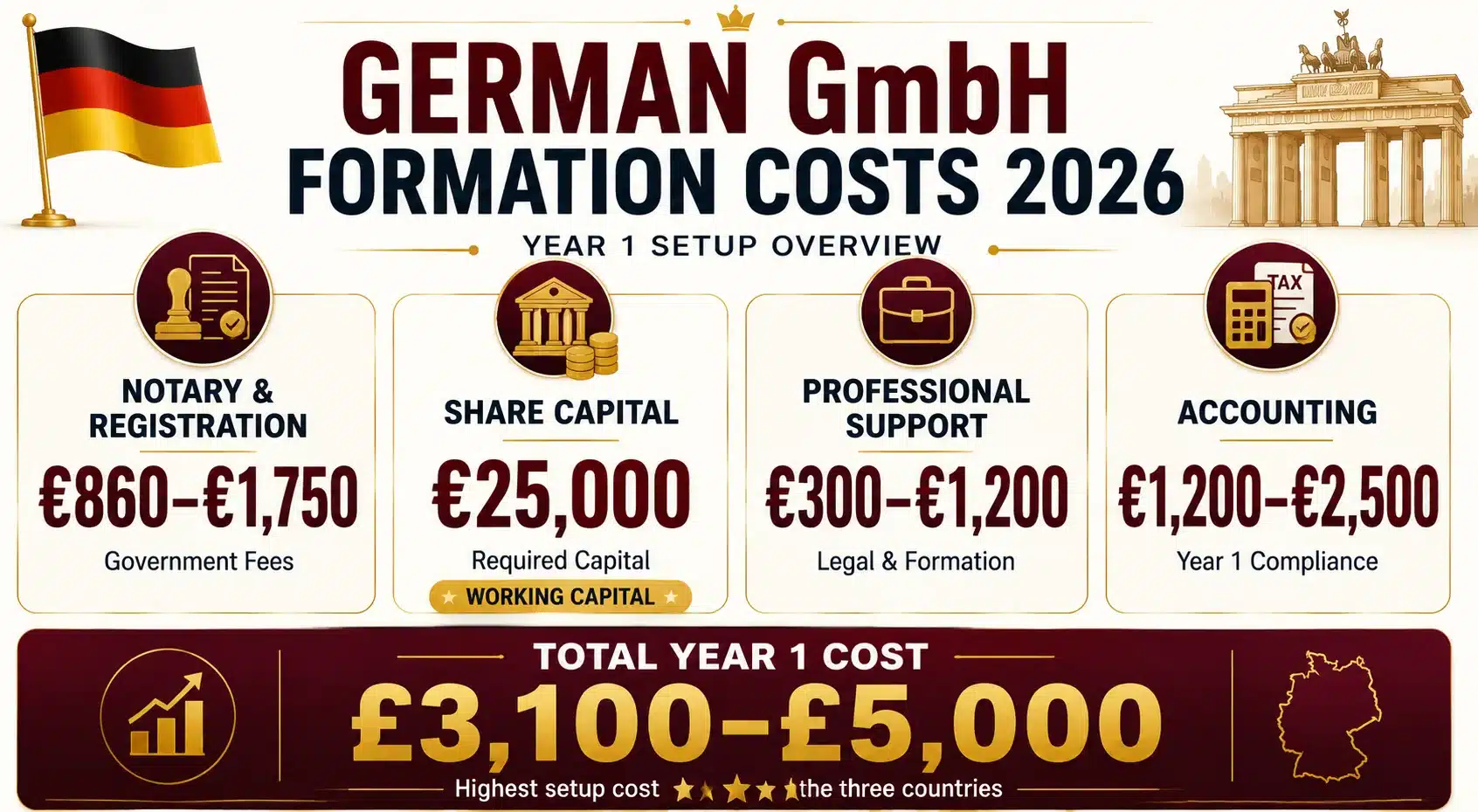
- Commercial Register (Handelsregister) entry fee: €40-€50
- Chamber of Commerce (IHK) registration: €120-€200 (mandatory membership for most commercial businesses)
- Notary fees: €700-€1,500
The notary requirement is the critical factor here. German law mandates that GmbH formation documents, including the articles of association and shareholder resolutions, must be notarized by a German notary (Notar). This is not optional and cannot be circumvented. The notary acts as an independent legal officer, verifies the identity of founders, reads the articles aloud (in full, in German), and certifies the documents. The notary fee is regulated by law and scales with share capital, typically €700-€1,500 for a standard GmbH.
This requirement alone means German formation costs are 10-15x higher at the government/legal level compared to the UK.
Total government + notary costs: €860-€1,750 (approximately £720-£1,470 at current rates)
Minimum Share Capital Requirement
This is the most surprising number for founders, comparing Germany to the UK or Poland:
- Germany GmbH: Minimum €25,000 share capital required by law
- UK Limited Company: Minimum £1 share capital
- Poland Sp. z o.o.: Minimum PLN 5,000 (~£1,000)
Here is how the German requirement works in practice: you must deposit at least €12,500 (half of the minimum) into a German business bank account before the notary will certify the formation. Many founders deposit the full €25,000. Once the Handelsregister has confirmed the registration, you can withdraw the funds and use them for business operations they are not locked away permanently.
However, you must have €25,000 available at the point of formation. For a bootstrapped founder, this is a genuine barrier. You may need to temporarily divert personal savings, borrow from family, or seek a short-term business loan, all of which carry costs and complexity.
Real example: Lena is a Berlin-based solo SaaS founder trying to incorporate a GmbH. She needs €25,000 sitting in a bank account before the notary will proceed, before she’s paid a single developer, licensed a single tool, or earned a single euro of revenue. This requirement alone makes the UK or Poland more practical for early-stage founders without existing capital.
Professional and Legal Fees
- Formation service (recommended): €300-€600. A specialist service handles document preparation, notary appointment scheduling, and Handelsregister submission. Saves significant time and reduces the risk of documents being rejected.
- Lawyer or accountant-led formation: €600-€1,200. Better for complex structures, cross-border ownership, or situations where the articles of association need customisation. Worth paying for if your structure involves multiple international shareholders or specific governance provisions.
- DIY: Not recommended for Germany. Even founders who are familiar with business administration find Germany’s notary process difficult to navigate alone. The notary will not file on your behalf, they certify, not prepare. You need professionally drafted documents before the notary appointment.
Accounting Setup and Annual Fees
German accounting standards under the HGB (Handelsgesetzbuch) are stricter and more detailed than UK requirements. Every GmbH is required to maintain proper double-entry bookkeeping and file annual financial statements. There is no meaningful DIY option the complexity genuinely requires professional support.
- Annual accounting: €800-€2,000/year
- First-year cost: €1,200-€2,500 (higher due to setup and backlog)
- VAT (Mehrwertsteuer) filings: Typically required monthly or quarterly in Year 1, with advance VAT returns (Umsatzsteuervoranmeldung) adding to the accountant’s workload
- Trade tax (Gewerbesteuer): A local business tax ranging from ~14-17% effective rate depending on municipality, on top of the 15% corporation tax. The combined effective corporate tax rate in Germany is typically 28-33%, significantly higher than the UK at 19-25% or Poland at 9-19%.
Payroll considerations (if you have employees): Germany has some of the highest employment costs in Europe. Employer social security contributions (for pension, health, unemployment, and nursing care) total approximately 21% of gross salary on top of the employee’s contributions. Total employment cost is roughly 142% of gross salary a critical factor when building a German team.
Real example: A German GmbH paying one employee a €50,000 gross salary faces approximately €10,500 in employer social contributions effectively a €60,500 total cost for that role.
German GmbH: Total Cost Summary
| Cost Item | One-Time | Annual (Ongoing) |
|---|---|---|
| Government + notary registration | €1,250 (~£1,050) | – |
| Formation service | €450 (~£380) | – |
| First-year accounting | €1,500 (~£1,260) | €900/year (~£760) |
| Software | €300 (~£252) | €200/year (~£168) |
| Banking/insurance | €500 (~£420) | €500/year (~£420) |
| TOTAL | ~£3,360 | ~£1,350/year |
The €25,000 capital requirement is not included above it is a deposit, not a permanent cost. But you must have it available.
Germany Real-World Scenarios
Scenario A: Solo founder (minimal) Formation + notary: £1,470 | Accounting: £1,000 | Software: £250 | Banking: £250 Year 1 total: ~£2,970 (plus €25K on deposit)
Scenario B: Growing B2B business Formation: £1,680 | Accounting: £1,680 | Software + payroll software: £400 | Banking/insurance: £670 Year 1 total: ~£4,430
Why consider Germany despite higher costs?
- The GmbH structure is highly trusted in German, Austrian, and Swiss markets enterprise B2B clients often prefer or require it
- Strong investor familiarity in the DACH venture ecosystem
- More sophisticated holding company and group tax structures available at scale
- Germany’s Mittelstand business culture rewards incorporated entities with more credibility than freelance or foreign structures
Polish Sp. z o.o. Formation Costs
Poland’s Sp. z o.o. (Spółka z ograniczoną odpowiedzialnością) is the functional equivalent of a UK Limited Company or German GmbH. What makes it stand out in 2026 is the combination of genuinely low formation and operating costs, a reasonable capital requirement, EU membership with full passporting rights, a fast-growing startup ecosystem, and an increasingly favorable tax environment.
For bootstrapped founders and cost-conscious operators, Poland is consistently the best value option in this comparison not because it’s “cheap,” but because it’s structurally efficient.
Government Fees
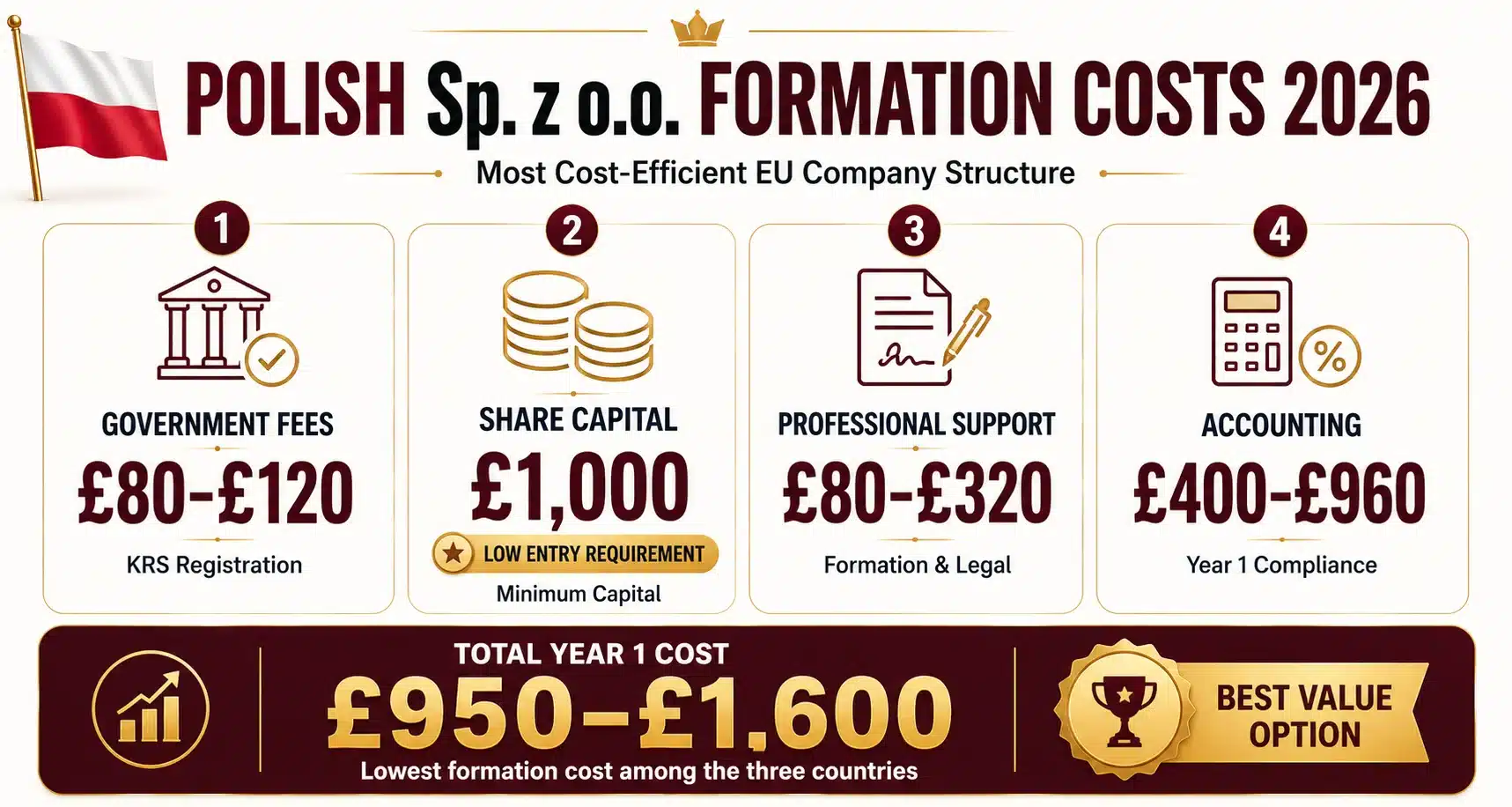
- National Court Register (KRS) filing: PLN 500-750 (~£80-£120)
- The S24 online registration system allows incorporation without a notary for standard structures, which dramatically cuts costs compared to Germany
- Many formation services absorb the KRS fee into their flat package price
- Timeline: 3-7 business days via the online system
Minimum Share Capital Requirement
Poland requires a minimum of PLN 5,000 (~£1,000) in share capital. This is:
- 50x lower than Germany (€25,000)
- More than the UK’s £1 minimum, but realistic for any founder
- Payable in cash or in-kind contributions (equipment, IP, software licences)
In practice, most founders deposit PLN 5,000 and retain it as working capital it doesn’t disappear. It’s roughly equivalent to what UK founders spend on formation and first-month costs anyway, so it rarely represents a genuine barrier.
Professional and Legal Fees
Formation service: PLN 500-1,000 (~£80-£160)
This is dramatically cheaper than either the UK or Germany. Polish professional service costs reflect the country’s wage structure relative to Western Europe, not lower quality. Many Warsaw-based formation services offer English-language support and experience working with international founders.
Lawyer or accountant-led formation: PLN 1,000-2,000 (~£160-£320)
Appropriate for non-standard structures, cross-border ownership, or when you need Polish-language documents reviewed by someone you trust.
Why Poland is so affordable compared to Germany: The S24 system (available since 2012 and significantly improved since) allows standard Sp. z o.o. formations without mandatory notary involvement. The legal framework is simpler, and the registration process is more digitised. Professional service costs are lower because the underlying wage base is lower a senior Warsaw accountant earns roughly 40-50% of an equivalent London or Munich counterpart.
Accounting Setup and Annual Fees
- Annual accounting: PLN 2,000-5,000/year (~£320-£800/year)
- First-year cost: PLN 2,500-6,000 (~£400-£960) including setup
- VAT filing: Required for businesses above PLN 200,000 (~£32,000) revenue, or optionally below that threshold. The standard Polish VAT rate is 23%.
- Simplified bookkeeping: Available for smaller entities, reducing the accountant’s workload and cost
An important practical note: your accountant should be comfortable working with foreign directors and communicating in English. Most Warsaw and Kraków-based accountants serving international founders do, but verify this before signing any engagement letter.
Real comparison: Polish Sp. z o.o. Accounting runs approximately PLN 3,000/year (~£480) for a straightforward services business. The equivalent UK cost is £1,000-£1,500/year. The annual saving of ~£700-£1,000 compounds significantly over the lifetime of the business.
The Tax Advantage (Often the Deciding Factor)
Poland offers a 9% CIT (Corporate Income Tax) rate for businesses with annual revenues below €2 million, or £1.7 million. The standard rate above that threshold is 19%. Compare this to:
- UK: 19% (profits under £50,000) rising to 25% (profits above £250,000)
- Germany: ~29-33% effective rate (15% CIT + ~14-18% trade tax)
For a Polish company making £60,000/year in profit, the 9% CIT rate means a tax bill of approximately £5,400. The same profit in a UK company (at 25% for a profitable business) would generate a £15,000 tax bill. That’s a £9,600/year difference purely from the choice of jurisdiction.
Poland also offers the Estonian CIT model (introduced in 2021), which allows companies to defer all corporate tax until profits are distributed. If you reinvest profits into the business, you pay zero CIT until you take money out. For growth-focused founders who don’t need to extract profits, this is a significant structural advantage.
Polish Company: Total Cost Summary
| Cost Item | One-Time | Annual (Ongoing) |
|---|---|---|
| Government registration (KRS) | £100 | – |
| Formation service | £120 | – |
| First-year accounting | £480 | £480/year |
| Software | £150 | £100/year |
| Banking/insurance | £200 | £200/year |
| TOTAL | ~£1,050 | ~£780/year |
Poland Real-World Scenarios
- Scenario A: Bootstrapped founder (minimal setup) Formation: £220 | Accounting: £480 | Software: £150 | Banking: £100 Year 1 total: ~£950
- Scenario B: Growing digital business with accountant Formation: £300 | Accounting: £800 | Software: £200 | Banking/insurance: £300 Year 1 total: ~£1,600
- Scenario C: SaaS business with one local employee. Formation: £300 | Accounting + payroll: £1,200 | Software: £300 | Banking/insurance: £400. Year 1 total: ~£2,200
Trade-offs to acknowledge honestly:
- Company documents and the KRS register are in Polish you’ll need a Polish-speaking accountant or translation support
- Banking can take 7-14 days; some banks still require an in-person visit for first-time non-resident directors
- Less developed startup banking ecosystem vs UK (though Revolut Business, mBank, and Santander Poland are all improving their digital onboarding)
- If you’re planning to raise Western VC funding, a Polish holding structure may require restructuring later factor in £3,000-£8,000 in future legal costs if that’s part of your roadmap
Cost Comparison and Hidden Factors
The 5-Year View: The Only Comparison That Matters
Formation cost is a one-time event. Annual operating costs are forever. The table below shows the true cost of each jurisdiction over five years using mid-range scenario figures.
| Factor | UK | Germany | Poland |
|---|---|---|---|
| Formation cost (one-time) | £300 | £3,360 | £220 |
| Capital requirement | £1 | €25,000 | ~£1,000 |
| Year 1 total (mid-scenario) | £2,700 | £4,430 | £1,600 |
| Year 2+ annual | £1,690 | £1,350 | £780 |
| 5-year total cost | ~£9,460 | ~£8,790 | ~£4,720 |
Key insight
Germany costs the most upfront by a significant margin, but its lower annual costs mean it actually becomes competitive with the UK over time if you can meet the capital requirement. Poland is approximately 50% cheaper than either over a five-year horizon.
Case Study: The Consulting Founder
Profile
Sarah is a management consultant earning £80,000/year in revenue with £55,000 in profit. She’s based in London but is open to incorporating in any EU country. She’s bootstrapped, has no employees, and is not planning to raise investment.
UK route
- Year 1: £2,700 | Years 2-5: £1,690/year | 5-year total: £9,460
- Corporation Tax at 25% on £55K profit: £13,750/year
Poland route
- Year 1: £1,600 | Years 2-5: £780/year | 5-year total: £4,720
- Corporation Tax at 9% on £55K profit: £4,950/year (saving £8,800/year vs UK)
Over 5 years, Poland saves Sarah £4,740 in operating costs plus approximately £44,000 in tax savings (£8,800/year × 5). Total advantage: approximately £48,740 over 5 years.
Formation cost is irrelevant in this picture. The tax rate is everything.
Hidden Costs Nobody Mentions
These are the costs that will determine your real total bill, and most founders discover them six to twelve months too late.
1. Tax Optimization Mistakes (£3,000-£15,000/year impact)
The single most expensive mistake in company formation is choosing the wrong tax structure, not the wrong country. A UK company director who pays themselves entirely via PAYE salary instead of a salary + dividend split can pay £2,000-£4,000/year more in combined income tax and National Insurance. A German GmbH owner who doesn’t understand the distinction between managing director salary (Geschäftsführergehalt) and profit distribution can face unexpected tax assessments. A single consultation with a tax advisor at the point of formation typically £300-£500 routinely saves founders thousands per year for the lifetime of the business.
2. Your Time (Invisible but Real)
Formation takes time. At a conservative £50/hour consultant rate, here’s what each country costs in founder time:
- UK: ~5 hours of your time £250
- Germany: ~12-15 hours (notary preparation, appointments, document review) £600-£750
- Poland: ~8-10 hours (navigating a foreign language system) £400-£500
This is a real cost that doesn’t appear in any formation service quote.
3. Choosing the Wrong Accountant (£1,000-£3,000 impact)
There is a meaningful quality difference between accountants at different price points. A bottom-of-market “£500/year accountant” typically files the minimum required documents. A £1,200-£1,500/year accountant typically provides proactive tax planning, quarterly reviews, and strategic advice. The additional £700 in annual fees very often returns £2,000-£5,000 in tax savings. Paying for the cheaper accountant to save money is usually a false economy.
4. Banking Delays (1-3 weeks of lost trading)
You cannot invoice clients or receive payments until your business bank account is open. Delays vary significantly:
- UK: 3-5 days (Starling, Tide, Monzo Business all fast)
- Poland: 7-14 days (traditional banks slower; Revolut Business faster)
- Germany: 10-14 days or more (conservative banking culture; some banks require an accountant reference)
For a business billing £5,000/month, a two-week banking delay represents a real cash flow cost.
5. Compliance Penalties (£500-£10,000 risk)
Each country has mandatory filings with real financial penalties for missing them:
- UK: Late Corporation Tax return £100 automatic penalty, escalating to £1,000+. A missing confirmation statement can trigger Companies House to strike off the company.
- Germany: Late annual accounts courts can impose enforcement fees of €5,000-€25,000 for persistent non-compliance.
- Poland: Late KRS filings or VAT returns PLN 500-5,000 in fines (£80-£800)
Prevention: accounting software with automatic reminders (£150-£300/year) and a proactive accountant. The cost of getting this wrong is orders of magnitude higher than the cost of getting it right.
6. Future Restructuring Costs
If you choose Poland or Germany now and later need a UK or Irish holding company for investment, expect to pay £3,000-£10,000 in legal fees for the restructuring, plus potential tax events on asset transfers. This doesn’t mean avoid Poland or Germany; it means factor these potential future costs into your decision if fundraising is a realistic scenario.
When Formation Cost Matters Most
Formation cost is most meaningful when you are:
- Pre-revenue or very early-stage (formation cost represents a meaningful share of your available cash)
- Running a micro-business (£10,000-£30,000 revenue) a £1,000 formation cost is 3-10% of annual revenue
- A side-hustler converting part-time income into a formal structure for the first time
When Formation Cost Matters Least
Formation cost is largely irrelevant when you are:
- Profitable (£50,000+ revenue), a single year of tax savings exceeds the total formation cost
- Planning to raise investment, investors will often require restructuring regardless, and will fund it
- Building a team, payroll and compliance costs will dominate your administrative spend
Time-to-Break-Even on Formation Costs
How long does it take for the tax savings from incorporating to recover the formation cost?
- UK Company vs freelancer/sole trader: Formation cost: ~£2,700 | Tax savings vs sole trader: £3,000-£8,000/year Break-even: 4-10 months
- Germany GmbH vs freelancer: Formation cost: ~£3,360 | Tax savings vs Freiberufler status: £4,000-£8,000/year Break-even: 5-10 months (but capital requirement remains a barrier)
- Poland Sp. z o.o. vs sole trader: Formation cost: ~£1,050 | Tax savings vs individual trading: £2,000-£9,000/year Break-even: 1-6 months
For any profitable business, formation cost pays for itself quickly. The real question is which structure saves the most in Year 2, Year 3, and beyond.
ROI Calculator: How to Use It
What the Calculator Does
The downloadable Cost Calculator Spreadsheet (available in Excel and Google Sheets format) takes your specific situation and outputs a personalized 5-year cost and tax projection across all three jurisdictions.
You provide
- Your home country (affects double-tax treaty implications)
- Target incorporation country (UK / Germany / Poland / Compare all)
- Expected first-year revenue and anticipated growth rate
- Number of employees (if any) and approximate salary
- Business type (services / SaaS / e-commerce / product / other)
- Accountant preference (full service / basic compliance / DIY)
- Whether you plan to raise external investment
The calculator outputs
- Total formation costs (all fees, broken down by category)
- Year 1 operating cost estimate
- Estimated annual Corporation Tax by country at your revenue and profit level
- Net profit comparison across all three countries
- 5-year cost projection (formation + operating + tax)
- Recommendation score (0-100 per country) with written reasoning
Step-by-Step Walkthrough
- Step 1: Open the spreadsheet. You’ll see three country tabs (UK, Germany, Poland) plus a summary comparison tab.
- Step 2: Fill in your situation on the Inputs tab. The form takes approximately five minutes to complete. All fields have contextual notes explaining what to enter.
- Step 3: The calculator auto-populates estimates based on your inputs. Tax calculations run in the background using 2026 rates.
- Step 4: Navigate to the Comparison tab. You’ll see a side-by-side breakdown of Year 1 cost, annual ongoing cost, estimated tax bill, and 5-year total for each country. A recommendation is generated based on your specific inputs with a plain-language explanation.
- Step 5: Use the output to inform a conversation with a professional, either a tax advisor or an accountant in the recommended country, to verify the estimate for your exact situation.
Example output
You’re a £60,000/year consulting business operating from London, no employees, planning to stay bootstrapped.
- UK company Year 1: £2,700 | Tax: £15,000 (25%) | Net: £42,300
- Poland Year 1: £1,600 | Tax: £5,400 (9%) | Net: £53,000
- 5-year advantage of Poland over UK: ~£52,000
- Calculator recommendation: Poland 91/100 | UK 74/100
Important Limitations
The calculator is a planning guide, not a substitute for professional advice. Specifically:
- Tax calculations are generalised estimates your actual liability depends on your residency, the nature of your income, double-tax treaty positions, and how you structure your remuneration
- Exchange rates fluctuate; all GBP figures use approximate mid-2026 rates (±5-10% variance possible)
- Does not include visa, immigration, or relocation costs
- Does not model non-resident director implications, which can significantly change tax outcomes in some situations
- For businesses where annual tax exposure exceeds £10,000, a professional tax consultation (typically £300-£600) is strongly recommended before making a final decision
The calculator is updated quarterly to reflect tax law changes. Sign up for Formation Updates to receive notifications when changes affect your jurisdiction.
Beyond Cost: Other Factors to Consider
Speed of Formation
Speed matters when you have a client waiting, a contract to sign, or a bank account to open. The three countries are dramatically different here.
- UK: 1-2 business days via Companies House digital filing. Fastest in Europe for standard incorporations.
- Poland: 3-7 business days via the S24 online system for standard formations.
- Germany: 10-14 business days minimum. The notary appointment alone typically takes 5-7 days to schedule, and processing with the Handelsregister adds another week.
The practical implication
If you need to start trading, issue invoices, or open a bank account within the next week, the UK is your only realistic option. If you have 2-3 weeks, any country works.
Banking Accessibility for International Founders
Banking difficulty is one of the most underappreciated factors in the formation decision.
- UK: Most accessible. UK neobanks (Starling, Tide, Monzo Business) have digital-first onboarding that typically completes in 3-5 days, including for non-resident directors. Traditional banks require more documentation but are reliable. Non-residents can open UK business accounts without physically visiting the UK in most cases.
- Poland: Improving rapidly. Revolut Business, mBank, and Alior Bank all have workable digital onboarding for Polish Sp. z o.o. entities. Some traditional banks still require at least one in-person visit for non-resident directors. Timeline: 7-14 days.
- Germany: Most challenging. German banking culture is conservative and relationship-oriented. Major banks like Deutsche Bank, Commerzbank, and Sparkasse have historically required accountant introductions, detailed business plans, and in-person meetings for new GmbH accounts. Neobanks like FYRST and Kontist have improved this somewhat, but Germany remains the hardest of the three for non-resident founders to navigate banking quickly.
VAT Registration and Management
VAT is a significant ongoing administrative burden that affects all three countries differently.
- UK: VAT registration is mandatory above £90,000/year revenue (2026 threshold). Registration is straightforward online. Standard VAT rate 20%. Filing is quarterly online via HMRC’s Making Tax Digital system. VAT returns are largely automated with modern accounting software.
- Germany: VAT (Mehrwertsteuer) registration is typically required from day one for new GmbHs. Standard rate 19%. Monthly advance VAT returns (Umsatzsteuervoranmeldung) are required in Year 1, switching to quarterly after satisfactory compliance history. Slightly more administrative burden than the UK.
- Poland: VAT registration is voluntary below PLN 200,000/year (~£32,000). Standard rate 23%. For businesses selling internationally, VAT management can be complex, particularly for digital services where OSS (One Stop Shop) registration may be relevant.
Tax Optimization Strategies by Country
All three jurisdictions offer meaningful tax planning opportunities, but they work differently.
- UK tax planning: The most common strategy for a limited company director is the salary + dividend split. Taking a salary at or near the National Insurance threshold (currently £12,570/year) and extracting remaining profits as dividends reduces combined income tax and NI by £2,000-£4,000/year compared to taking everything as salary. This is legal, well-established, and widely used. An accountant who doesn’t proactively recommend this in Year 1 is leaving money on the table.
- Germany tax planning: The GmbH structure enables holding company setups where dividends flow between entities at a 95% exemption rate, highly tax-efficient for founders who want to reinvest rather than withdraw profits. The trade-off is complexity; you need a specialist tax advisor (Steuerberater) to implement this correctly.
- Poland tax planning: The 9% CIT rate for small businesses is a built-in structural advantage. Additionally, Poland’s Estonian CIT model, available since 2021, allows businesses to pay zero corporation tax until they distribute profits. If you’re reinvesting revenue into growth, you could operate for years with no CIT liability at all. This is particularly powerful for SaaS, e-commerce, or service businesses with high margins and a reinvestment mindset.
Investor Expectations and Future Fundraising
If there is any possibility of raising external investment in the next three to five years, this factor should weigh heavily in your formation decision.
- UK company: The UK Limited Company structure is the most universally understood by investors in the UK, Europe, and the US. Term sheets, shareholder agreements, EIS/SEIS tax relief for investors (a major advantage for UK seed-stage fundraising), and standard share class structures are all well-established. If fundraising is part of your plan, the UK is almost always the right choice.
- Germany GmbH: Well-understood by EU institutional investors, particularly those focused on the DACH market. Less familiar to US investors. The GmbH structure has some quirks (minimum share transfer formalities require a notary) that make it slightly less flexible for cap table management than the UK.
- Poland Sp. z o.o.: Less familiar to Western investors. If you raise institutional funding at any significant scale, you will likely need to restructure into a UK or Dutch holding company, a process that typically costs £3,000-£10,000 in legal fees and can trigger tax events. This doesn’t make Poland wrong for bootstrapped businesses, but it’s a real consideration if your model assumes future institutional investment.
Conclusion and Decision Framework
The right jurisdiction depends entirely on what your business needs right now. The UK is the strongest default fast to set up, easy to bank with, and familiar to investors, making it practical for most founders. Poland is the right call if keeping costs low is the priority, offering 5-year total costs roughly 50% cheaper than the UK, with a tax environment that rewards profitable small businesses. Germany makes sense for a specific type of founder, one building for the DACH enterprise market who has the capital and patience the GmbH structure demands.
What this comparison ultimately shows is that the formation fee itself is the smallest part of the equation. The quality of your accountant, your remuneration structure, and your tax planning will define far more of your financial outcome than the country you choose to register in. Get those right, and the formation decision takes care of itself.
The Most Important Reminder
Formation cost is not the biggest cost. It never was. The costs that will genuinely define the financial outcome of your company are the quality of your professional advisors, the structure of your remuneration, the efficiency of your tax planning, and your compliance record over time.
A founder who spends £300 to form a UK company, hires a proactive accountant at £1,500/year, and structures their salary and dividends correctly could save £4,000-£8,000 per year compared to the same founder who forms cheaply, uses a bottom-of-market accountant, and pays themselves sub-optimally.
The best formation decision is the one that sets the right foundation financially, structurally, and administratively for the business you’re actually building.
Disclaimer: This guide provides general information for educational purposes and is accurate as of June 2026. It does not constitute legal, tax, or financial advice. Costs vary based on individual circumstances. Consult a qualified professional before making incorporation decisions.