Europe remains one of the world’s most attractive destinations for entrepreneurs, startups, SMEs, and multinational companies looking to expand internationally. With access to the European Single Market, stable legal systems, highly skilled workforces, and business-friendly jurisdictions, establishing a company in Europe can unlock significant growth opportunities. However, choosing the best country to start a business in Europe is not always straightforward. Each jurisdiction offers different advantages depending on your industry, business model, tax considerations, regulatory requirements, and expansion goals.
While some countries are known for fast digital company formation, others offer attractive tax regimes, access to investment, or strategic locations for international trade. This guide compares some of Europe’s leading business destinations, highlighting their strengths, potential challenges, and the types of businesses they best support. Whether you’re launching a startup, opening a European headquarters, or expanding an existing company, this guide will help you make a well-informed decision.
What Makes a Country Business-Friendly?
Before selecting where to establish your company, it’s important to understand what makes one jurisdiction more suitable than another. While tax rates often attract attention, successful business expansion depends on a much broader range of factors.
Some of the key considerations include
- Ease of company formation
- Corporate tax environment
- Access to the European Single Market
- Banking and financial infrastructure
- Political and economic stability
- Availability of skilled workers
- Legal and regulatory transparency
- Government support for businesses
- Industry-specific opportunities
- Ongoing compliance requirements
The ideal country will depend on whether your priority is minimising costs, attracting investors, hiring talent, protecting intellectual property, or expanding across multiple European markets.
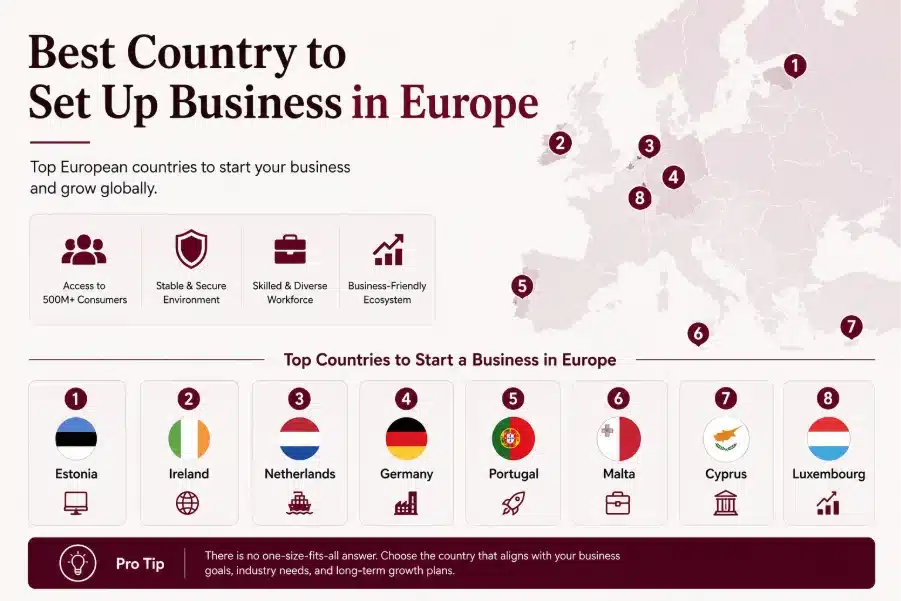
Best Countries to Start a Business in Europe
Estonia
Estonia has built an international reputation as one of Europe’s most digitally advanced business destinations. Through its e-Residency programme, entrepreneurs from around the world can establish and manage an Estonian company remotely, making it particularly attractive for digital businesses and location-independent founders.
Advantages
- Fast online company registration
- Digital government services
- Transparent regulatory framework
- Strong technology ecosystem
- Excellent environment for startups
Considerations
Although Estonia offers an efficient business environment, companies operating locally may still need to comply with accounting, reporting, and tax obligations. Businesses with physical operations in other countries must also consider local tax residency rules.
Best suited for
- Technology companies
- SaaS businesses
- Digital agencies
- Software development
- Online consulting
Ireland
Ireland has become one of Europe’s leading business hubs thanks to its internationally recognised corporate tax framework, English-speaking workforce, and strong presence of multinational companies.
Its reputation for innovation and access to highly skilled professionals continues to attract businesses from sectors including technology, pharmaceuticals, financial services, and digital commerce.
Advantages
- Competitive corporate tax regime
- English-speaking business environment
- Strong international reputation
- Highly skilled workforce
- Excellent access to global markets
Considerations
Demand for office space and skilled employees can increase operating costs compared with some other European countries.
Best suited for
- Technology companies
- Financial services
- International headquarters
- Software businesses
- Pharmaceutical companies
Netherlands
The Netherlands is one of Europe’s most established destinations for international businesses. Its strategic location, world-class logistics infrastructure, and business-friendly environment make it a popular choice for companies serving both European and global markets.
The country is home to one of Europe’s busiest ports, Rotterdam, and offers excellent transport links, making it particularly attractive for trading, logistics, manufacturing, and international headquarters.
Advantages
- Strategic location within Europe
- Excellent logistics and transport infrastructure
- Strong international business reputation
- Highly educated and multilingual workforce
- Stable legal and regulatory environment
Considerations
Businesses should account for ongoing compliance obligations and local tax requirements. Operating costs, particularly in major cities, may also be higher than in some neighbouring countries.
Best suited for
- International trading companies
- Logistics businesses
- Manufacturing
- E-commerce
- Regional headquarters
Germany
Germany has the largest economy in Europe and continues to attract businesses looking for long-term stability and growth. Its strong industrial base, skilled workforce, and access to the EU Single Market make it an excellent location for companies across a wide range of sectors.
Although company formation procedures can involve more formalities than in some other European countries, many businesses view this as a worthwhile investment because of Germany’s strong commercial reputation.
Advantages
- Europe’s largest economy
- Excellent infrastructure
- Highly skilled workforce
- Strong legal protection
- Access to a large domestic and European market
Considerations
Businesses should be prepared for structured compliance requirements, formal incorporation procedures, and ongoing accounting obligations.
Best suited for
- Manufacturing
- Engineering
- Technology
- Automotive
- Professional services
- International trading
Portugal
Portugal has become increasingly popular among entrepreneurs and international investors due to its competitive business costs, growing startup ecosystem, and strategic location.
Government initiatives supporting innovation and entrepreneurship have helped position Portugal as an attractive destination for both startups and established companies looking to expand into Southern Europe.
Advantages
- Competitive operating costs
- Growing startup ecosystem
- Access to the EU market
- Skilled and multilingual workforce
- Attractive quality of life
Considerations
Some administrative procedures may take longer depending on the business activity and licensing requirements.
Best suited for
- Startups
- Technology companies
- Digital businesses
- Tourism
- Professional services
Malta
Malta has established itself as an attractive jurisdiction for international businesses thanks to its English-speaking workforce, EU membership, and internationally recognised corporate framework. The country is particularly well known for serving internationally focused businesses operating across multiple markets.
Advantages
- English-speaking business environment
- EU member state
- Attractive corporate framework
- Strong professional services sector
- Well-developed financial services industry
Considerations
Businesses should obtain professional advice regarding local tax rules, licensing requirements, and industry-specific regulations before incorporation.
Best suited for
- Holding companies
- International trading
- Financial services
- Technology
- Online businesses
Cyprus
Cyprus has become a preferred destination for international entrepreneurs seeking a strategic location between Europe, the Middle East, and Asia. As an EU member state, Cyprus offers businesses access to the European Single Market while providing a well-established legal framework based on English common law principles.
Its professional services sector, favourable tax environment, and efficient company registration process continue to attract international investors.
Advantages
- Strategic location connecting Europe, Asia, and Africa
- EU membership
- Competitive corporate tax regime
- English widely used in business
- Strong financial and professional services sector
Considerations
Depending on the business activity, additional licences or regulatory approvals may be required. Companies must also comply with annual reporting, accounting, and tax obligations.
Best suited for
- International holding companies
- Consulting firms
- Trading businesses
- Investment companies
- Professional services
Luxembourg
Luxembourg is recognised as one of Europe’s leading financial centres. Despite its relatively small size, it offers exceptional political stability, a highly skilled multilingual workforce, and a sophisticated legal and financial infrastructure.
The country is particularly attractive for investment structures, multinational corporations, and businesses requiring access to international financial markets.
Advantages
- Strong financial sector
- Political and economic stability
- Highly skilled multilingual workforce
- Excellent investor confidence
- Central European location
Considerations
Operating costs, including office space and salaries, can be higher than in many other European jurisdictions. Businesses should also seek professional advice regarding corporate structuring and compliance.
Best suited for
- Investment funds
- Holding companies
- Asset management firms
- Financial services
- Multinational headquarters
Comparison of the Best Countries to Start a Business in Europe
| Country | Key Strength | Ideal For | Business Environment |
| Estonia | Digital company formation | SaaS, startups, online businesses | Excellent |
| Ireland | International business hub | Technology, finance, pharmaceuticals | Excellent |
| Netherlands | Logistics and international trade | Trading, manufacturing, headquarters | Excellent |
| Germany | Europe’s largest economy | Manufacturing, engineering, professional services | Excellent |
| Portugal | Affordable business expansion | Startups, tourism, digital businesses | Very Good |
| Malta | International corporate services | Holding companies, online businesses | Very Good |
| Cyprus | Strategic international location | Consulting, investment, trading | Very Good |
| Luxembourg | Financial and investment centre | Funds, multinational corporations | Excellent |
Which Country Is Best for Different Types of Businesses?
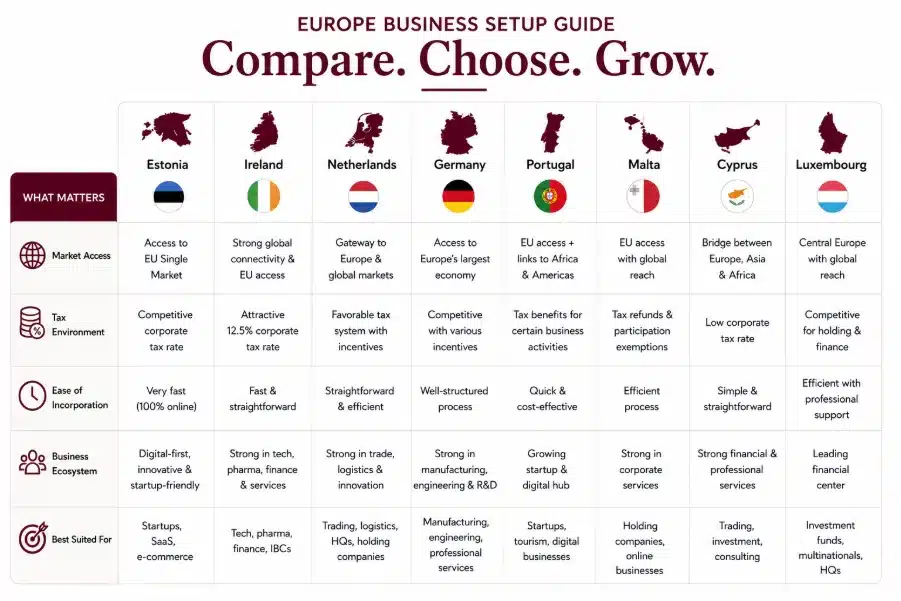
There is no single answer to the question of the best country to start a business in Europe. The right jurisdiction depends on your company’s objectives, industry, and long-term growth strategy.
For Startups
Estonia and Portugal are popular choices for startups due to their supportive innovation ecosystems, modern digital infrastructure, and relatively straightforward incorporation processes.
For Technology Companies
Ireland and Estonia continue to attract technology businesses thanks to their skilled workforces, strong digital infrastructure, and established tech communities.
For Manufacturing Businesses
Germany remains one of Europe’s leading manufacturing hubs, offering world-class infrastructure, engineering expertise, and access to one of the continent’s largest consumer markets.
For International Trading
The Netherlands and Cyprus provide strategic geographic locations, excellent transport links, and efficient access to European and international markets.
For Holding Companies
Malta, Cyprus, and Luxembourg are frequently considered by businesses seeking internationally recognised corporate structures and access to sophisticated professional services.
For Financial Services
Luxembourg and Ireland are among Europe’s leading financial centres, making them attractive locations for investment firms, asset managers, and multinational financial institutions.
Ultimately, selecting the best country to start a business in Europe should involve evaluating tax considerations, regulatory requirements, operational costs, market access, and your long-term expansion plans rather than focusing on a single factor alone.
Conclusion
Choosing the best country to start a business in Europe depends on your business goals, industry, and long-term growth plans. While each country offers unique advantages, the right choice should balance market access, compliance requirements, operating costs, and future expansion opportunities.
At Open a European Company, we help businesses select the most suitable European jurisdiction and manage every stage of the company formation process. Whether you’re starting a new venture or expanding into Europe, our experts are here to make your business setup straightforward and compliant.