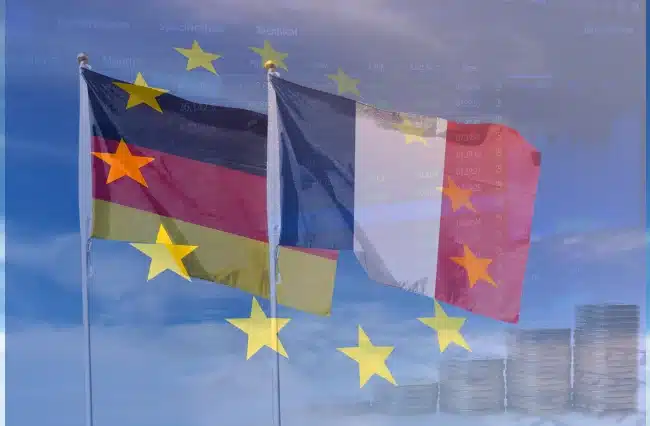
The Eurozone has had its fair share of pessimistic forecasts in recent years. Concerns about stagnation, unemployment, and deflation dominated headlines. Yet, recent figures show there is still life in the bloc’s economy — thanks largely to stronger-than-expected performances from France and Germany, its two biggest players.
Germany narrowly avoided recession with a modest 0.1% growth in the third quarter, while France posted a more encouraging 0.3% growth. Together, they helped the Eurozone register 0.2% collective growth, providing a welcome boost to investor confidence.
Germany Avoids Recession
Germany had been at the centre of gloomy forecasts, with many economists warning that Europe’s largest economy was heading for contraction. After shrinking in the previous quarter, fears of a technical recession were widespread.
Instead, modest quarterly growth of 0.1% reflected:
-
Stronger domestic spending, supported by low unemployment and wage growth.
-
Improved exports, particularly to non-EU markets such as the US and China.
The German Council of Economic Experts has since forecast 1% growth in 2015, following a 1.2% expansion in 2014. While these figures may not be spectacular, they highlight Germany’s resilience.
Related: Company Formation in Germany
France Beats Expectations
France surprised many analysts by recording 0.3% growth in the third quarter. President François Hollande, buoyed by the figures, announced that France could achieve 0.4% growth for the full year.
This upturn was driven by:
-
Stronger-than-expected consumer spending.
-
Targeted government stimulus.
-
Modest recovery in industrial output.
While France still faces challenges high unemployment and weak competitiveness — the growth figure signals that Europe’s second-largest economy retains potential.
Related: Company Formation in France
Greece Emerges from Recession
One of the more surprising stories has been Greece. After years of crisis, austerity, and bailouts, Greece managed to post:
-
0.8% growth in Q1
-
0.3% growth in Q2
-
0.7% growth in Q3
Although the Greek economy is still well below pre-crisis levels, it is now the fastest-growing economy in the Eurozone. This turnaround reflects improved exports, a rise in tourism, and gradual investor confidence returning to the country.
Related: Company Formation in Greece
Italy’s Struggles
Italy, however, has not shared the same success. The economy contracted by 0.1%, tipping it back into recession. Structural problems such as weak productivity, high public debt, and sluggish reforms continue to weigh heavily on growth prospects.
This underperformance contrasts sharply with other southern European economies like Spain, which are showing tentative signs of recovery.
Eurozone Outlook
The Eurozone’s 0.2% growth in Q3 2014, while modest, represented an improvement on the 0.1% recorded in Q2. Economists see it as a fragile but encouraging sign.
The European Central Bank (ECB) has introduced stimulus measures to stave off deflation and support recovery. These include:
-
Low interest rates.
-
Asset purchase programmes.
-
Credit easing for banks to encourage lending.
(Source: European Central Bank)
Nancy Curtin, CIO at Close Brothers Asset Management, highlighted both the progress and challenges:
“On their own, these growth figures are nothing to write home about, but in the context of the negative news emerging from the Eurozone in recent months, the simple fact that growth isn’t slowing will reassure investors. But let’s be clear, the outlook for the Eurozone is still heavily clouded. Inflation remains in the doldrums, employment across the bloc is not improving, and manufacturing is in a state of near stagnation.”
Key Drivers of Growth
-
Germany: Export strength, low unemployment, and solid domestic demand.
-
France: Consumer spending resilience and government support.
-
Greece: Structural reforms and booming tourism.
-
Eurozone-wide policy: ECB stimulus boosting liquidity.
Challenges remain: low inflation, weak job creation, and political uncertainty in several member states.
What This Means for Businesses
For businesses and investors, the mixed picture presents both opportunities and risks.
-
Germany and France remain attractive bases for companies targeting the wider EU market.
-
Greece’s turnaround offers opportunities in tourism, real estate, and infrastructure.
-
Italy’s struggles serve as a reminder to evaluate risk carefully
Conclusion
While the Eurozone continues to face structural challenges, the resilience of Germany and France has provided a much-needed boost. Add to this Greece’s unexpected resurgence, and the outlook is more balanced than recent forecasts suggested.
For international businesses, this is a reminder that even in uncertain times, opportunities abound in Europe’s diverse economies. With the right strategy and support, companies can establish themselves in these markets and benefit from long-term growth.
At Open a European Company, we provide expert guidance for investors and entrepreneurs looking to set up in Europe’s most promising economies.
Contact us today on +44 (0)208 421 7470 or via our website to explore your options.