
Congratulations on forming your company! That certificate of incorporation feels like the finish line. It’s actually the starting gun.
Here is the direct answer to what you should do after company formation: Register for Corporation Tax within 3 months, open a dedicated business bank account, set up your statutory records, appoint an accountant, and build a compliance calendar for the year ahead. Miss these steps and you risk fines of £500 to £5,000 or more, plus operational chaos down the road. Most founders spend months planning incorporation, then scramble when they realise how much comes after. The first 30 days are when good habits are made or costly ones.
This guide breaks the entire process into a clear, day-by-day new company checklist so nothing falls through the cracks. Why does the first month matter so much? Two reasons. First, many compliance deadlines are triggered by your incorporation date or your trading start date. Not by when you get around to dealing with them. The clock is already running. Second, the systems and habits you establish now (bookkeeping, record-keeping, tax planning) determine how much time and money you spend on administration for the next several years. Getting them right once is far easier than fixing a mess twelve months in.
A survey by the Federation of Small Businesses found that small business owners routinely spend more than 5 hours per week on administrative and compliance tasks. Most of that burden is the direct result of poor systems established in the early days. This guide exists to spare you from that pattern.
Days 1 to 5: Immediate Priorities
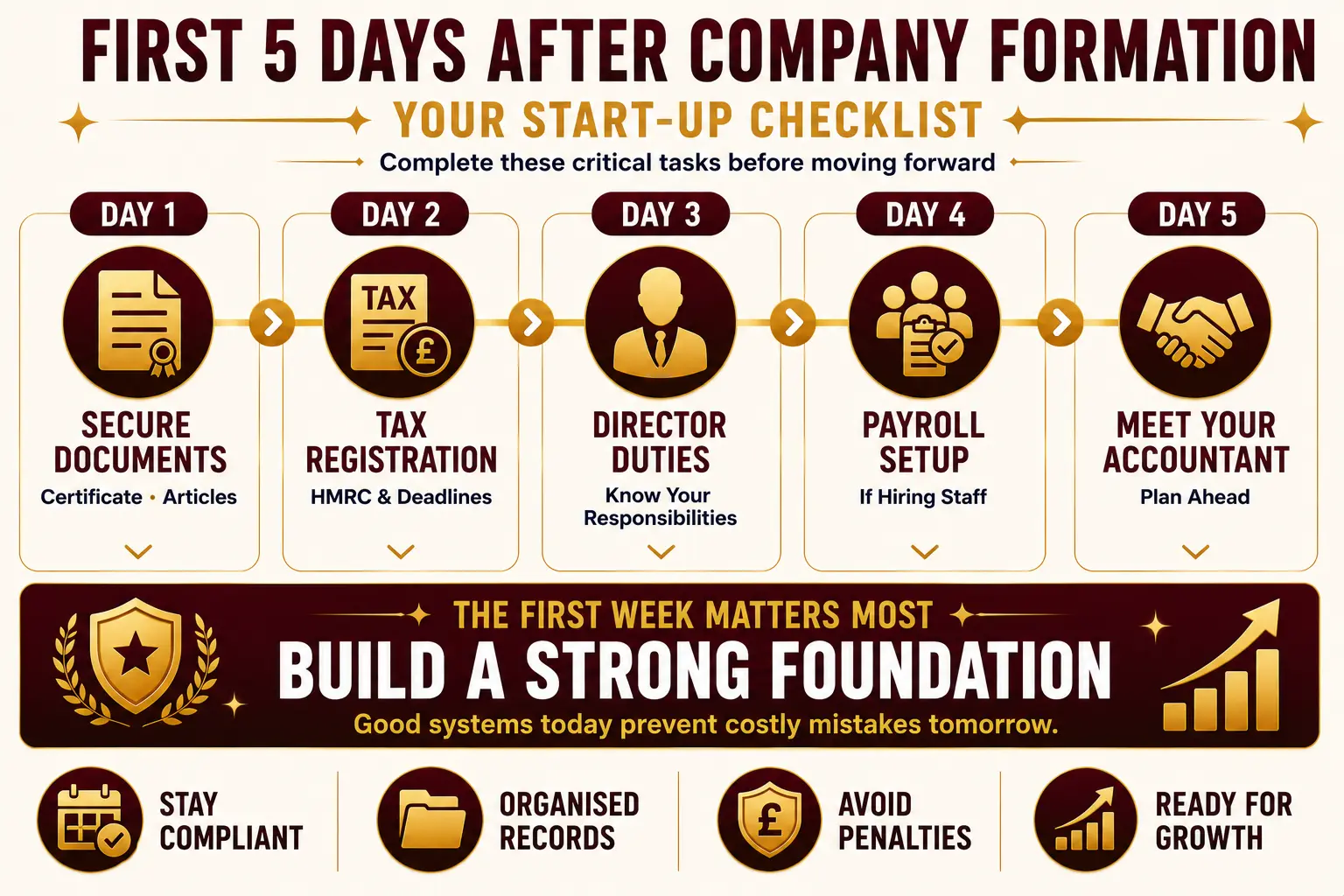
Day 1: Registration Day: Secure Your Documents
You will receive your Certificate of Incorporation digitally (and by post in some countries). Do not just save it to your downloads folder and forget about it.
- Download and store: Certificate of Incorporation, Memorandum of Association, and Articles of Association.
- Create a file system: Set up both a cloud folder (Google Drive, Dropbox) and a physical binder.
- Notify key contacts: Your accountant, solicitor, and any advisors need this immediately.
- Celebrate: Seriously. You built something. Mark the date.
Your Certificate of Incorporation is a legal document you will need repeatedly: for opening your bank account, applying for business insurance, entering supplier contracts, and sometimes for customer due diligence checks. Treat it like a passport. Multiple copies, stored in multiple locations. Screenshot or print the Companies House confirmation email too.
Some founders discover months later that their registered office address or director details were entered incorrectly at formation. Day 1 is the easiest time to spot and fix errors before any official correspondence goes to the wrong address.
Day 2: Tax Registration: Don’t Miss This Window
This is the most time-sensitive step of your entire first 30 days. In the UK, HMRC will send you a letter within 14 days of incorporation with instructions to register for Corporation Tax. You must register within 3 months of starting to trade, according to HMRC guidance, registering late triggers automatic penalties. Tax registration requirements vary by country. Here’s a quick reference:
| Country | Authority | Deadline | What You Register For |
| United Kingdom | HMRC | 3 months from trading start | Corporation Tax, PAYE, VAT (if turnover >£90k) |
| Germany | Finanzamt + IHK Chamber | Within 4 weeks of business start | Trade tax (Gewerbesteuer), VAT (Umsatzsteuer) |
| Poland | National Court Registry (KRS) | Done during formation | Automatic NIP tax ID assignment |
| United States | IRS + State Revenue | Varies by state | EIN, state income tax registration |
| Ireland | Revenue Commissioners | Within 30 days of trading | Corporation Tax, PAYE, VAT |
Set a calendar reminder for all quarterly and annual tax dates on this same day. Future you will be grateful.
Day 3: Director Obligations: Know What You’ve Signed Up For
Being a director is a legal position with real duties. Under the UK Companies Act 2006, directors must act in the company’s best interests, exercise reasonable care, and avoid conflicts of interest. Breaching these duties can lead to personal liability.
- Verify your details: Check that your name and service address are correctly filed with Companies House.
- Review director responsibilities: Read the official guidance.
- Consider director insurance: Directors and Officers (D&O) liability insurance is optional but strongly recommended.
The seven statutory duties of a director under the Companies Act 2006 are: act within your powers; promote the success of the company for the benefit of its members; exercise independent judgement; exercise reasonable care, skill and diligence; avoid conflicts of interest; not accept benefits from third parties; and declare any interest in a proposed transaction. Reading and understanding these is not a formality. It is a legal obligation that comes with the title. One area that catches new founders off guard is the duty to maintain solvency.
If a company continues trading while insolvent and the director knew (or should have known) there was no reasonable prospect of avoiding insolvent liquidation, that director can be held personally liable for the company’s debts. This is called wrongful trading under the Insolvency Act 1986. Understanding this risk from Day 3 shapes how you manage cash flow from now on.
Day 4: Payroll Setup (If You Have Employees)
If you are paying yourself or any employee a salary above £96 per week, you must register for PAYE with HMRC before the first payday.
- Register for PAYE at HMRC’s employer portal.
- Choose payroll software (Xero Payroll, BrightPay, Sage and most integrate with accounting tools).
- Collect employee details: full name, address, National Insurance number, P45 (if applicable).
Even if you are the only person in the business, you may still need to register for PAYE. Many director-shareholders pay themselves a small salary (typically set at the National Insurance threshold, currently £12,570 per year for 2024/25) and top it up with dividends. This salary, even if modest, triggers PAYE registration. Speak to your accountant about the optimal salary level for your situation before running your first payroll.
One thing founders frequently overlook: PAYE does not just cover Income Tax. It also covers National Insurance contributions (both employer’s and employee’s), student loan repayments, and statutory payments like Statutory Sick Pay and Statutory Maternity Pay. Getting your payroll software configured correctly from the start prevents a cascade of corrections later.
Day 5: Accountant Introduction: Get Aligned Early
Even if you plan to handle bookkeeping yourself, having an accountant from day one is a sound investment. The average small business accountant in the UK costs £50 to £150/hour or £100 to £400/month on a fixed package. That is far less than the cost of a single compliance error.
Share with your accountant today
- Certificate of Incorporation
- Memorandum and Articles of Association
- Your business plan and revenue projections
- Agree on scope: will they handle bookkeeping, annual accounts, tax returns, or just review?
A common mistake is treating the accountant relationship as purely transactional: you send documents, they file returns. The most valuable accountants act as a strategic sounding board.
From Day 5, ask your accountant: What is the most tax-efficient way to extract profits from this business? When should I register for VAT? What expenses should I be tracking from day one? Are there any grants or reliefs available to a business like mine? If you do not yet have an accountant, use an accountant finder service such as the ICAEW’s Find a Chartered Accountant or ACCA’s Find an Accountant tool. Look for someone who specialises in your sector and has experience with companies at your stage.
Days 6 to 10: Essential Setup
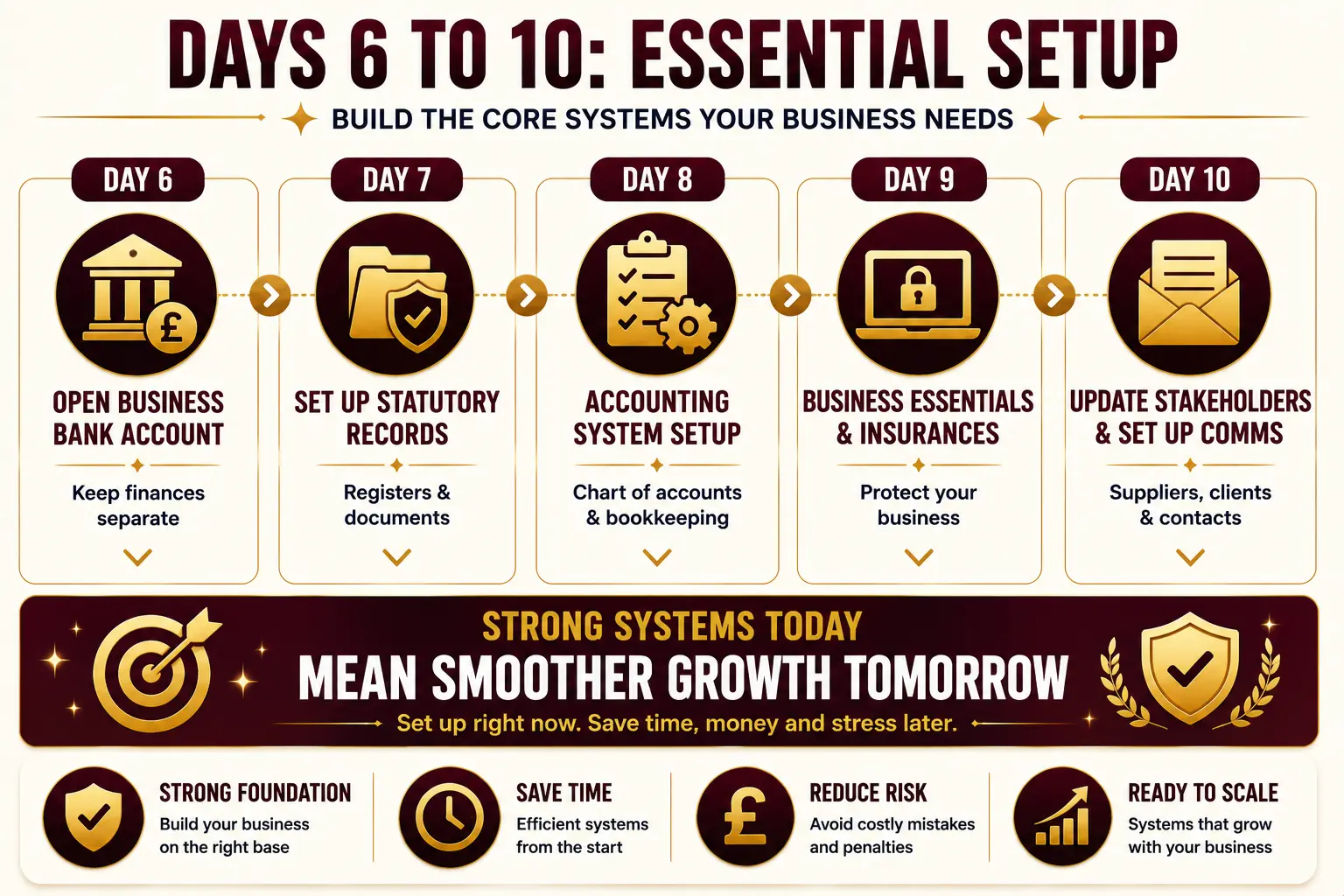
Day 6: Business Bank Account
Opening. A business bank account is not optional. It is a practical and legal necessity. Mixing personal and company funds pierces the corporate veil and destroys limited liability protection. It also makes HMRC audits exponentially more painful.
Documents most UK banks require
- Certificate of Incorporation
- Government-issued photo ID (passport or driving licence)
- Proof of business address
- Articles of Association
- Brief business description or plan
Timeline: Allow 3 to 7 working days for approval. Start this on Day 6, not Day 20.
Good options for UK startups: Starling Business, Tide, Monzo Business (free or low-cost digital banks), or traditional banks like Lloyds/Barclays if you need branch access.
Real-World Example: The £2,300 Bookkeeping Nightmare
A London-based SaaS founder used her personal account for the first 8 months of trading because her business account application was rejected and she did not retry. When filing annual accounts, her accountant spent 22 billable hours untangling personal and business transactions. Final bill: £2,300. Had she opened a simple Starling Business account (free) on Day 6, she would have paid £0 in extra accounting fees. The lesson: the 30 minutes it takes to apply for a business account is the best ROI you will get all year.
Day 7: Accounting Software: Set Up Your Financial Command Centre
Manual spreadsheets are fine for personal budgeting. For a company with invoicing, VAT, and payroll, you need dedicated software from the start.
Popular options
- Xero: Best for growth-stage businesses, strong accountant integrations. From £15/month.
- QuickBooks: User-friendly, excellent for service businesses. From £12/month.
- FreshBooks: Ideal for freelancers and small service firms. From £11/month.
- Wave: Free, good for very early-stage businesses. Lacks some UK-specific VAT features.
Connect your business bank account on Day 7 itself. Auto-reconciliation saves 2 to 3 hours per month and dramatically reduces the risk of errors. Also set up your chart of accounts on this day: categories for income streams, staff costs, marketing, software subscriptions, travel, and professional fees at a minimum.
One often-missed step: create your invoice template in the software on Day 7, before you send your first invoice. UK law requires invoices to include your company name, company registration number, registered office address, invoice date, unique invoice number, description of goods or services, and the amount payable, including VAT (if you are VAT registered). Getting the template right once means every subsequent invoice is compliant automatically.
Day 8: Statutory Registers: Your Legal Record-Keeping Obligation
UK law requires every limited company to maintain statutory registers. These are not optional and non-compliance can result in a £5,000 fine.
Required registers
- Register of Members (Shareholders): Names, addresses, number of shares held, date of acquisition.
- Register of Directors: As of November 2025, you no longer need to hold a separate register of directors at your registered office. Companies House holds this centrally. But internal records are still best practice.
Store these securely and share access with your accountant. Update them within 14 days whenever anything changes. If you have multiple shareholders, the Register of Members should record the exact number of shares each person holds, the class of shares (ordinary, preference, etc.), and the date on which shares were transferred or issued. Disputes over shareholdings are far easier to resolve when there is a clean, contemporaneous register.
Your company will also need to maintain records of People with Significant Control (PSCs): anyone who holds more than 25% of shares or voting rights, or who otherwise exercises significant influence or control over the company. This information must be filed with Companies House and kept up to date.
Day 9: Business Insurance: Protect What You’ve Built
Some business insurance is legally required; some is just smart risk management. Get quotes before you start trading, not after your first crisis.
Insurance types by business model
- Employers’ Liability: LEGALLY REQUIRED if you have any employees. Minimum £5m cover. Fine for non-compliance: up to £2,500 per day.
- Professional Indemnity: Essential for consultants, lawyers, designers, developers, and accountants.
- Public Liability: If customers or the public visit your premises or you visit theirs.
- Product Liability: If you manufacture or sell physical products.
- Cyber Liability: Increasingly important for any business holding customer data or operating online. Covers breach response costs, regulatory fines, and third-party claims.
Typical combined cost for a small UK business: £300 to £1,000/year. Useful comparison tool: Simply Business for UK SME insurance quotes. When comparing policies, do not just compare premiums.
Check the excess, the policy limits, and specifically what is excluded. A £200/year professional indemnity policy with a £5,000 excess and a £100,000 limit is very different from a £350/year policy with a £1,000 excess and a £500,000 limit.
Day 10: Document Filing System: The Foundation of Clean Accounts
A disorganised filing system costs money every year at tax time. Set this up once and it pays dividends for the life of the company.
Folders to create (cloud and physical)
- Invoices Issued (by month)
- Receipts & Expenses (by category)
- Bank Statements
- Tax Documents (HMRC correspondence, VAT returns)
- Contracts & Legal
- Insurance
HMRC requires accounting records to be kept for a minimum of 6 years. Cloud backup (Google Drive, Dropbox, or your accounting software’s built-in document storage) is essential. Not just for compliance but for your own protection. Hard drive failures, office floods, and laptop thefts are not abstract risks. Many accounting software packages like Xero and QuickBooks include receipt capture via a mobile app, which means you can photograph a receipt the moment you receive it and it is automatically categorised. Use this feature.
A practical tip: name your digital files consistently from Day 1. Use a format like YYYY-MM-DD_SupplierName_Amount.pdf for expenses and YYYY-MM-DD_ClientName_INV001.pdf for invoices. When your accountant asks for ‘the November phone bill’ three years from now, you will find it in seconds rather than minutes.
Days 11 to 20: Build Your Foundation
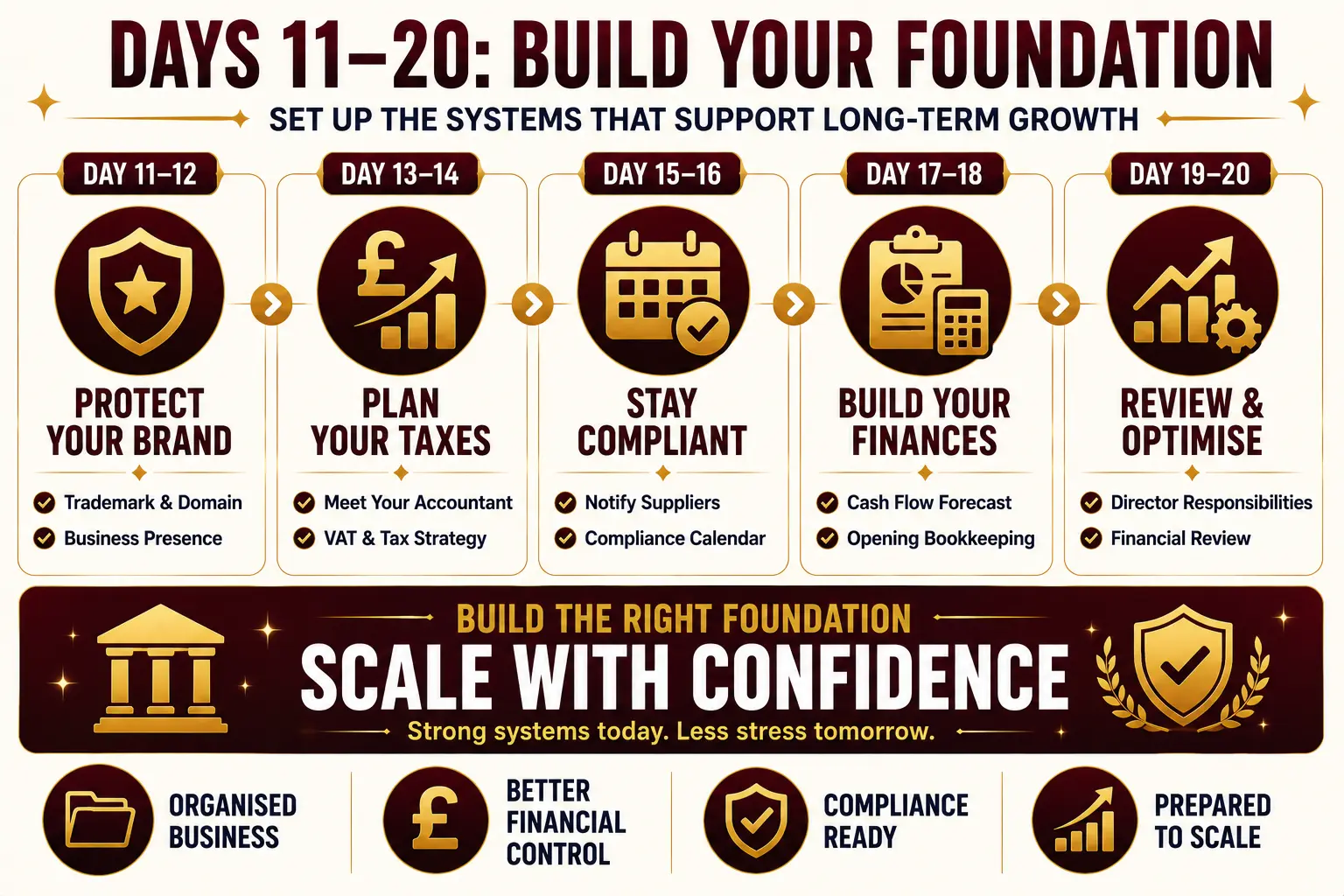
Day 11: IP and Domain Registration: Protect Your Brand
Many founders register a company name and assume the brand is protected. It is not. Your Companies House registration only prevents another company from using the same name. It does not protect your brand.
- Trademark registration (UK IPO): From £170 per class. Covers name, logo, or slogan. Apply at ipo.gov.uk .
- Domain names: Register .com and .co.uk simultaneously. If you are in another country, register that country TLD too. Use Namecheap, GoDaddy, or Google Domains.
- Copyright: Automatic in the UK for original creative works. No registration needed. Keep dated evidence of creation just in case.
Days 12 to 13: Customer Communications and Professional Presence
Update all customer-facing touchpoints with your new company details. Under UK law, your registered company number, registered office address, and company status must appear on your website and all business correspondence.
- Email signature (company name, number, registered address)
- Website footer (registered details, ICO number if collecting data)
- Business cards and letterheads
- LinkedIn company page
- Any existing contracts with customers: update to reflect company entity
Note: If you are collecting any personal data from customers or website visitors, you must register with the ICO (Information Commissioner’s Office), typically £40 to £60/year.
Day 14: Tax Planning Review with Your Accountant
This is one of the highest-value conversations you will have in your first month. Many founders overpay tax in their first year simply because they did not plan ahead.
Topics to cover with your accountant
- Salary vs dividend split (highly tax-efficient for director-shareholders in the UK)
- When to register for VAT (mandatory above £90,000 turnover, optional below it)
- R&D tax credits (if applicable and valuable for tech/innovation businesses)
- Expenses you can legitimately claim from day one
The salary/dividend strategy alone can save a director £2,000 to £8,000 per year in tax versus taking a full salary. Worth 30 minutes of accountant time.
Days 15 to 16: Supplier Notifications and Compliance Calendar
Notify major suppliers of your new company details so they can issue invoices correctly. Your company name must appear on all purchase invoices for VAT reclaim purposes. This is a simple email or call, but it prevents a surprisingly common problem: supplier invoices made out to your trading name or personal name rather than your limited company. Then build your compliance calendar. This single step prevents most compliance failures. Use Google Calendar, Outlook, or a dedicated tool. The medium does not matter. What matters is that every deadline is visible and you have alerts set well in advance.
Critical dates to add for UK companies
- Corporation Tax return: 12 months after financial year end
- Corporation Tax payment: 9 months and 1 day after financial year end
- Confirmation Statement: annually (from incorporation date)
- Annual Accounts: 9 months after financial year end (private companies)
- VAT returns: quarterly (if registered)
- PAYE/RTI submissions: monthly or quarterly
Set reminders 2 to 4 weeks before each deadline. Missing a Confirmation Statement can result in a £5,000 fine and your company being struck off the register. The consequences are disproportionate to the 5 minutes it takes to file. For German companies, note that the Gewerbesteuererklärung (trade tax return) is due annually and failure to file carries its own penalty regime. Confirm all your country-specific dates with your local advisor.
Days 17 to 18: Financial Planning and Opening Bookkeeping
Forecast your first 12 months. This does not need to be complex. A simple spreadsheet with projected monthly revenue, fixed costs, and variable costs is enough to give you an early warning of cash flow problems.
Enter these opening balances in your accounting software
- Bank opening balance (your first deposit as a company)
- Any loans or investments received
- Any personal money you have advanced to the company (this becomes a Director’s Loan. Your accountant needs to know about it)
According to the Federation of Small Businesses. Cash flow problems, not profitability, are the leading cause of small business failure in the UK. Start tracking from day one. When building your forecast, include a specific line for tax liability. Many founders project revenue, deduct their known expenses, and think of the remainder as profit they can spend. In reality, 19 to 25% of that profit (depending on your company size and the Corporation Tax rate applicable to you) will be owed to HMRC. Building tax into your cash flow model from Month 1 prevents the all-too-common situation of reaching your tax payment date with insufficient funds.
Day 19: Director Obligations Deep Dive
Take an hour to read the Companies Act 2006 director duties, specifically Sections 171 to 177. These cover your duty to act within your powers, promote the success of the company, exercise independent judgement, avoid conflicts of interest, and not accept benefits from third parties. Ignorance is not a defence. Directors can be held personally liable for debts if they act fraudulently or continue trading while knowing the company is insolvent. D&O insurance protects against many (but not all) claims. Worth discussing with your accountant if you are in a higher-risk sector. with your accountant if you are in a higher-risk sector.
Two practical actions for Day 19: First, write a one-page summary of your company’s financial position as you understand it today: assets, liabilities, outstanding invoices, and cash in the bank. This is your baseline. Second, confirm with your accountant what your year-end date is and when your first set of statutory accounts will be due. Your year-end is typically either 31 March (aligned to the UK tax year) or the last day of the month in which you incorporated. Knowing this now means no surprises in 9 to 12 months.
Day 20: First Financial Review
Schedule a call or meeting with your accountant to review the first 3 weeks. Check that:
- All transactions are correctly categorised
- The bank reconciliation matches your bank statement exactly
- Your invoicing is set up, professionally formatted, and legally compliant
- Your tax registrations are confirmed and reference numbers received
- Your compliance calendar is built and shared with your accountant
If you are running solo without an accountant yet, conduct this review yourself using the above checklist. Be honest: if the books are already messy after 3 weeks, that is a signal to invest in professional support before it compounds. Many accountants offer an initial review session for a fixed fee of £100 to £250, which is often worth it even if you plan to handle bookkeeping yourself.
Days 21 to 30: Stabilise and Systematise
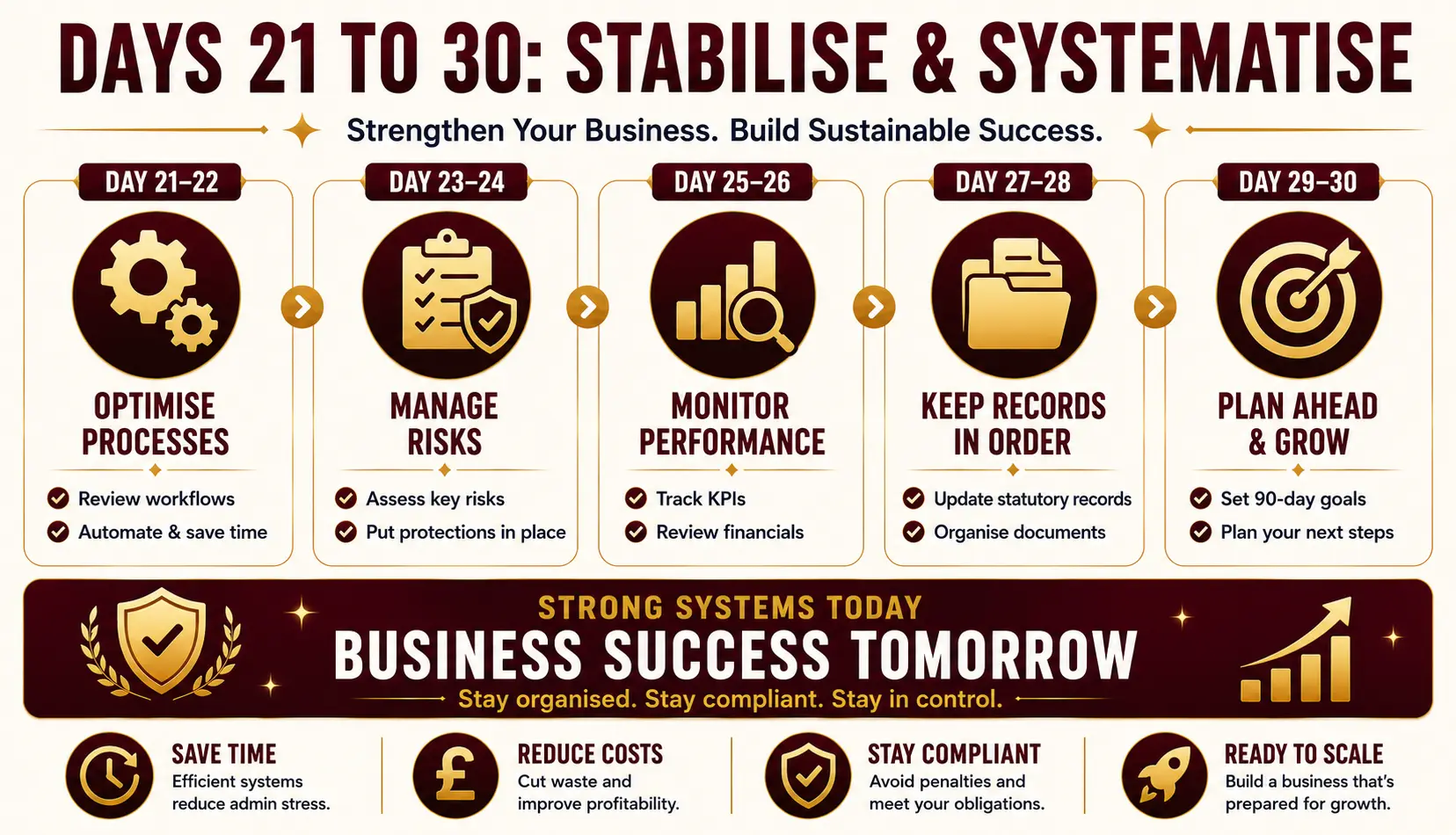
Days 21 to 22: First Reconciliation and Monthly Routine
Reconcile your bank account fully. Every transaction should have a category, a receipt (for expenses), and an invoice (for income). If anything is uncategorised, resolve it now. Small gaps compound into big problems at year-end.
Establish your monthly accounting routine
- Bank reconciliation: 1.5 to 2 hours (or 20 minutes if your software is connected to your bank)
- Invoice review: 30 minutes. Check what is overdue, chase anything 14+ days late
- Expense categorisation: 30 minutes
- Quick cash flow check: 15 minutes
Total: roughly 2.5 to 3 hours per month. Schedule it as a recurring calendar event. The first Friday of each month works well.
On Day 22, also review your invoicing: are there any outstanding invoices from your first few weeks of trading? Late payment is endemic in UK small businesses. Research from the Xero Small Business Insights report found that the average UK small business waits 27 days beyond terms to get paid.
Following up consistently from Week 3 signals to clients that you expect to be paid on time. A polite, automated payment reminder set to trigger at 7 days past due date costs nothing to configure in most accounting software and significantly improves cash flow.
Days 23 to 25: Automate, Document, and Delegate
Day 23: Recurring expense automation
Set up automatic payments for software subscriptions, insurance, and any recurring costs. Create a simple tracker so you know exactly what leaves your account each month. Subscription creep is real. A surprisingly common issue for growing businesses is paying for software tools that no one uses. A monthly 10-minute audit of recurring payments pays for itself quickly.
Day 24: Employee onboarding (if applicable)
If you have hired or are about to hire your first employee, ensure they have a written employment contract (legally required from day one of employment under the Employment Rights Act 1996), a completed HMRC starter checklist, and are correctly configured on your payroll system. Also confirm whether your sector has specific minimum wage requirements or collective agreements that affect pay rates.
Day 25: Process documentation
Document your invoice process, receipt tracking method, and monthly close routine. Store it in a shared location (Notion, Confluence, or a simple Google Doc). This feels premature when you are a one-person company. It becomes invaluable the moment you delegate, hire, or hand anything to an external bookkeeper. A 15-minute voice note walking through your process, transcribed and saved, is better than nothing.
Days 26 to 28: Forecasting, Account Optimisation, and Tax Reserves
Build a 12-month revenue and expense forecast. Even a rough one. The act of creating it reveals risks: seasonal dips, VAT registration thresholds approaching, or periods where payroll costs exceed projected revenue. Your forecast does not need to be precise. It needs to be honest. Founders typically overestimate revenue in the first 12 months and underestimate how long sales cycles take.
Build your forecast around three scenarios: conservative (you win 60% of expected clients), base case (you win your expected clients), and optimistic (you win 130% of expected clients). Knowing the conservative case ensures you plan for the downside without being paralysed by it. Review your business bank account features. Are you paying fees for things you do not need? Are there better alternatives? For UK founders, Starling Bank and Tide consistently rank highly for low-cost business accounts with strong accounting integrations.
Build your tax reserve now
Based on your forecast, estimate your first quarter’s Corporation Tax liability. Set aside that amount in a separate savings pot or sub-account. Being caught short at tax payment time is one of the most avoidable crises for new founders. A simple rule of thumb: set aside 20 to 25% of net profit each month into a separate tax savings account. When the bill arrives, you will already have it.
Day 29: Stakeholder Update
If you have investors or shareholders, send a brief written update: what you have set up, what is trading, what the plan is for the next 90 days. Even a single paragraph email establishes the communication cadence you intend to maintain. Good stakeholder communication from the earliest days serves a practical purpose beyond relationship management: it creates a record. If disputes arise later about company direction, decisions made, or expectations set, early written updates provide context and evidence. Keep them brief, factual, and forward-looking. If you do not have external investors, use Day 29 to update any informal advisors, mentors, or supporters who helped you get to incorporation. A short thank-you note with a brief status update costs nothing and maintains relationships you may need in future.
Day 30: Month 1 Review: Reflect and Plan Month 2
Sit down and answer three questions:
- What went well in the first 30 days?
- What was harder or more time-consuming than expected?
- Are you on track financially versus your original forecast?
Then plan Month 2 with concrete priorities: marketing, hiring, product development, or simply embedding the routines you built in Month 1.
Celebrate. Genuinely. You have done something most people only talk about.
Beyond 30 Days: Your Ongoing Compliance Rhythm
Use this rhythm to stay ahead of obligations year-round:
| Frequency | Task | Time Required | Who |
| Monthly | Bank reconciliation + invoice review | 2 to 3 hours | Founder or bookkeeper |
| Monthly | Chase overdue invoices | 30 mins | Founder |
| Quarterly | VAT return (if registered) | 1 to 2 hours | Accountant |
| Quarterly | Tax planning review with accountant | 1 hour | Founder + Accountant |
| Quarterly | Financial forecast update | 1 to 2 hours | Founder |
| Annually | Annual accounts preparation | Varies | Accountant |
| Annually | Corporation Tax return | Varies | Accountant |
| Annually | Confirmation Statement (Companies House) | 15 mins | Founder or agent |
| Annually | Insurance renewal review | 30 mins | Founder |
| Annually | Director review of company strategy | 2 to 4 hours | Board/Directors |
How to Choose the Right Accountant for a New Company
An accountant is the single most important professional relationship for a new company. The wrong one costs you money through bad advice and missed opportunities. The right one effectively pays for themselves through tax efficiency alone. Here is what to look for.
Specialist vs Generalist
A generalist accountant handles everything from sole traders to large limited companies. A specialist focuses on a sector (tech startups, creative industries, property) or company type (venture-backed, owner-managed). For most new founders, a specialist in owner-managed small businesses with experience in your industry is the ideal. Ask any potential accountant: what percentage of your clients are similar to me in terms of size, sector, and stage? If the answer is less than 30%, keep looking. You want someone who solves your specific problems every day, not someone for whom you are an unusual edge case.
Fixed Fee vs Hourly Billing
Most small business accountants now offer fixed-fee packages. This is far preferable to hourly billing for new founders. You know exactly what you are paying, there is no incentive to overcomplicate things, and there are no bill-shock moments at year end.
Typical fixed-fee package inclusions for a small UK limited company
- Annual statutory accounts preparation and filing with Companies House
- Corporation Tax return preparation and filing with HMRC
- Confirmation Statement filing
- Quarterly bookkeeping review
- Director Self Assessment tax return
Expect to pay £800 to £2,500 per year for a comprehensive package covering all of the above. Firms charging significantly less than this are likely cutting corners or limiting their scope. Firms charging significantly more should be able to articulate clearly what justifies the premium.
The First Meeting: Questions to Ask
Treat your first meeting with a potential accountant as an interview. You are hiring them.. You are hiring them.
- How do you communicate with clients: email, phone, or portal?
- Who will actually handle my account day-to-day?
- What accounting software do you work with, and will I have access?
- How do you handle HMRC inquiries if one is opened against my company?
- Can you give me an example of tax planning advice you have given to a client at my stage?
The last question is especially revealing. A good accountant will have a concrete, specific example. An average one will give you a generic answer about ‘salary and dividends.’ An excellent one will ask about your specific situation before answering.
Case Study: How One Founder Saved £6,400 in Year One Through Proper Setup
James incorporated a digital marketing consultancy in Birmingham in January. He had previously traded as a sole trader and was accustomed to paying himself everything he earned. His new accountant, engaged on Day 5, immediately restructured his remuneration: a salary of £12,570 (the personal allowance threshold) and the remainder as dividends. The accountant also identified that James’s home office, broadband, phone, and professional development costs were all legitimate deductible expenses he had not been claiming. Combined with the dividend strategy, James paid £6,400 less in tax in his first year as a limited company than he had expected. This more than covered the £1,200 accountant fee many times over. The difference was not clever accounting; it was simply having the right conversation on Day 5 rather than at year-end.
5 Costly Mistakes Founders Make in Month 1 (And How to Avoid Them)
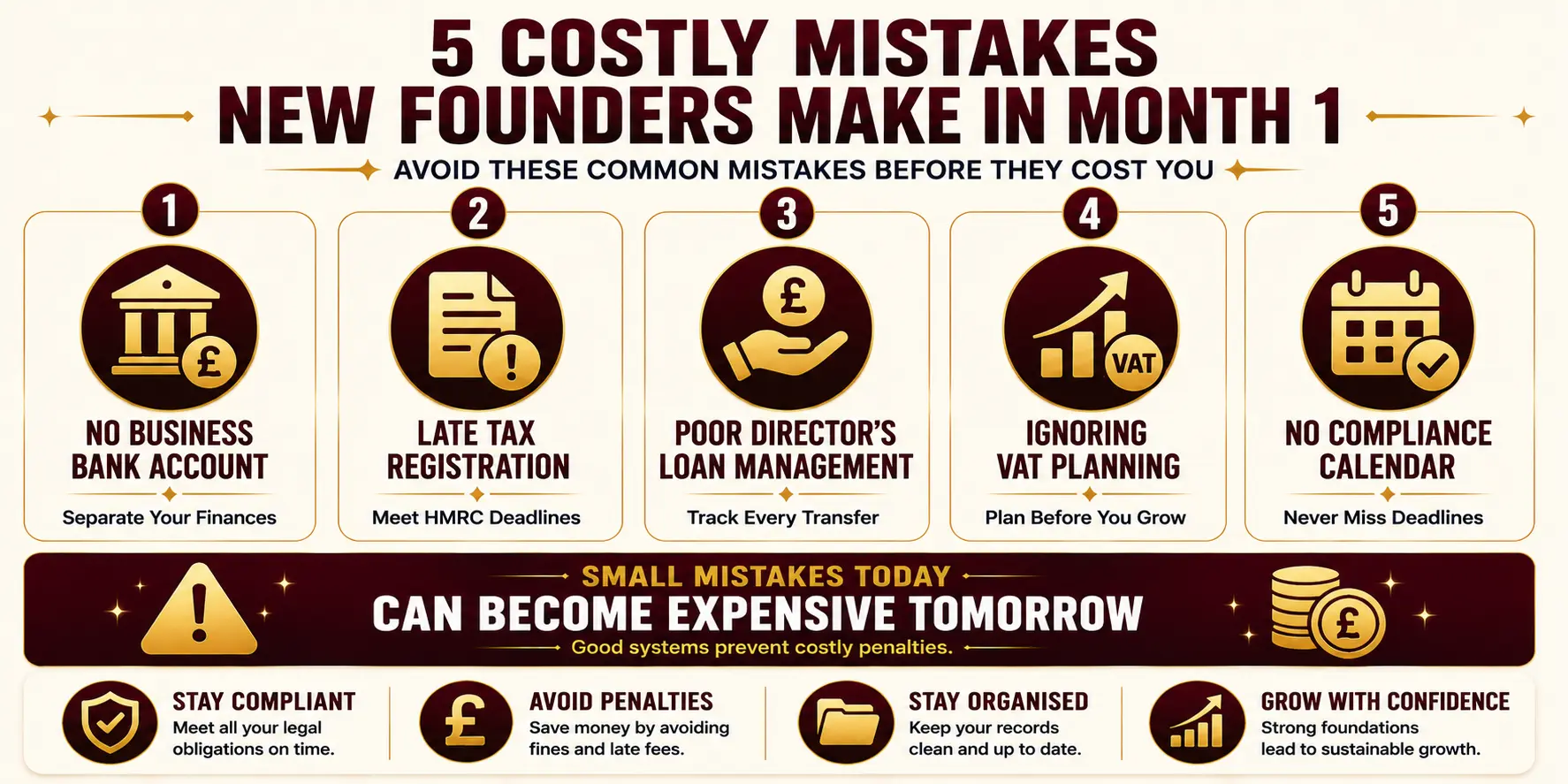
Mistake 1: Delaying the Business Bank Account
Founders often delay this because the application seems tedious or because their first bank application is rejected. Every day you use a personal account creates reconciliation work. Start the application on Day 6 without exception. If your first choice of bank rejects you (common for high-risk sectors like crypto, adult entertainment, or high-volume cash businesses), apply elsewhere immediately rather than continuing to use your personal account. Most digital banks have lighter underwriting requirements than traditional banks and can open an account within 24 to 48 hours online.
Mistake 2: Missing the Corporation Tax Registration Window
HMRC’s 3-month deadline from trading start is firm. Late registration triggers automatic penalties starting at 10% of unpaid tax, rising to 20% for delays of more than 6 months. Critically, ‘starting to trade’ does not mean receiving your first invoice payment. It means beginning any commercial activity. Signing a contract, purchasing stock, or even just advertising your services can count as starting to trade. Register as soon as you take any step toward generating revenue, even if that revenue has not yet arrived.
Mistake 3: Treating the Director’s Loan Account Casually
Taking money from the company bank account for personal use without recording it as a Director’s Loan or salary is one of the most common issues HMRC investigates in owner-managed company audits. Every transfer between company and personal accounts needs to be documented. Director’s Loans that remain outstanding 9 months after the company’s year-end are subject to an additional S455 tax charge (currently 33.75% of the outstanding balance). This charge is repayable when the loan is repaid, but in the meantime represents a significant cash flow cost. Always talk to your accountant before moving company money to personal accounts.
Mistake 4: Ignoring VAT Planning
If your annual turnover is approaching £90,000 (the 2024 to 2025 UK VAT registration threshold), you may want to register for VAT voluntarily before hitting the threshold, or plan your revenue timing carefully. Surprise mandatory VAT registration with retroactive liability is expensive. But VAT planning is not just about the threshold. There are several VAT schemes worth knowing about: the Flat Rate Scheme (potentially beneficial for service businesses with low VAT on purchases), Cash Accounting (you only pay VAT when you are paid, rather than when you invoice), and Annual Accounting (a single VAT return per year). Your accountant should walk you through these options in your Day 14 tax planning session.
Mistake 5: No Compliance Calendar
Filing deadlines are not intuitive. Without a calendar, founders miss them. The Confirmation Statement alone (a 5-minute annual filing) carries a £5,000 fine if missed and can result in your company being struck off. But the Confirmation Statement is just one of many deadlines. Annual accounts, Corporation Tax returns, VAT returns, PAYE submissions, and Self Assessment returns all have separate deadlines that can fall at different times of year depending on your company’s year-end. A missed deadline is almost never the result of an unwillingness to comply. It is almost always the result of not knowing the deadline existed. Build the calendar on Day 16 and share it with your accountant on the same day.
Quick reference: UK compliance penalties you want to avoid:
| Obligation | Deadline | Penalty for Missing |
| Corporation Tax registration | 3 months from trading start | 10 to 30% surcharge on unpaid tax |
| Confirmation Statement | 1 year from incorporation | Up to £5,000 fine + potential strike-off |
| Annual Accounts (private company) | 9 months after year-end | £150 to £1,500+ depending on how late |
| VAT registration (mandatory) | Within 30 days of exceeding £90k threshold | Up to 15% of VAT due from late registration date |
| Employers’ Liability Insurance | Before first employee starts | Up to £2,500 per day without valid insurance |
| PAYE registration | Before first payday | Interest + penalties on unpaid PAYE |
Final Thoughts
The founders who build successful, smoothly-run businesses are not necessarily smarter or better funded. They are simply more organised at the start. The systems you build in your first 30 days (clean accounts, a compliance calendar, a dedicated bank account, statutory records) compound over time into a company that runs efficiently and avoids nasty surprises. Think of the first 30 days as infrastructure. You would not build a house without laying foundations. The compliance and financial systems you establish now are the foundations on which your business will grow. Rush them, and every subsequent step is built on unstable ground. Take the time to do them properly, and everything that follows (hiring, fundraising, scaling, eventually selling or passing on the business) happens on solid footing. One final thought: most of what this guide covers is not optional, nor is it especially difficult. It is simply unfamiliar. The reason most founders struggle in their first 30 days is not lack of intelligence or effort. It is lack of a roadmap. You now have one. Work through it day by day. Do not try to do everything at once. Tick each item off in sequence and by the end of Month 1 you will have done what most founders spend their first year scrambling to catch up on. Use this guide as your business startup checklist. And when Month 1 is complete, come back to the Beyond 30 Days section and repeat the cycle: monthly, quarterly, annually. The first 30 days are the hardest part. After that, it is just rhythm.