Amazon sellers face a defining choice within their first few years in business: remain a sole trader or incorporate as a limited company. Choose incorrectly, and you risk overpaying anywhere from £3,000 to £15,000 per year in unnecessary tax. Choose well, and you build a scalable, protected, and tax-efficient business that can expand across the UK and Europe.
Most guides treat Amazon seller company formation as a generic business question. It is not. Amazon FBA sellers face a set of structural pressures that ordinary small businesses never encounter. Pan-European inventory obligations, cross-border VAT triggers that activate from the first unit of stock stored in a foreign warehouse, marketplace payment routing rules, and rapid revenue scaling all make a decision structure with real financial consequences.
In 2026, these pressures are more acute than ever. Amazon introduced a 1.5% fuel and logistics surcharge on FBA fulfilment fees across the UK, Germany, France, Italy, Spain, Poland, Sweden, the Netherlands, Ireland, and Belgium from 17 April 2026. This compresses seller margins and makes tax-efficient structuring even more financially impactful. At the same time, Amazon also lowered its base EU fulfilment fees by an average of £0.15 per unit for 2026, so sellers who get their structure right can capitalise on that improvement rather than losing it to avoidable tax.
Your company structure directly affects the following:
- Tax liability: corporation tax versus income tax versus self-employment National Insurance contributions
- Personal liability: especially exposure to product liability claims arising from imported goods
- VAT registration timing and compliance across multiple jurisdictions
- Access to business banking accounts, payment processors, and marketplace seller accounts
- Your ability to bring in co-founders, investors, or eventually exit the business at a favourable valuation
This guide is written specifically for Amazon and FBA sellers, not generic entrepreneurs. Whether you are at £30,000 in annual revenue and wondering whether you need a company at all, or operating at £300,000 and considering whether a European entity makes sense alongside your UK limited company, you will find concrete and actionable answers in the sections that follow.
Do You Actually Need a Company?
The honest answer is: not always, and not immediately. The financial penalty runs in both directions. Forming a company too early wastes money on unnecessary accountancy fees and compliance work. Forming too late means years of overpaying income tax and National Insurance contributions at rates that a limited company structure would have avoided.
When a Sole Trader Structure Works Well
Operating as a sole trader, meaning as a self-employed individual, is entirely legal and often the most practical starting point for a new Amazon business. You can run a fully operational FBA business, maintain supplier relationships, hold inventory, and manage your Seller Central account without any company formation requirements.
Sole trader status works well when the following conditions apply:
- Annual net profit sits below £30,000
- You are testing a product category or niche before committing to significant inventory investment
- You sell exclusively within the UK and have not yet approached the VAT registration threshold
- You have no employees and face limited product liability exposure through the nature of your goods
- Your business is in its first one to two years and operational simplicity is more valuable than marginal tax savings
The 2026 Tax Comparison That Actually Matters
UK corporation tax rates for 2026/27 are confirmed unchanged from April 2023: 19% small profits rate on taxable profits up to £50,000, and 25% main rate on profits above £250,000, with marginal relief tapering between the two thresholds.
The following table shows the real difference in tax burden across common Amazon seller profit levels, using confirmed 2026/27 rates. The Ltd Company column assumes an optimised salary and dividend structure with personal allowance fully utilised.
| Annual Net Profit | Sole Trader Tax Plus NI | UK Ltd Total Tax (2026/27) |
| £30,000 | Approx £6,400 (21%) | Approx £5,100 (17%) |
| £50,000 | Approx £13,500 (27%) | Approx £9,800 (20%) |
| £100,000 | Approx £34,000 (34%) | Approx £19,500 (20%) |
| £150,000 | Approx £58,500 (39%) | Approx £29,000 (19%) |
| Extra accountancy cost/yr | n/a (sole trader baseline) | £1,200 to £2,500 above sole trader cost |
Source: HMRC confirmed rates 2026/27. Corporation tax 19% on profits up to £50,000, 25% above £250,000. Ltd figures assume salary at personal allowance (£12,570) with the remainder as dividends. Individual results vary.
At £100,000 profit, the tax saving from operating through a limited company is approximately £14,500 per year. The additional accountancy cost of running a company is roughly £1,500 to £2,000 per year above sole trader accounting. The net annual benefit is therefore around £12,000 to £13,000. That is a material sum that compounds significantly over multiple trading years.
Personal Liability: The Risk Sole Traders Underestimate
Tax is the obvious reason to incorporate. Liability is the less obvious but equally important one. As a sole trader, your personal assets including your home, savings, and personal bank accounts are exposed to business debts and legal claims.
For Amazon FBA sellers, this matters for a specific reason. If you import goods from overseas manufacturers and a customer suffers harm or loss due to a product defect, you are the importer of record and the legally responsible party under UK product safety legislation. Claims of this nature can easily exceed the value of your entire Amazon business. A limited company creates a legal boundary between your personal finances and those of the business.
A Practical Decision Framework for 2026
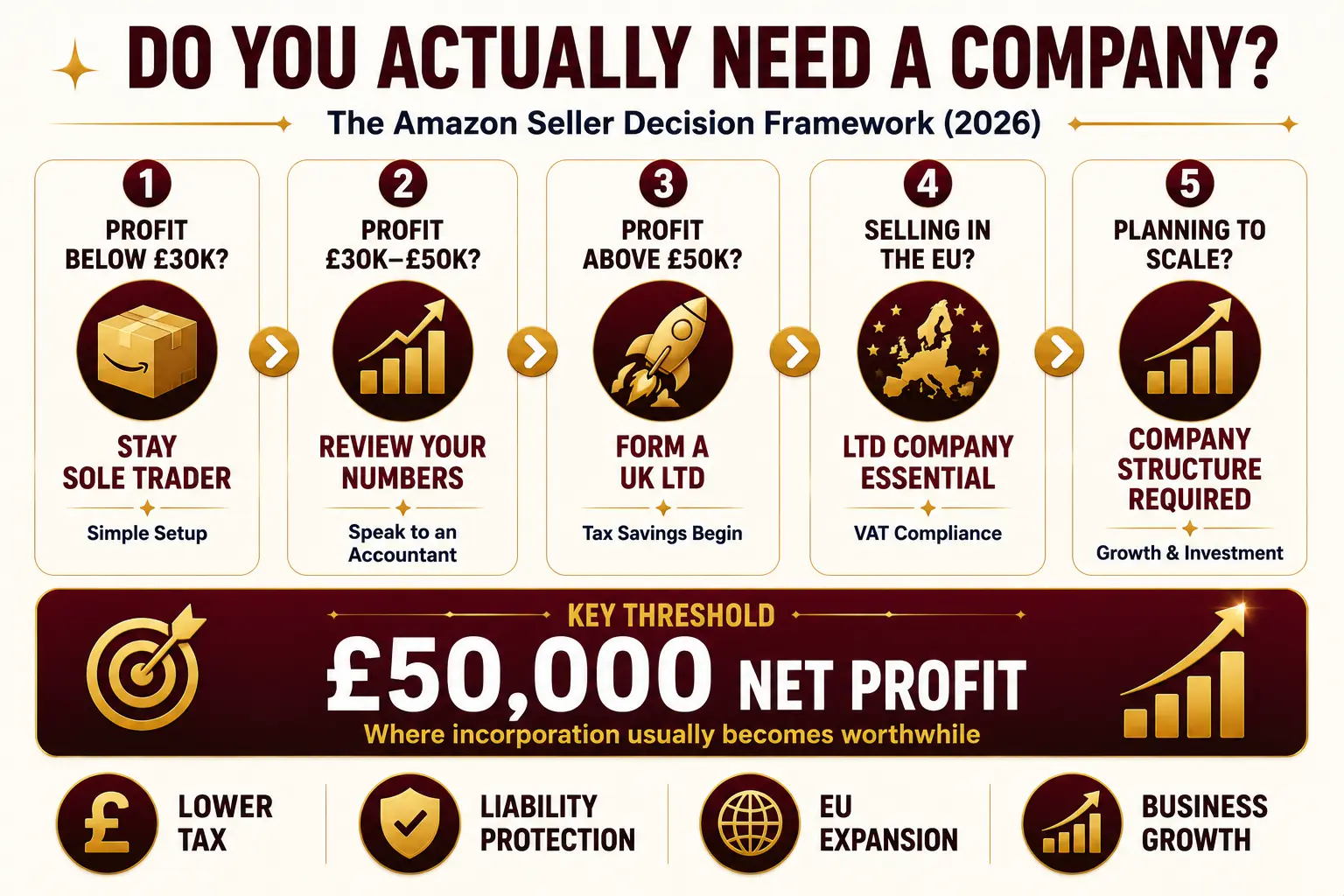
- Annual profit below £30,000: Stay as a sole trader and review the decision in twelve months as revenue grows.
- Annual profit between £30,000 and £50,000: Model the numbers with a specialist accountant. The decision depends on your specific tax position.
- Annual profit above £50,000: Incorporate without delay. The tax savings from Year 1 alone justifies the cost.
- Selling via FBA in the EU: A limited company structure is practically essential for clean VAT compliance and supplier credibility.
- Planning to raise investment or sell the business: Company structure is non-negotiable. Investors and acquirers do not buy sole trader businesses.
UK Limited Company for Amazon Sellers in 2026
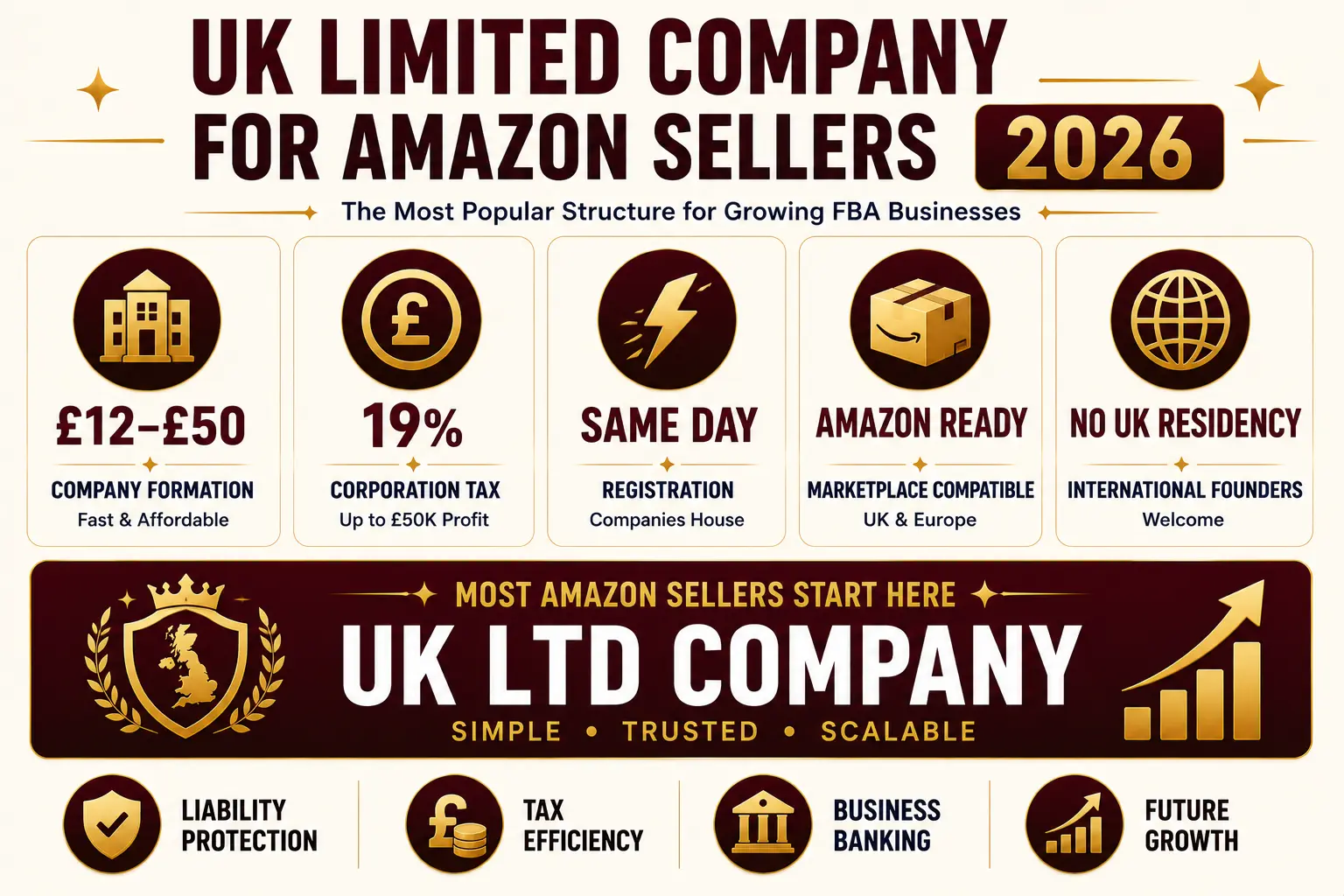
The UK limited company remains the default choice for the majority of Amazon sellers operating in or into the UK market in 2026. It is well understood by Amazon’s platform, payment providers, business banks, and international suppliers. It is also one of the fastest and cheapest company formations available anywhere in the world.
Why the UK Ltd Remains the Starting Point for Most Sellers
- Formation cost of £12 to £50 via Companies House, with same-day registration available if submitted before 3pm
- Corporation tax of 19% on profits up to £50,000 (2026/27 confirmed rate), rising to 25% on profits above £250,000
- Global credibility: the UK Ltd structure is recognised and trusted by Amazon, international suppliers, and logistics providers worldwide
- Banking compatibility: Stripe, Wise Business, Payoneer, Monzo Business, and Tide all offer straightforward account opening for UK limited companies
- Marketplace compatibility: Amazon Seller Central processes UK Ltd accounts without friction across all European marketplaces
- No residency requirement: company directors do not need to live in the UK, making it suitable for international sellers targeting the UK and European markets
Formation Cost and Timeline
UK company formation is genuinely simple and fast compared to most other jurisdictions:
- Self-filing via Companies House: £12, same-day registration when submitted online before 3pm
- Via a formation agent: £50 to £150, often including a registered address for the first year
- VAT registration: free to apply, typically taking four to eight weeks for HMRC to process
- Business bank account: one to three weeks via digital banks such as Tide, Monzo Business, or Starling
The total cost to establish a compliant UK limited company with a business bank account and VAT registration is typically between £200 and £500 in the first year, including accountancy support.
VAT Registration in 2026: When and Why It Matters
The UK VAT registration threshold for 2026/27 remains at £90,000 of taxable turnover in any rolling twelve-month period. This has been unchanged since 1 April 2024. The deregistration threshold sits at £88,000. Once you cross £90,000, you must notify HMRC within 30 days and begin charging VAT from your effective registration date. Source: HMRC, confirmed 2026.
For FBA sellers, voluntary registration before reaching this threshold continues to be the smarter financial move in 2026:
- Import VAT paid on stock entering the UK is fully reclaimable on your first VAT return once registered. At scale, this represents a significant cash benefit.
- Making Tax Digital for Income Tax (MTD for ITSA) is expanding in 2026 to sole traders and landlords with income above £50,000. VAT-registered businesses are already in the MTD ecosystem, making the transition simpler.
- Business-to-business customers expect a VAT number on invoices and cannot reclaim input tax without one.
- If you sell to EU consumers via Amazon’s European fulfilment programmes, VAT obligations in those countries begin from your very first sale, not at any threshold.
Banking for Your Amazon Account in 2026
Amazon pays seller proceeds into a bank account registered to the seller’s country of operation. For a UK limited company, you need a UK business bank account. The most commonly used options among Amazon FBA sellers are:
- Tide: Fast account opening process, strong integration with Amazon payouts, and FCA regulated. Popular among early-stage sellers.
- Monzo Business: Strong mobile app experience, integrates with Xero and QuickBooks, and suits sellers who want all financial activity in one view.
- Wise Business: Multi-currency accounts in GBP, EUR, USD, and more. Strongly recommended for sellers operating across UK and EU marketplaces simultaneously.
- HSBC or NatWest: Traditional banks offering trade finance, credit facilities, and merchant services for higher-revenue sellers who need structured credit products.
Case Study: UK Seller at £100,000 Annual Revenue (2026 Rates)
Case Study: Sophie, UK Homeware Seller
Revenue: £100,000 per year. Net profit margin: 22%, giving £22,000 net profit. Selling exclusively on Amazon UK via FBA. Sole trader for her first two years.
As a sole trader: Income tax plus National Insurance on £22,000 profit totalled approximately £6,200 per year.
As a UK Ltd: Corporation tax on £22,000 at 19% (2026/27 small profits rate) equals £4,180. Sophie draws £12,570 salary (within personal allowance, no income tax) and takes the remainder as dividends at 8.75%. Total tax: approximately £3,800.
Net saving by incorporating: approximately £2,400 per year at her current profit level.
Projected saving at £50,000 net profit (her Year 3 target): more than £8,000 per year.
Sophie was incorporated in Year 3. Her accountant calculated the transition cost at £1,800, including company setup, bank account, and first-year company accounts. The investment paid back within three months of tax savings.
European Options in 2026: Germany, Poland, and the Netherlands
Post-Brexit, UK sellers expanding to Amazon.de, Amazon.fr, Amazon.it, and Amazon.es face a genuine question: should they operate through their existing UK Ltd company with EU VAT registrations added on top, or form a dedicated European legal entity?
In most cases, adding EU VAT registrations to a UK Ltd is sufficient up to approximately £150,000 in European revenue per year. Above that level, or when you want a stronger local market presence in a specific country, forming a European entity becomes worth considering. Here is how the main options compare for 2026.
Germany: The GmbH
The GmbH is Germany’s limited liability company and the standard choice for businesses with serious German market ambitions. Germany remains the largest Amazon marketplace in Europe and accounts for a substantial share of total European FBA revenue for most UK sellers.
- Formation cost: approximately 750 to 2,500 euros, including mandatory notarisation
- Minimum share capital: 25,000 euros, of which only 12,500 euros must be paid in at the point of formation
- Corporate tax rate: 15% Korperschaftsteuer plus approximately 14% trade tax (Gewerbesteuer), producing an effective combined rate of around 29%
- Formation timeline: four to eight weeks due to notarisation and court registration requirements
- Best suited for: sellers with significant German revenue who want to present as a German domestic business to local suppliers, logistics partners, and institutional buyers
Poland: The Sp. z o.o.
The Polish limited liability company is the most cost-effective serious European structure available to Amazon sellers in 2026. Poland hosts key elements of Amazon’s Central European fulfilment network and is increasingly important for FBA logistics across the entire region.
- Formation cost: approximately 250 PLN (around £50) via the online S24 registration portal
- Minimum share capital: 5,000 PLN, approximately £1,000 at current exchange rates
- Corporate income tax: 9% for small taxpayers with revenue below 2 million euros; 19% at the standard rate above that
- Formation timeline: one to three weeks via the S24 online system, with no notary requirement
- Pan-EU FBA access: Poland is a mandatory VAT registration country for Pan-European FBA in 2026. Having a Polish entity simplifies compliance and can improve relationships with Amazon’s local logistics teams.
- Best suited for: cost-conscious sellers wanting genuine EU incorporation with a highly competitive 9% tax rate on profits up to the 2 million euro threshold
Netherlands: The BV
The Dutch BV is favoured by international sellers building a European holding structure or capitalising on the Netherlands’ position as one of Europe’s most significant logistics hubs. Rotterdam and Amsterdam Schiphol handle enormous volumes of inbound goods from Asia.
- Formation cost: approximately 1,500 to 3,000 euros
- Minimum share capital: one euro (nominal requirement only)
- Corporate tax: 19% on the first 200,000 euros of profit; 25.8% on profit above that level
- Participation exemption: dividends received from subsidiaries are exempt from Dutch corporate tax, making the BV an effective European holding vehicle for multi-entity structures
- Formation timeline: three to six weeks
- Best suited for: sellers building a multi-country European structure who want a tax-efficient holding company, or those using Dutch FBA warehousing for broader European distribution
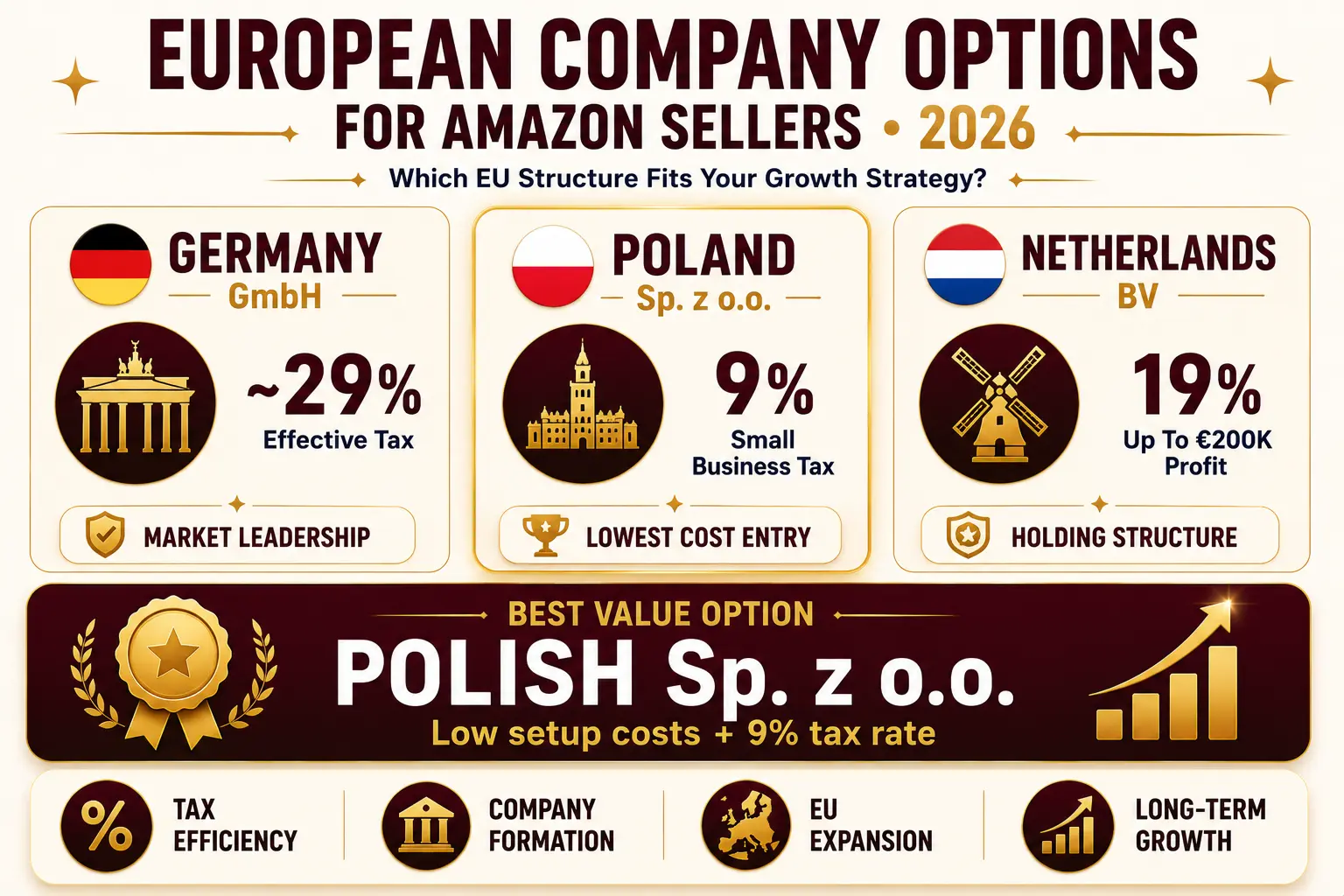
European Entity Comparison Table (2026)
| Factor | UK Ltd | German GmbH | Polish Sp. z o.o. | Dutch BV |
| Formation cost | £12 to £150 | 750 to 2,500 euros | ~50 euros online (S24) | 1,500 to 3,000 euros |
| Share capital | £1 minimum | 25,000 euros | 5,000 PLN (~£1,000) | 1 euro nominal |
| Corp tax 2026 | 19% (up to £50K) / 25% | ~29% effective | 9% (up to €2M) / 19% | 19% (up to €200K) / 25.8% |
| Formation time | Same day | 4 to 8 weeks | 1 to 3 weeks | 3 to 6 weeks |
| Notary required | No | Yes, mandatory | No, online S24 system | Yes |
| Ideal use case 2026 | UK and global ops | German market focus | Budget EU entry, 9% tax | European holding structure |
When Each Country Makes Sense in 2026
- UK Ltd: You are starting out, based in the UK, or want the simplest possible setup. Works as a base for EU VAT registrations without a separate EU entity below around £150,000 in European revenue.
- German GmbH: Your German marketplace revenue exceeds £200,000 per year and you want to present as a German domestic business with full local credibility to suppliers, distributors, and B2B customers.
- Polish Sp. z o.o.: You want genuine EU incorporation at the lowest possible cost, with access to Pan-EU FBA warehousing and a 9% corporate tax rate on profits below 2 million euros. Particularly compelling in 2026 given Poland’s growing role in Amazon’s European fulfilment network.
- Dutch BV: You are building a multi-country structure and want a tax-efficient European holding company that benefits from the participation exemption on subsidiary dividends.
VAT Strategy in 2026: The Most Important Topic for Amazon FBA Sellers
VAT is where Amazon sellers lose the most money. The losses come from two directions: penalties and back taxes from non-compliance, and missed reclaim opportunities from failing to register at the right time. In 2026, Amazon itself is increasingly obligated under UK and EU regulations to police VAT compliance among third-party sellers. Non-compliant sellers risk not just HMRC penalties but also account suspension, frozen payouts, and loss of the Buy Box.
UK VAT in 2026: The £90,000 Threshold and When to Ignore It
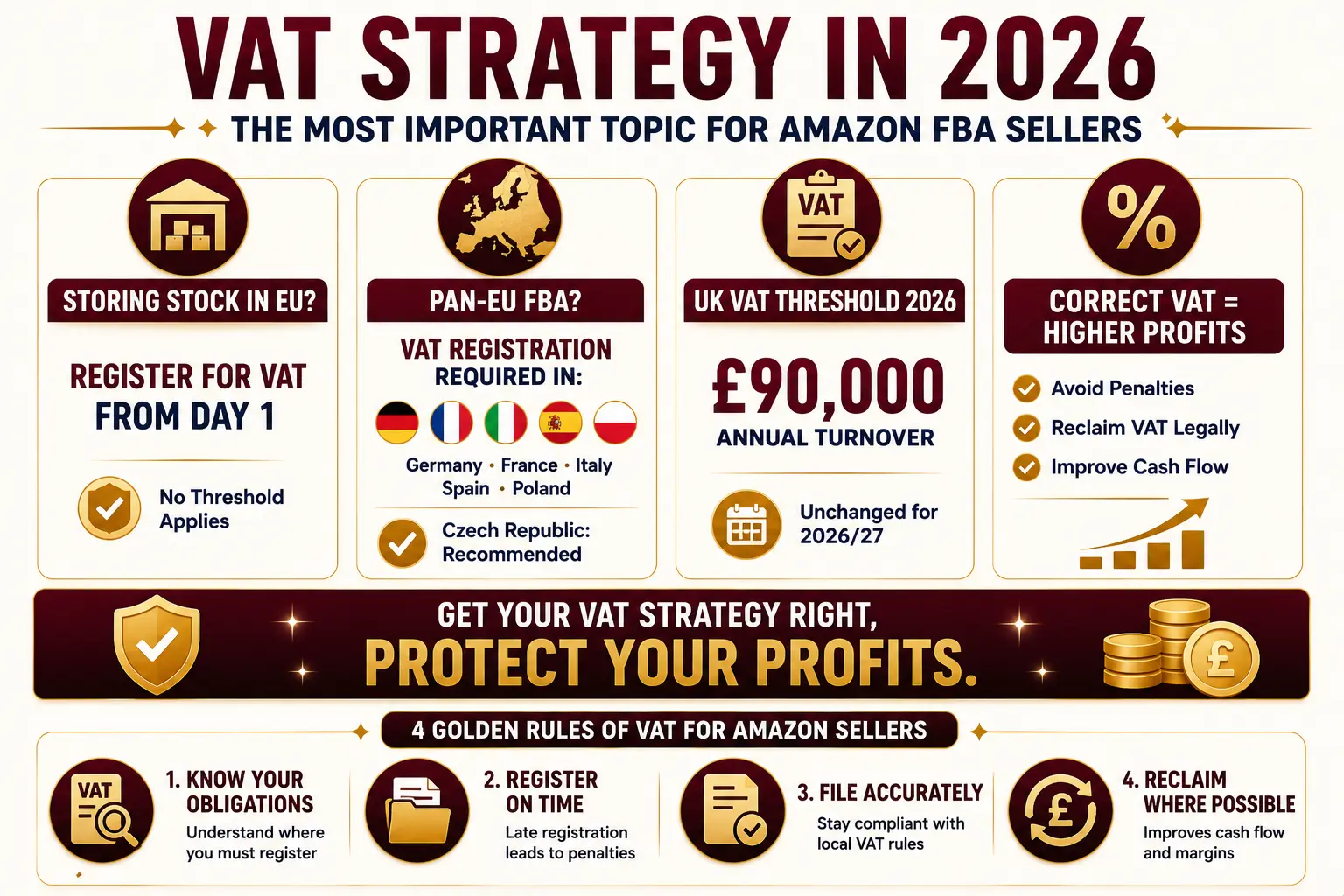
The UK VAT registration threshold for 2026/27 remains at £90,000 in taxable turnover over any rolling twelve-month period. The deregistration threshold is £88,000. Both figures have been unchanged since 1 April 2024. Once you exceed £90,000, you must notify HMRC within 30 days of the end of the month in which you crossed the threshold.
For FBA sellers, voluntary registration before the threshold is often the more financially intelligent decision in 2026:
- Import VAT paid when stock enters the UK is fully reclaimable on your next VAT return. At higher import volumes this reclaim is substantial.
- Making Tax Digital is expanding in 2026. VAT-registered sellers are already operating within the MTD framework and will face a simpler transition as MTD for Income Tax rolls out to higher-income sole traders.
- Business buyers cannot reclaim input tax without a valid VAT number on your invoice, making you less competitive against VAT-registered suppliers.
- Voluntary registration removes the risk of unexpectedly crossing the threshold mid-shipment and being liable for output VAT on sales made before your registration was processed.
EU VAT in 2026: The Rule That Continues to Catch Sellers Off Guard
This remains the most misunderstood and most costly compliance area in Amazon FBA. The moment you store inventory in an EU country, you are legally required to register for VAT in that country from the very first sale. There is no minimum revenue threshold. No grace period. No exemption for small sellers.
In 2026, Amazon is legally required under UK and EU marketplace legislation to ensure VAT compliance among its third-party sellers. The platform actively enforces this, and non-compliant sellers face listing blocks, withheld payouts, and removal from Pan-European programmes.
This obligation applies in the following scenarios which are common among growing FBA businesses:
- Amazon Pan-European FBA (2026): Amazon distributes your inventory across Germany, France, Italy, Spain, and Poland. You must have active VAT registrations in all five countries before your goods arrive in any warehouse. Note: Czech Republic registration is no longer mandatory for Pan-EU FBA as of 2026 but remains strongly recommended for optimal inventory distribution and CEP programme access.
- Amazon Central Europe Program (CEP): Amazon stores your stock in Germany, Poland, and the Czech Republic. You need VAT registrations in all three countries involved.
- Amazon European Fulfillment Network (EFN): You store stock in one country and Amazon ships cross-border. VAT obligations are simpler but you still need registration in the country from which stock ships.
The EU One-Stop-Shop Scheme in 2026
For cross-border distance selling within the EU where you are not physically storing stock in the buyer’s country, the OSS scheme continues to provide meaningful relief in 2026.
- A single quarterly VAT return is filed in one EU member state, your chosen OSS country of registration.
- This single return covers declared sales to consumers across all 27 EU member states.
- The scheme activates when your total EU cross-border B2C sales exceed 10,000 euros in a calendar year.
- OSS does not replace VAT registration in countries where you physically store FBA inventory. It only covers distance sales where stock ships cross-border from a single country.
Most growing Pan-EU FBA sellers in 2026 operate a hybrid model: standard local VAT registrations in each country where Amazon warehouses their stock, plus a single OSS registration to handle all other EU distance selling in one quarterly return. This is the recommended approach for any seller on Pan-EU FBA.
VAT Rates Across Key Amazon Markets in 2026
| Country | Standard VAT Rate | Key Implication for FBA Sellers in 2026 |
| United Kingdom | 20% | Threshold £90,000 (unchanged 2026); entirely separate from EU VAT system post-Brexit |
| Germany | 19% | Mandatory for Pan-EU FBA 2026; largest EU Amazon marketplace |
| France | 20% | Mandatory for Pan-EU FBA 2026; strong consumer market |
| Italy | 22% | Mandatory for Pan-EU FBA 2026; higher return rates in some categories |
| Spain | 21% | Mandatory for Pan-EU FBA 2026; fast-growing marketplace |
| Poland | 23% | Mandatory for Pan-EU FBA and CEP 2026; 9% corporate tax for Polish entity |
| Czech Republic | 21% | Required for CEP 2026; no longer mandatory for Pan-EU FBA but recommended |
| Netherlands | 21% | Key import and logistics hub; voluntary registration enables import VAT reclaims |
Import VAT Reclaim: Money Most Sellers Leave Behind
When goods are imported into the UK or an EU country, import VAT is charged at the border at the destination country’s standard rate. For most Amazon sellers importing from China or other Asian manufacturers, this represents a significant upfront cost on every shipment.
The import VAT is fully reclaimable on your next VAT return, provided the following conditions are met:
- You are VAT registered in the country where the goods were imported
- You hold the correct customs documentation (in the UK, this is the C79 certificate issued by HMRC)
- The goods are imported for business purposes and not personal use
To illustrate the scale of this opportunity: a seller importing £600,000 of goods into the UK per year pays approximately £120,000 in import VAT. Every penny of that is reclaimable as input tax. Sellers who delay VAT registration forfeit these reclaims permanently for any period before their registration date. This is a permanent and irreversible loss.
Stock and Inventory Tax Treatment
Inventory is the largest asset on most Amazon seller balance sheets and how you account for it has a direct impact on both your reported profitability and your tax liability. Mishandling inventory accounting is one of the more common and more costly mistakes made by growing FBA businesses.
What You Can Deduct as a Business Expense
Stock purchases are not immediately expensed in full against your income. Inventory is a balance sheet asset, not a trading expense. You deduct it as Cost of Goods Sold only in the accounting period when the stock is actually sold to a customer. This distinction matters because holding unsold inventory inflates your apparent profit in any given period if not accounted for correctly.
The following costs are legitimately deductible as business expenses for Amazon sellers in 2026:
- Product cost as shown on manufacturer or supplier invoices
- Import duties, freight, and shipping costs from origin to FBA warehouse
- Amazon FBA fulfilment fees, storage fees, and referral fees on completed sales (including the 1.5% fuel and logistics surcharge active from April 2026)
- Product inspection and quality control costs in the country of manufacture
- Product photography, graphic design, and listing creation costs
- Software subscriptions including Helium 10, Jungle Scout, and accounting tools
- Amazon advertising spend including Sponsored Products, Sponsored Brands, and DSP
- Professional fees for accountants, VAT agents, and legal advisers
Stock Valuation Methods
UK companies are required to apply one of the accepted stock valuation methods consistently from year to year. Switching methods requires justification and affects comparative financial statements.
- FIFO (First In, First Out): The most widely used method for Amazon sellers. Assumes that the oldest units of stock are sold first. Particularly accurate when you receive multiple shipments at varying unit costs throughout the year, which is the norm for FBA businesses.
- Weighted Average Cost: Averages the total cost of all available units. Simpler to maintain but less precise when per-unit costs fluctuate significantly between shipments. Acceptable under UK GAAP.
- LIFO (Last In, First Out): Not permitted under UK GAAP or IFRS. Do not use this method regardless of what accounting software might allow.
Writing Off Damaged, Lost, and Stranded Inventory
Amazon regularly loses, damages, or disposes of FBA inventory. These events generate both write-off opportunities and reimbursement income that must be correctly handled in your accounts.
- Inventory lost or damaged by Amazon: Deductible as a business loss at the cost price of the affected units. Amazon’s reimbursement for these events is taxable income in the period received.
- Inventory destroyed by Amazon due to unsellable status: Deductible at cost. Request destruction confirmation from Seller Central for your accounting records.
- Stranded inventory: Review your stranded inventory report monthly. Goods left stranded for extended periods incur long-term storage fees and the new 2026 fulfilment surcharge compounds this cost. If goods are ultimately destroyed, write off at original cost.
- Expired goods: Write off at cost value in the accounting period when the expiry date passes. Relevant for sellers in food, health, and beauty categories.
Recommended Accounting Software for Amazon Sellers in 2026
Manual bookkeeping becomes unworkable above approximately £30,000 in annual revenue. Amazon’s settlement reports are complex and the data needs to be mapped correctly into your accounting system. The most effective setups used by UK FBA sellers in 2026 are:
- Xero with A2X: The most popular combination among established UK Amazon sellers. A2X automatically maps Amazon settlement data into Xero, categorising fees, refunds, VAT, and inventory adjustments correctly. Handles multiple Amazon marketplaces simultaneously and is fully MTD compliant.
- QuickBooks with Link My Books: A strong alternative. Link My Books performs the same Amazon settlement mapping function and is particularly well suited to sellers who prefer the QuickBooks interface or have existing setups.
- Sage: Better suited to larger operations with dedicated finance teams or those requiring more complex inventory management integration. Generally considered more than needed for most FBA sellers below £1 million in revenue.
Scaling Timeline and Structure Changes
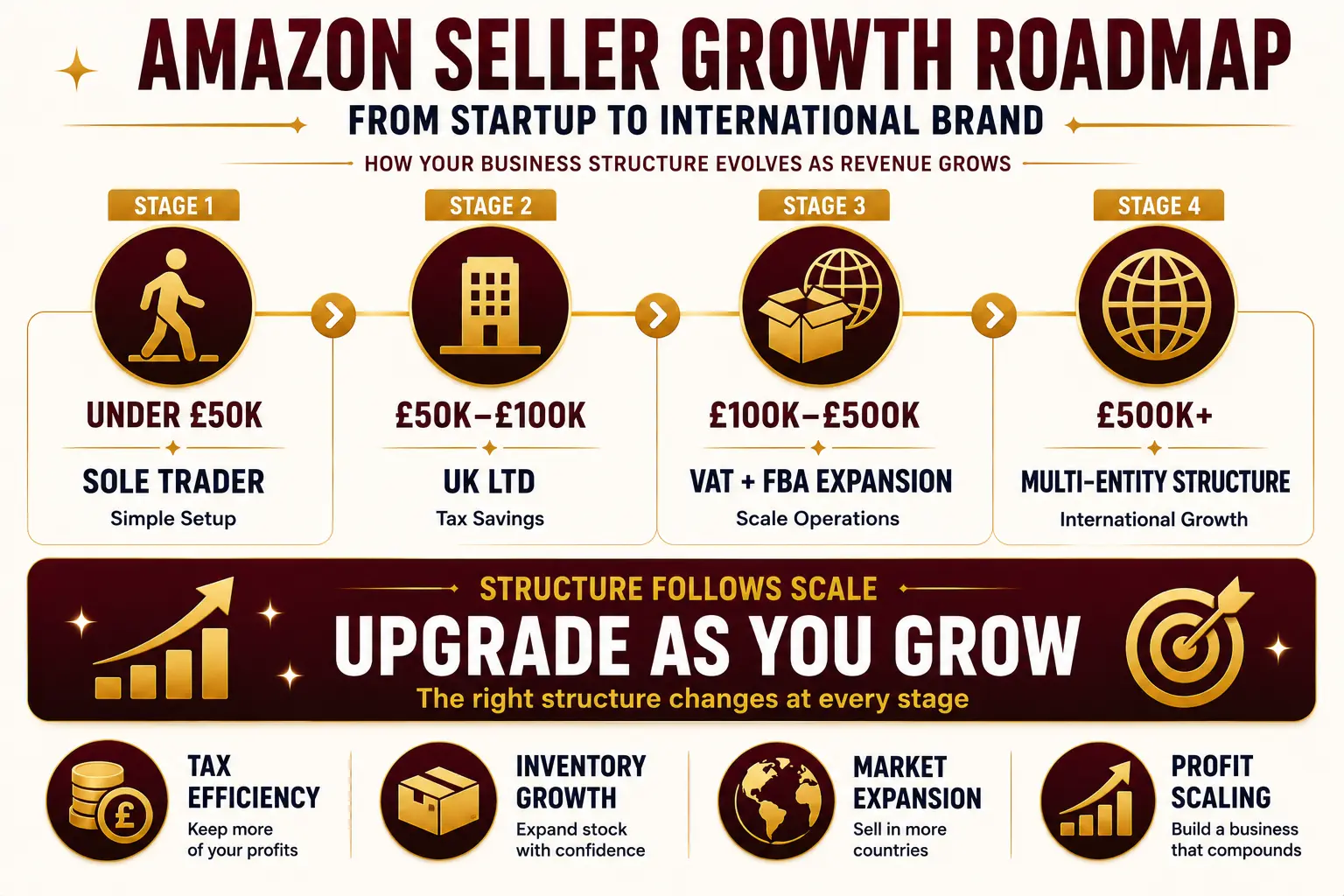
The optimal company structure for your Amazon business is not a permanent decision. It changes as your revenue grows, as you expand into new marketplaces, and as your operational complexity increases. Here is a practical roadmap aligned to common FBA revenue milestones in 2026.
Pre-£50,000 Revenue: Sole Trader Is Usually Appropriate
At this stage in your business, the tax saving achievable through a limited company structure is unlikely to exceed the additional accountancy and compliance costs. The priority should be building a sustainable and repeatable product and sales operation.
Key actions at this stage:
- Register as self-employed with HMRC if you have not already done so
- Open a dedicated bank account for business transactions even if it is a personal account used solely for Amazon income and expenses
- Keep clean and complete records of all inventory purchases, Amazon fees, shipping costs, and advertising spend. MTD for Income Tax is expanding and digital record-keeping habits built now will ease compliance later.
- Consider voluntary VAT registration if you are importing significant volumes of stock from outside the UK, as the import VAT reclaim may justify it even at lower revenue levels
£50,000 to £100,000: The Transition Zone
This revenue band is where the incorporate-or-wait decision becomes most pressing. At net profit levels approaching £50,000, a UK Ltd company will almost always produce a material tax saving from Year 1 that outweighs the additional compliance cost.
Recommended steps at this stage:
- Engage a specialist Amazon accountant to model the precise tax saving based on your specific income, drawings, and expenses
- Form a UK Ltd company via Companies House if the modelling confirms a net saving
- Open a dedicated business bank account under the company name
- Register for VAT proactively if approaching the £90,000 threshold or importing from outside the UK
- Implement accounting software with Amazon marketplace integration before the company’s first full trading period
£100,000 to £500,000: Company Structure Is Essential
At this scale, operating as a sole trader is leaving a significant and measurable amount of money on the table while simultaneously increasing your personal risk exposure.
Priorities at this stage include:
- Optimising your salary and dividend split with your accountant to minimise income tax and National Insurance using 2026/27 rates
- Filing quarterly VAT returns, or switching to monthly returns if you consistently receive large input VAT refunds from import activity
- Evaluating Pan-EU FBA programmes and their VAT implications, working with a specialist VAT agent to handle multi-country registrations
- Factoring the 2026 Amazon fuel surcharge (1.5% on EU FBA fees) into your unit economics and margin calculations
- Maintaining separate holding accounts for corporation tax, PAYE, and VAT to avoid cash flow surprises at payment dates
£500,000 and Above: Multi-Country Structures and International Planning
At this revenue level, a single UK limited company is likely no longer the optimal structure. The potential savings from a multi-entity international structure begin to exceed the professional fees required to establish and maintain it.
Options worth exploring at this scale:
- A European holding structure using a UK Ltd or Dutch BV as the parent company with subsidiary operating entities in key FBA countries
- Separate operating companies in Germany, Poland, or other high-revenue EU markets to take advantage of local tax rates and supplier relationships
- Transfer pricing arrangements between related entities, managed within HMRC and OECD guidelines, to optimise the allocation of profit across jurisdictions
- Intellectual property and trademark holding structures to protect brand value and create a defensible asset for an eventual business sale or licensing arrangement
Annual professional fees at this stage typically range from £5,000 to £20,000, but the achievable tax savings regularly run to multiples of that cost. The return on investment is material and compounding.
The Cost of Transitioning from Sole Trader to Limited Company
The transition from sole trader to limited company is straightforward for a product-based Amazon business and significantly less disruptive than most sellers expect. The key cost elements are:
- Company formation via Companies House: £12 to £150
- New business bank account: £0 to £60 per month depending on the provider and account tier
- Accountant fees for managing the transition: £500 to £1,500 as a one-off cost
- Inventory transfer from sole trader to company: normally completed at cost price with no tax event if structured correctly by your accountant
The entire transition including company formation, bank account opening, and the first set of company accounts can typically be completed within four to six weeks. Amazon Seller Central account transfers between entities require a support ticket but are routinely processed.
Real Amazon Seller Scenarios for 2026
Scenario One: Bootstrapped UK Seller at £30,000 Revenue
James: Pet Accessories on Amazon UK
Revenue: £30,000 per year. Net profit: £7,500 at a 25% margin. Sells exclusively on Amazon UK.
Recommendation: Remain as a sole trader for now.
At £7,500 net profit, James pays approximately £1,600 in income tax with no National Insurance contributions (below the small profits threshold). Incorporating would cost approximately £1,200 per year more in accountancy fees than he currently spends, which exceeds the potential tax saving.
James should revisit this decision when his annual revenue approaches £80,000 or when his net profit crosses £25,000, whichever comes first. He has enrolled in MTD for Income Tax in 2026, so his digital record-keeping is already in good shape for future transitions.
Scenario Two: Growing UK Seller at £120,000 Revenue
Emma: Kitchen Gadgets on Amazon UK
Revenue: £120,000 per year. Net profit: £36,000 (30% margin). VAT registered. Sells exclusively on Amazon UK.
Recommendation: Incorporate immediately.
As a sole trader: Income tax plus National Insurance on £36,000 profit totals approximately £10,400 per year.
As a UK Ltd: Optimised salary plus dividends structure using 2026/27 rates reduces total tax to approximately £5,200 per year.
Net annual saving from incorporating: approximately £5,200.
Incorporation and first-year accountancy costs: approximately £2,000. The investment returns within the first five months of trading as a company. By Year 3, cumulative tax savings exceed £15,000.
Scenario Three: International FBA Seller Across the UK and Europe
Raj: Health Supplements on Amazon UK, Amazon.de, and Amazon.fr
Revenue: £280,000 per year. UK: £180,000. Germany: £65,000. France: £35,000. Enrolled in Pan-EU FBA.
Structure: UK Ltd with active VAT registrations in the UK, Germany, France, Italy, Spain, and Poland (all five mandatory Pan-EU FBA countries for 2026).
2026 update: Raj reviewed his fee structure following Amazon’s April 2026 fuel surcharge announcement. The 1.5% surcharge on EU FBA fees adds approximately £900 per year at his current EU volume. His accountant identified an offsetting saving of £1,100 from the base EU fee reductions Amazon also announced for 2026, leaving him marginally better off overall.
Raj uses a specialist VAT agent at a cost of approximately £3,000 per year to manage five EU VAT returns. The compliance cost is justified by full Pan-EU FBA access, which provides lower per-unit fulfilment fees and Prime eligibility across all European Amazon marketplaces.
Scenario Four: Multi-Country Seller Above £600,000 Revenue
Chen: Electronics Accessories Across Multiple Marketplaces
Revenue: £620,000 per year. UK: £250,000. European marketplaces: £280,000. US: £90,000.
Sources inventory from manufacturers in China and Vietnam.
Structure: UK Ltd as the primary operating company and IP holder. Polish Sp. z o.o. as an EU operational entity. US LLC for American marketplace operations.
Rationale in 2026: The UK Ltd holds the brand trademarks and manages UK operations, paying 19% corporation tax on UK profits up to £50,000 and 25% above that. The Polish company handles EU FBA activity and benefits from the 9% Polish corporate tax rate on EU profits below 2 million euros. The US LLC manages Amazon.com operations.
Annual tax saving compared to running all operations through a single UK Ltd: approximately £22,000 to £35,000. Annual cost of maintaining the multi-entity structure: approximately £8,000 to £12,000.
Common Mistakes Amazon Sellers Make with Company Structure
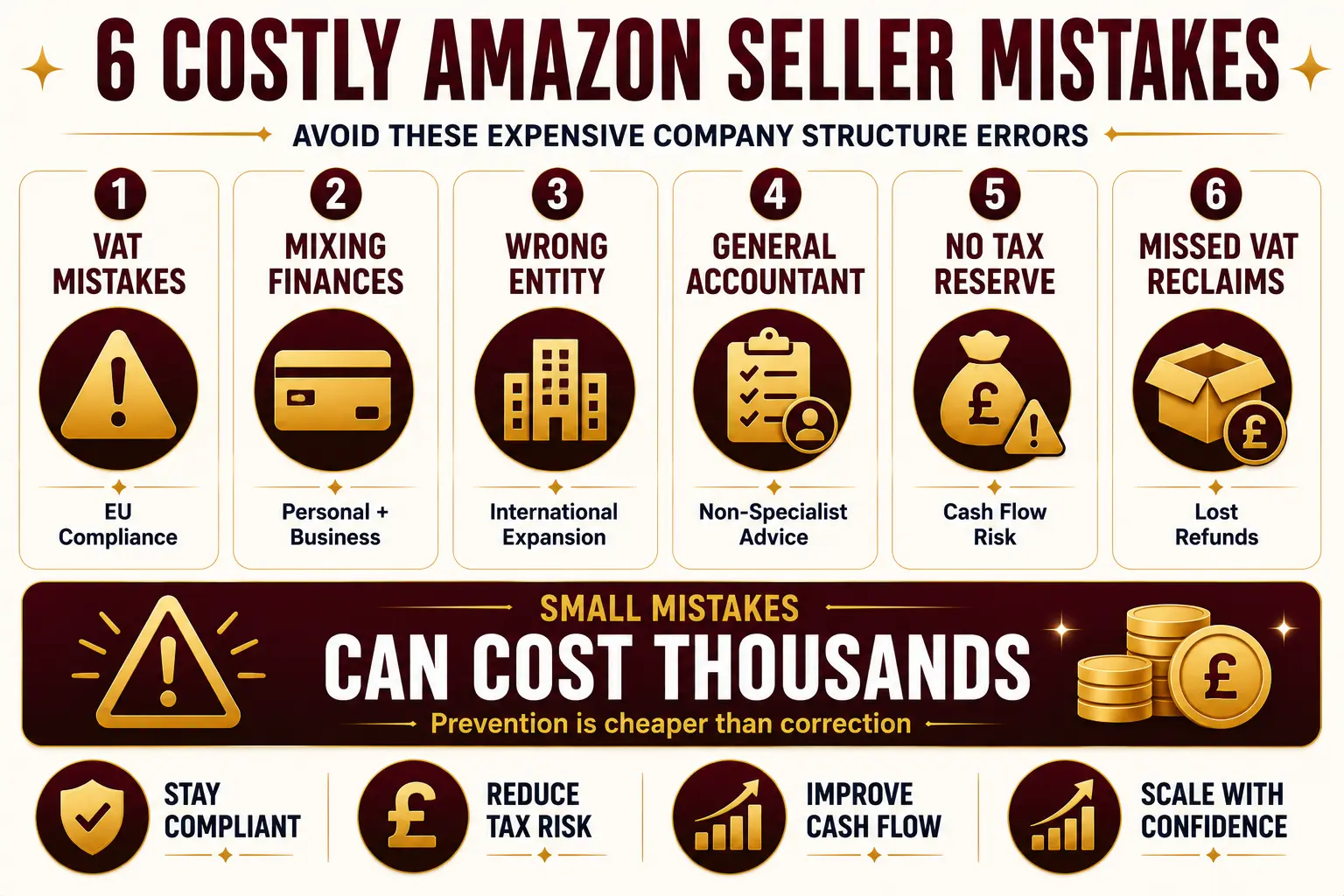
Mistake One: Ignoring EU VAT Obligations Until Penalties Arrive
This is the most financially damaging mistake in the FBA seller community. In 2026, Amazon is legally obligated under UK and EU marketplace regulations to enforce VAT compliance among third-party sellers. Non-compliant sellers face not only HMRC and EU tax authority penalties but also account suspension, withheld payouts, loss of the Buy Box, and removal from Pan-European programmes. The VAT registration process is the first thing to get right, not an afterthought.
A seller who stored goods in a German FBA warehouse for eighteen months without German VAT registration can face back taxes on every sale made during that period, plus interest and a penalty of up to 30% of the tax due. This can easily represent a five-figure or six-figure liability for an established seller.
Mistake Two: Mixing Personal and Business Finances
Using a personal bank account for business transactions is common among early-stage sellers and consistently creates problems at tax time. It makes legitimate expense tracking almost impossible, risks the disallowance of valid deductions by HMRC, and creates a bookkeeping burden that specialist accountants charge higher fees to resolve. Open a dedicated business bank account as the very first action you take after registering your business.
Mistake Three: Using the Wrong Entity for US Marketplace Expansion
A UK Ltd company can legally sell on Amazon US, and many sellers do this successfully. However, if you hold inventory in the United States, employ US-based staff, or generate substantial revenue from American customers, a US LLC or C-Corporation is typically more appropriate for that market. Assuming your UK company is the right vehicle for every market without taking specific US tax advice can create unexpected US tax obligations and treaty complications.
Mistake Four: Using a Non-Specialist Accountant
General practice accountants handle sole traders, tradespeople, and small retail businesses. Amazon FBA is a fundamentally different type of business with inventory accounting complexity, multi-currency settlement reports, pan-jurisdictional VAT obligations, and marketplace-specific fee structures that most generalist accountants have never encountered. The cost of using the wrong accountant is not just the fees paid. It is the missed tax savings, the incorrect VAT treatment, and the absence of proactive advice that a specialist would routinely provide.
Mistake Five: Not Maintaining Separate Tax Reserve Accounts
Amazon pays out gross revenue, including money that legally belongs to HMRC in the form of corporation tax and VAT. Many sellers treat their Amazon payout account as their operating budget and face a painful surprise when quarterly VAT payments or annual corporation tax bills arrive. The solution is simple: maintain a separate business savings account and transfer 20 to 25% of gross profit into it monthly. This habit prevents the most common cash flow crisis in e-commerce businesses.
Mistake Six: Missing Import VAT Reclaim Opportunities
Every month you import stock without being VAT registered is a month of input VAT that you cannot recover. The C79 certificate that evidences UK import VAT cannot be applied retrospectively to periods before registration. For a seller importing £60,000 of goods per month, the unclaimed import VAT amounts to £12,000 per month. Across twelve months of delayed registration, that is £144,000 of permanently lost input tax credit.
Which Structure Is Right for Your Amazon Business in 2026?
Work through the following five questions to identify the most appropriate starting structure for your current stage of business.
Structure Decision Framework for 2026
Question 1: Is your annual net profit above £50,000?
- No: Consider remaining as a sole trader. Review this question again in six months.
- Yes: Proceed to Question 2.
Question 2: Do you currently store, or plan to store, inventory in EU countries via FBA?
- No: A UK Ltd company is your recommended starting structure. Form one via Companies House.
- Yes: Proceed to Question 3.
Question 3: Is your total EU marketplace revenue above £150,000 per year?
- No: A UK Ltd with EU VAT registrations is sufficient. No separate EU entity is required yet.
- Yes: Proceed to Question 4.
Question 4: Is your primary goal in Europe to minimise tax cost or to build local market presence?
- Minimise tax: Consider a Polish Sp. z o.o. with its 9% corporate tax rate on profits up to 2 million euros.
- Build local presence: Consider a German GmbH for credibility in Europe’s largest Amazon marketplace.
Question 5: Do you sell across multiple continents, combining UK, EU, and US marketplaces?
- Yes: A multi-entity structure is worth modelling with a specialist. Consider UK Ltd, plus an EU entity, plus US LLC.
- No: A single well-structured entity with appropriate VAT registrations will serve you efficiently.
What to Remember and Where to Go From Here
Choosing the right structure for your Amazon business is one of the highest-return decisions you will make in the life of the company. The following points summarise what matters most in 2026:
- UK corporation tax rates for 2026/27 are confirmed unchanged: 19% on profits up to £50,000 and 25% above £250,000. Plan your salary-dividend split around these confirmed figures.
- The UK VAT threshold remains at £90,000 for 2026/27. Voluntary early registration is financially worthwhile for most FBA sellers who import stock.
- Pan-European FBA in 2026 requires VAT registration in Germany, France, Italy, Spain, and Poland before inventory arrives. The Czech Republic is no longer mandatory for Pan-EU FBA but is still needed for CEP.
- Amazon’s April 2026 fuel surcharge of 1.5% on EU FBA fees is fully deductible and makes margin-conscious tax structuring more valuable, not less.
- Polish Sp. z o.o. offers the lowest-cost EU incorporation of any serious European jurisdiction, combined with a 9% corporate tax rate on profits below 2 million euros.
- Import VAT reclaim is a genuine and significant cash benefit. Delaying VAT registration permanently forfeits those reclaims.
- Multi-country structures make financial sense above approximately £500,000 in annual revenue when specialist advice can unlock material cross-border tax savings.
- Always use Amazon-specialist accountants rather than general practitioners. The difference in advice quality and tax outcome is consistently material.
- Open a tax reserve account from Day 1. Transfer 20 to 25% of gross profit monthly. This single habit prevents the most common cash flow crisis in e-commerce businesses.
Conclusion
Choosing the right company structure is not a one-time administrative task. It is one of the most financially consequential decisions you will make as an Amazon seller, and it deserves the same attention you give to product selection, supplier negotiation, and marketing.
The core lesson of this guide is straightforward. Structure follows scale. A sole trader starting out with £20,000 in annual profit does not need a limited company today. A seller turning over £150,000 with inventory stored across three EU countries absolutely does, and the cost of not having one is measurable in thousands of pounds every single year.
In 2026, the environment for Amazon sellers has become more demanding on the compliance side. Amazon’s 1.5% EU fuel surcharge compresses margins. EU and UK regulators are requiring platforms to actively police VAT compliance among sellers. Pan-European FBA now mandates VAT registrations in five countries before your first unit of stock arrives. These developments do not make selling on Amazon harder in principle, but they do make getting your structure right earlier more important than it has ever been.
The sellers who will scale most profitably over the next three to five years are those who treat company formation and tax strategy as a competitive advantage, not a compliance burden. The right entity at the right time means more of your revenue stays in the business, funds the next inventory order, and compounds into a stronger brand.
Here is the practical summary of where to start, depending on your situation right now:
- Below £50,000 net profit and selling only in the UK: Operate as a sole trader, keep clean digital records, and set a calendar reminder to revisit this decision in six months.
- Approaching or above £50,000 net profit: Engage a specialist Amazon accountant this week. The tax savings from incorporating will almost certainly exceed the cost of the advice within the first quarter.
- Selling or planning to sell via Pan-European FBA: Do not activate Pan-EU programmes without VAT registrations in Germany, France, Italy, Spain, and Poland in place. The penalties for getting this wrong are severe and retroactive.
- Generating significant EU revenue above £150,000 per year: Model whether a Polish Sp. z o.o. or a UK Ltd with EU VAT registrations makes more sense. At the 9% Polish corporate tax rate, the difference at scale is material.
- Operating across the UK, EU, and US marketplaces at £500,000 and above: Commission a proper multi-entity structure review. The tax savings from correct international structuring at this scale will consistently exceed the professional fees by a significant multiple.
The tools available to Amazon sellers to get this right have never been better. Formation agents can incorporate a UK Ltd in hours. Digital banks open business accounts in days. VAT agents handle multi-country compliance for a few thousand pounds a year. Accounting software integrates directly with Amazon’s settlement reports. There is no structural reason to remain in a suboptimal arrangement once your revenue justifies the change.