If you are planning to start a business in the Netherlands or expand your foreign company into the Dutch market, one of the very first questions you need to answer is this: do you have to register in the Netherlands company register? The short answer is yes, and in almost every case, registration in the Dutch Business Register is not optional. It is a legal requirement.
This guide walks you through everything you need to know about company registration in the Netherlands, the role of the KVK (Chamber of Commerce), what the Dutch Business Register contains, the step-by-step registration process, and what happens after you register. Whether you are a solo entrepreneur, a foreign company opening a branch, or an investor looking to set up a Dutch BV, this article covers it all.
What Is the Netherlands Company Register?
The Netherlands company register, officially known as the Handelsregister, or Dutch Business Register, is the central public database maintained by the KVK (Kamer van Koophandel), which is the Netherlands Chamber of Commerce.
Every business, organisation, or legal entity that operates in the Netherlands is legally required to be listed in this register. That includes sole traders, freelancers (zzp’ers), partnerships, private limited companies (BV), public limited companies (NV), foundations, associations, and foreign companies operating through a branch or subsidiary.
The KVK is the official company registry of the Netherlands and is responsible for registering and dissolving businesses and maintaining the Dutch Business Register. It operates as a government-linked body, guided by the Handelsregisterwet (Trade Registry Act) 2007 and the Wet op de Kamer van Koophandel 2013.
As of 31 March 2025, the Dutch Business Register contained close to 2.6 million registered organisations a figure that continues to grow year on year. This shows just how active and business-friendly the Netherlands is as a jurisdiction for both domestic and international entrepreneurs.
Why Is Company Registration in the Netherlands Mandatory?
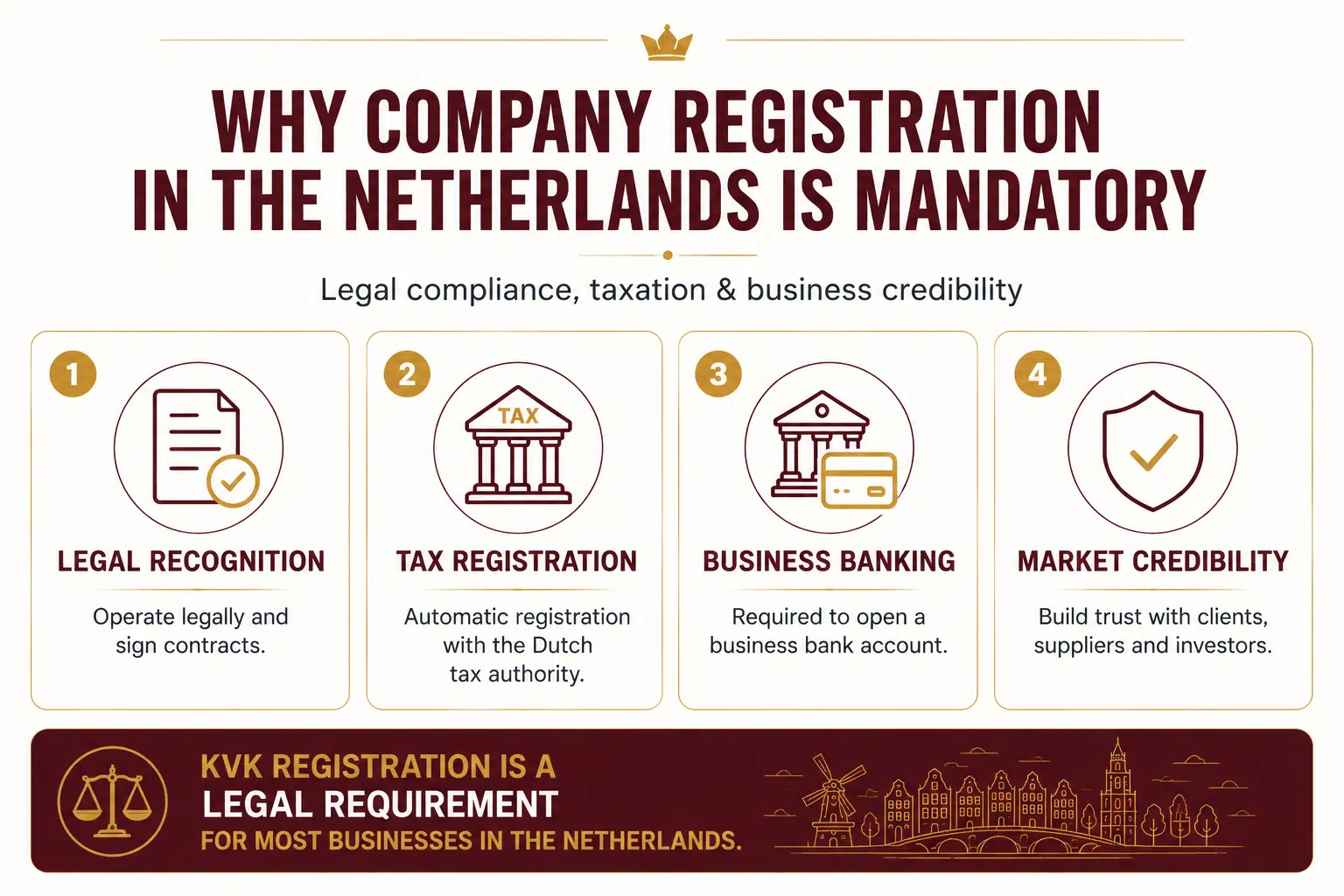
Registration in the Dutch Business Register is not simply a formality it is a legal obligation rooted in Dutch commercial law. Here is why it matters:
- Legal recognition: Without registration, your business has no official legal status in the Netherlands. You cannot sign binding contracts, invoice clients formally, or hold assets in the company’s name.
- Tax compliance: When you register with the KVK, your details are automatically shared with the Belastingdienst (the Netherlands Tax Administration). This triggers the issuing of your VAT number and starts the process for corporate tax registration. You do not need to register separately with the tax authority the KVK handles that automatically.
- Access to a bank account: Dutch and international banks require proof of registration in the Dutch Business Register before they will open a business bank account. Without a KVK number, you cannot open a business bank account in the Netherlands.
- Professional credibility: Clients, partners, suppliers, and investors can look up any registered company in the public register. Being in the register signals that your business is legitimate, transparent, and operating within the law. Your KVK number and contact details appear in the register, giving others confidence in your business.
- Compliance with Dutch law: Failure to register or to keep your registration information up to date can result in fines and administrative penalties. For foreign companies, non-compliance can also create tax liability risks and legal complications.
What Information Is Held in the Dutch Business Register?
The Dutch Business Register contains a wide range of information about every registered entity. Most of this information is public and can be searched by anyone. Here is what the register typically holds:
- Company name and trade name(s)
- Business address and contact details
- Legal form (BV, NV, sole trader, partnership, foundation, etc.)
- KVK number the unique registration number assigned to every business
- SBI codes the Standard Business Classification codes that describe the company’s business activities
- Names of directors, officers, and authorised signatories
- Shareholders (the main shareholder is listed, though full beneficial ownership information has separate UBO register requirements)
- Financial statements (for certain legal forms, audited financial statements must be filed with the Chamber of Commerce)
- Date of incorporation or registration
- Registration in the business register, date and any changes to company details over time
The KVK number is particularly important. This unique identifier is required on all invoices, official correspondence, and contracts. It is also used by the Belastingdienst administration to link your tax records to your business registration.
Who Must Register for Company Registration in the Netherlands?
The obligation to register in the Netherlands company register is broad. Under Dutch law, the following must all register with the KVK:
- Sole traders and freelancers (zzp’ers) are anyone who independently provides products or services to others with the intention of making a profit
- General partnerships (VOF) and limited partnerships (CV)
- Private limited companies (BV Besloten Vennootschap) the most popular legal form for foreign investors and entrepreneurs
- Public limited companies (NV Naamloze Vennootschap)
- Foundations (Stichting) and associations (Vereniging)
- Foreign companies opening a branch office, subsidiary, or representative office in the Netherlands
- Legal entities of any kind that conduct commercial activities in the Netherlands
The KVK considers you an entrepreneur and, therefore, subject to the registration requirement if you independently provide goods or services with the intent to earn income. Even if you are just testing the Dutch market, you are likely required to register once commercial activity begins.
Legal Forms Available for Company Registration in the Netherlands
Choosing the right legal form is one of the most important decisions you will make during company registration in the Netherlands. Each legal entity type has its own rules, liability implications, tax treatment, and administrative requirements.
BV (Besloten Vennootschap) Private Limited Company
The BV is by far the most common legal form used by foreign entrepreneurs and investors setting up in the Netherlands. Key features include:
- Limited liability for shareholders
- No minimum share capital requirement (it used to be €18,000; this was abolished in 2012)
- At least one director and one shareholder are required (they can be the same person)
- Must file audited financial statements with the Chamber of Commerce annually
- Shareholders’ details are partially held in the Dutch Business Register
- Requires a Dutch business address at the time of incorporation
The BV offers flexibility and strong legal protection, making it ideal for small and medium-sized businesses, holding structures, and foreign subsidiaries.
NV (Naamloze Vennootschap) Public Limited Company
The NV is used for larger companies that may wish to issue shares publicly. It requires a minimum share capital of €45,000 and involves more complex governance and reporting requirements. It is less common for smaller foreign investors.
VOF (Vennootschap onder Firma) General Partnership
A VOF involves two or more partners running a business together. Each partner has unlimited personal liability for the debts of the partnership. There is no separate legal entity, but registration in the Dutch Business Register is still mandatory.
Sole Trader (Eenmanszaak)
For individual entrepreneurs, the sole trader structure is the simplest option. The owner has unlimited personal liability. Registration with the KVK is still required, and the Belastingdienst administration will be notified automatically.
Branch Office of a Foreign Company
A branch is not a separate legal entity it is an extension of the parent company. However, it must still register in the Dutch Business Register. The parent company’s directors and authorised signatories must also be registered, and the branch must obtain a VAT number from the Dutch tax authorities. All required documents must be officially apostilled and translated into Dutch or English by a certified translator.
Step-by-Step: The Company Registration Process in the Netherlands
Understanding the registration process in detail will help you avoid delays and costly mistakes. Here is a practical overview of how company registration in the Netherlands works.
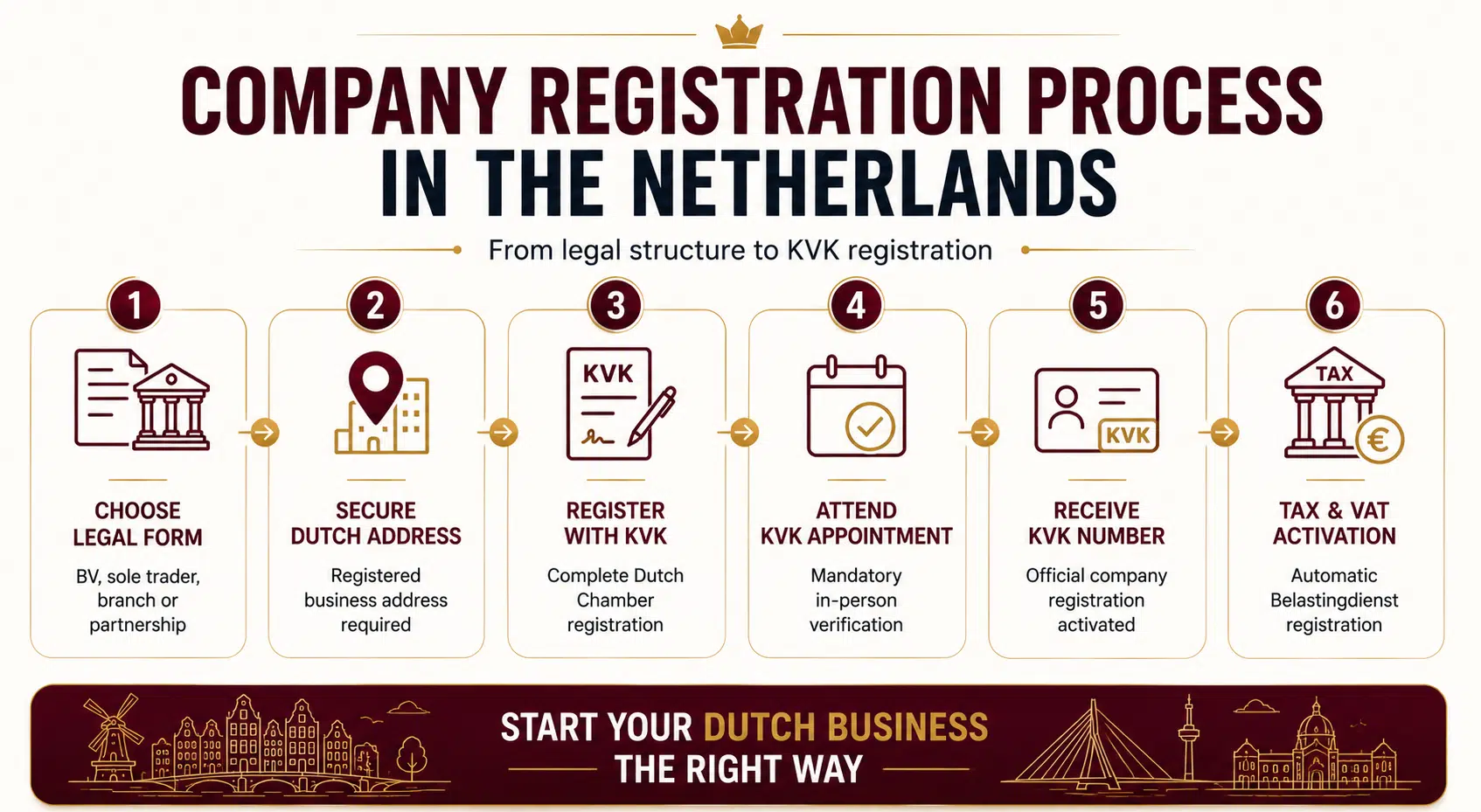
Step 1: Choose Your Legal Form
Before anything else, decide on the most appropriate legal entity for your business. For most foreign entrepreneurs, the BV is the natural choice. If you are a freelancer or sole trader, the eenmanszaak may be sufficient. Take professional advice if you are unsure, as the wrong choice can have significant tax and liability consequences.
Step 2: Secure a Dutch Business Address
To register your company in the Dutch Business Register, you need a valid Dutch address. This can be:
- Your own physical office or business premises
- A serviced office address
- A virtual office address provided by a registered address service
You cannot use a P.O. Box as your registered address. If you are using someone else’s address (such as an accountant’s address), you must obtain a signed declaration of consent allowing you to use their address as your business address. A registered address is also often required before you can open a business bank account.
Step 3: Choose and Check Your Company Name
Your company name must be unique and not already in use by another registered business. You can search the Dutch Business Register on the KVK website to check availability. The name must comply with Dutch naming rules and cannot be misleading or identical to an existing trade name.
Step 4: Complete the Online Registration Form
Go to the KVK website and complete the digital registration form. You will need your Dutch citizen service number (Burgerservicenummer, BSN) to complete the registration process online. The form will ask for:
- Your chosen company name
- Legal form of the business
- Business address and contact details
- SBI codes describing your business activities
- Details of directors and authorised signatories
- Shareholder information (for BVs and NVs)
For BV formation, the process also involves notarial deed preparation. A Dutch civil-law notary must draft and execute the deed of incorporation before the company can be formally registered.
Step 5: Book and Attend Your KVK Appointment
Even though much of the registration process is completed online, a mandatory in-person appointment at a KVK office is required. At this appointment, you will need to bring:
- Valid proof of identity (Dutch or foreign passport, or a European identity document)
- Proof of your business address (if different from your home address)
- Any additional documents required for your specific legal form
You must register your business no later than one week after you start business activities. Alternatively, you can register up to three months before your planned start date. If you register within the one-week window before or after your start date, you receive your KVK number immediately at the appointment. If you register earlier, the KVK number is sent by post in the week before your start date.
Step 6: Pay the Registration Fee
At your KVK appointment, you pay a one-time registration fee. As of January 2025, this fee is €82.25. This is a one-off payment; there are no annual renewal fees for basic registration.
Step 7: Receive Your KVK Number
Once approved, your business is issued a unique KVK number. This number is your official identifier in the Netherlands company register. You are legally required to display it on all invoices, correspondence, and official documents.
Step 8: Automatic Registration with the Belastingdienst
For businesses established in the Netherlands, the KVK automatically forwards your registration details to the Belastingdienst (Netherlands Tax Administration). This triggers the issuance of your VAT number and initiates corporate tax registration. You do not need to contact the tax authority separately; this part of the process is handled for you.
What Happens After Company Registration in the Netherlands?
Registration in the Dutch Business Register is the starting point, not the finish line. Once your company is registered, a number of important follow-on steps are required.
Open a Business Bank Account
With your KVK number and VAT number in hand, you can now apply to open a business bank account in the Netherlands. Dutch banks and the international banks with offices in Amsterdam will require your KVK registration extract and other documentation. For foreign company owners, the bank account opening process can take some time, and specialist support is often helpful.
VAT Registration and Dutch Tax Compliance
Your VAT number will be issued automatically, but you need to understand your obligations under Dutch tax law. Depending on your business activities and turnover, you may need to file quarterly or annual VAT returns with the Belastingdienst administration. The Netherlands has an extensive network of double-taxation treaties, which may be relevant if you are a foreign company or director.
Annual Filing of Financial Statements
For BVs and other legal entities, Dutch law requires the annual filing of financial statements with the Chamber of Commerce. These are deposited in the Dutch Business Register and are publicly available. The deadline for filing is generally within 12 months of the end of the financial year. Late or missing filings can result in penalties.
Maintaining Your Registration
You are legally obliged to keep your registration in the Dutch Business Register up to date. Any changes to your business, including changes in directors, authorised signatories, shareholders, business address, contact details, or business activities, must be reported to the KVK promptly. Failure to maintain accurate registration information can lead to fines and, in serious cases, personal liability for directors.
UBO Registration
Certain legal entities are also required to register their Ultimate Beneficial Owners (UBOs), the individuals who own or control the company, in the UBO register. This is a separate register maintained alongside the Dutch Business Register as part of the Netherlands’ anti-money laundering and financial transparency obligations.
Company Registration in the Netherlands for Foreign Companies
Foreign companies looking to expand into the Dutch market face some additional requirements during the registration process. Whether you are setting up a subsidiary (a new Dutch BV), opening a branch office, or establishing a representative office, registration in the Dutch Business Register is mandatory.
For branch registrations, the following are typically required:
- All registered directors and proxy holders (authorised signatories) of the parent company must also be registered in the Netherlands
- A passport copy and proof of private address must be provided for all directors and proxy holders
- Documents must be officially apostilled and translated into Dutch or English by a certified translator
- The branch must register with the Dutch tax authorities to obtain a VAT number
There is no share capital requirement for Dutch branches. The accounting requirements for a Dutch branch generally mirror those for the parent company in its country of origin.
For foreign entrepreneurs who are not yet living in the Netherlands, working with a local company formation specialist can make the process significantly smoother. A Dutch representative who understands the local community and the KVK registration process can help ensure your registration goes through without delays or errors in the Belastingdienst administration.
Can Trade Registration and Company Registration Happen at the Same Time?
Historically, there was a question about whether trade registration and company registration could happen simultaneously. In practice, the two processes are closely linked, and for most legal forms, they happen as part of the same KVK registration process.
For a BV, the sequence is:
- A Dutch civil-law notary drafts and executes the deed of incorporation
- The notary (or your formation specialist) submits the registration to the KVK
- The KVK registers the company in the Dutch Business Register and issues the KVK number
- The Belastingdienst is automatically notified and issues tax identifiers
In practice, simultaneous filing for both trade registration and company registration in the business register does take place, particularly when working with attorneys or corporate filing specialists who have established relationships with the KVK and notarial offices. These specialists can push the required paperwork through quickly and without costly procedural errors.
If all you want to do is register a trade name (handelsnaam) in the Dutch Business Register, the process is simpler but you still need to go through the KVK registration process and obtain a KVK number.
The Benefits of Working with a Company Formation Specialist
Navigating company registration in the Netherlands is straightforward for Dutch residents with a BSN and an existing business address. But for foreign entrepreneurs and international companies, the process involves additional steps, unfamiliar documentation requirements, and potential language barriers.
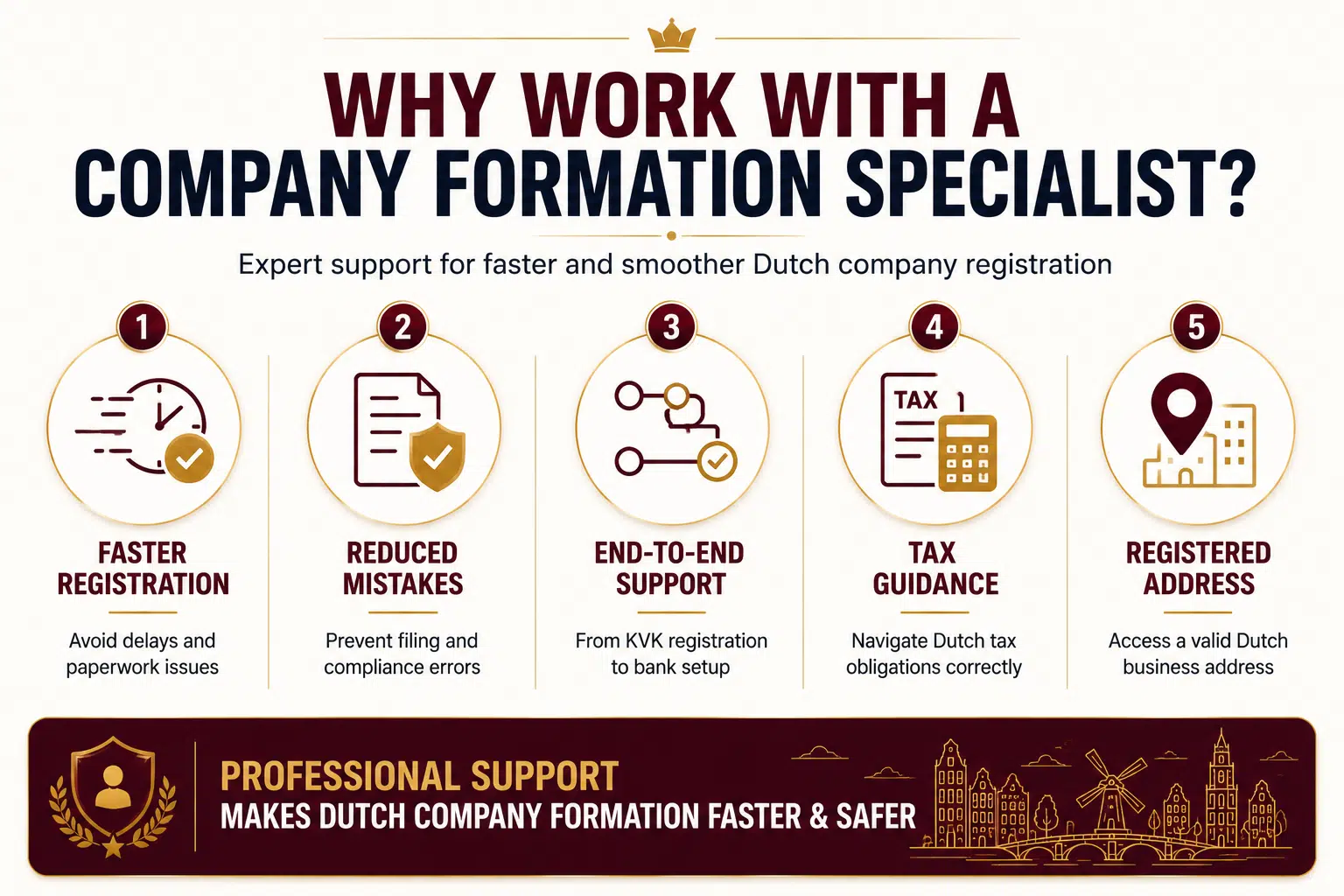
Working with a European company formation specialist offers several clear advantages:
- Faster registration. Specialists with existing relationships at the KVK and notarial offices can complete the registration process more quickly and avoid procedural delays.
- No costly mistakes. Errors in the registration process, such as wrong SBI codes, missing documents, incorrect legal forms, or improperly translated documents, can delay your registration significantly. A specialist minimises these risks.
- End-to-end support. A good formation specialist handles everything: company name checks, business address provision, deed of incorporation preparation, KVK registration, VAT number application, and bank account setup guidance.
- Tax advice. Dutch tax law is complex. Specialist advisors can help you structure your company in a tax-efficient way from day one, navigate the Belastingdienst administration, and ensure you are compliant with all Dutch tax obligations.
- Registered address services. If you do not have a physical presence in the Netherlands, a formation specialist can provide a registered Dutch business address, which is required for KVK registration and often necessary before opening a business bank account.
Key Facts: Company Registration in the Netherlands at a Glance
Here is a quick summary of the essential facts about company registration in the Netherlands:
- Is registration mandatory? Yes. All businesses and legal entities operating in the Netherlands must register in the Dutch Business Register maintained by the KVK.
- Who manages the register? The KVK (Kamer van Koophandel) the Netherlands Chamber of Commerce.
- What number do you receive? A unique KVK number, which must appear on all invoices and official correspondence.
- What is the registration fee? €82.25 as of January 2025 (one-time fee).
- When do you need to register? No later than one week after starting business activities, or up to three months before your planned start date.
- Do you need a Dutch address? Yes. A registered Dutch business address is mandatory for KVK registration.
- What about tax registration? It is automatic. The KVK forwards your details to the Belastingdienst, which issues your VAT number without requiring a separate application.
- What is the most common legal form? The BV (Besloten Vennootschap), a private limited company, is the most popular structure for foreign entrepreneurs and investors.
Conclusion: Company Registration in the Netherlands Is Mandatory and Easier Than You Think
Company registration in the Netherlands is a legal requirement for virtually every business and legal entity operating in the country. The Dutch Business Register, maintained by the KVK, is a comprehensive, public-facing register that underpins the transparency and credibility of the Dutch business environment.
The registration process itself is structured and relatively straightforward, especially with the right support. You will receive your KVK number at your appointment, your tax details will be handled automatically through the Belastingdienst administration, and you can then move forward with opening a business bank account, fulfilling your Dutch tax obligations, and growing your presence in one of Europe’s most attractive business jurisdictions.
The Netherlands offers an exceptional environment for foreign businesses: a strategic gateway to the EU market, a highly educated multilingual workforce, a stable legal system, and an extensive network of double-taxation treaties. Whether you are a freelancer, a small business owner, or a global company looking to establish a Dutch subsidiary, getting your company registration in the Netherlands right from the start is essential.
If you need help navigating the registration process in the Netherlands company register from choosing the right legal form and securing a registered business address to completing your KVK registration and opening a bank account, our team of European company formation specialists is here to help. Contact us for a free consultation today.