Germany remains one of Europe’s strongest destinations for company formation offering access to the EU single market, a stable legal system a skilled workforce and one of the largest economies in the region. For entrepreneurs, investors and international businesses setting up a German company can be a strategic step towards expanding across Europe.
However, the process can feel complex if you are unfamiliar with German legal structures, notary requirements, tax registration, commercial register filings and local compliance rules.
This guide explains how to register a company in Germany the main company types available, the key differences between GmbH and AG, the expected company formation cost Germany 2026 and the steps involved in launching your business correctly.
Why Start a Company in Germany?
Germany is often seen as one of the most attractive countries in Europe for business formation. It offers a combination of economic strength, legal certainty, infrastructure and access to a large consumer and business market.
For international entrepreneurs, Germany can be particularly attractive because it provides
-
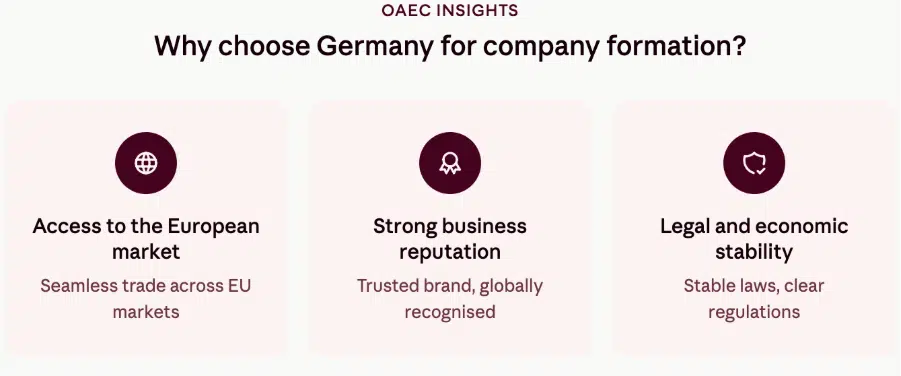
Access to the European Market
A German company gives businesses a credible base within the European Union. This can make it easier to trade with EU customers, work with European suppliers, apply for VAT registration, and build trust with local partners.
-
Strong Business Reputation
Germany has a global reputation for quality, stability and professionalism. A German-registered company can help strengthen credibility when dealing with clients, investors, banks, distributors and commercial partners.
-
Legal and Economic Stability
Germany has a well-established legal framework for companies. The rules around liability, ownership, taxation and reporting are clearly defined, which makes the country attractive for serious long-term business planning.
Main Types of Companies in Germany
Before looking at how to register a company in Germany, it is important to choose the right legal structure. Your company type affects your share capital requirements, tax position, liability, governance, reporting duties and long-term flexibility.
The most common options include
1. GmbH – Gesellschaft mit beschränkter Haftung
The GmbH is the German equivalent of a private limited liability company. It is one of the most popular structures for both German and foreign entrepreneurs.
A GmbH is commonly used by SMEs, consultants, trading companies, tech businesses, family businesses and international companies entering Germany.
Key features of a GmbH
- Separate legal entity
- Limited liability for shareholders
- Minimum share capital of €25,000
- At least €12,500 usually paid in before registration
- Managed by one or more managing directors
- Suitable for small, medium and growing companies
- Requires notarised articles of association
- Must be registered with the Commercial Register
The GmbH is usually the preferred option for foreign founders because it balances credibility, liability protection and operational flexibility.
2. UG – Unternehmergesellschaft
The UG is often described as a mini-GmbH. It is a limited liability company that can be formed with lower share capital. A UG can technically be formed with as little as €1 share capital, although this is often not commercially practical.
Key features of a UG
- Limited liability
- Lower entry capital than a GmbH
- Suitable for smaller startups or entrepreneurs with limited initial funds
- Must build reserves from profits
- Lower credibility than a GmbH in some business contexts
- Can later be converted into a GmbH
The UG may be suitable for early-stage founders, but many international businesses prefer a GmbH because it looks more established to banks, suppliers and clients.
3. AG – Aktiengesellschaft
The AG is Germany’s stock corporation. It is generally used by larger companies, businesses with institutional investors, or organisations planning to raise capital through shares.
An AG requires a more formal governance structure than a GmbH. It typically includes a management board and a supervisory board. The AG structure is more complex and expensive to maintain, but it can offer greater capital-raising potential.
Key features of an AG
- Separate legal entity
- Limited liability
- Minimum share capital of €50,000
- Suitable for larger companies and investment-backed businesses
- Shares may be transferred more easily
- Requires stronger corporate governance
- Managed by a management board and supervised by a supervisory board
- More complex reporting and compliance requirements
An AG is usually not necessary for small or medium-sized foreign businesses entering Germany unless there is a specific investor, capital market or corporate structuring reason.
GmbH vs AG Germany Comparison
One of the most important decisions for entrepreneurs is whether to form a GmbH or an AG. Both offer limited liability, but they are designed for different types of businesses.
A proper GmbH vs AG Germany comparison helps clarify which structure is more suitable for your goals.
| Feature | GmbH | AG |
| Best for | SMEs, startups and foreign investors | Large companies and businesses seeking investment |
| Minimum share capital | €25,000 | €50,000 |
| Liability | Limited | Limited |
| Management | Managing director(s) | Management board and supervisory board |
| Governance | Simpler and more flexible | More formal and regulated |
| Capital raising | Limited | Better suited for raising capital |
| Ongoing compliance | Lower | Higher |
Which Is Better – GmbH or AG?
For most foreign entrepreneurs and SMEs, a GmbH is usually the better option because it offers credibility, limited liability and simpler governance. An AG is more suitable for larger companies planning significant capital raising or formal shareholder structures
How to Register a Company in Germany – Step-by-Step?
The process of registering a German company involves several formal stages. The exact requirements depend on the business structure, shareholders, directors, location and business activity.
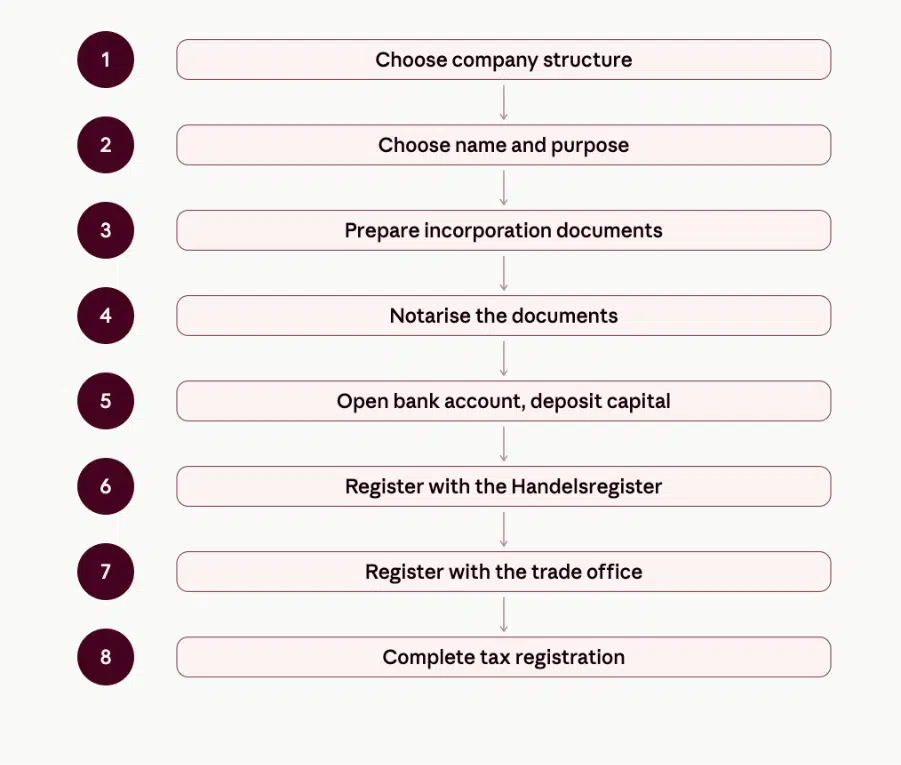
Below is a practical overview of how to register a company in Germany in 2026.
Step 1 – Choose the Right Company Structure
The first step is deciding whether you need a GmbH, UG, AG, branch or another structure. For most international businesses, a GmbH is the preferred structure because it is widely recognised and offers strong liability protection.
Step 2 – Choose a Company Name and Business Purpose
Select a company name that complies with German registration requirements. It should be unique, not misleading, and include your chosen legal structure, such as GmbH, UG, or AG.
You must also define your business purpose, outlining the activities your company will undertake. The description should be clear, accurate, and broad enough to support future business growth.
Step 3 – Prepare the Incorporation Documents
Prepare the Articles of Association, which outline key company details such as the company name, registered office, business purpose, share capital, shareholder information and management structure. At this stage, you’ll also appoint at least one managing director, who will be responsible for overseeing the company’s operations and ensuring compliance with legal and tax obligations. For more complex ownership structures, customised incorporation documents may be recommended.
Step 4 – Notarise the Incorporation Documents
German company formation normally requires notarisation. A German notary authenticates the articles of association and incorporation documents before the company can be registered.
The notary plays an important role in confirming the legal formation documents and submitting the registration application to the Commercial Register.
The German Company Register provides access to company register entries and submitted corporate documents from registers including commercial and partnership registers.
Step 5 – Open a Business Bank Account and Deposit Share Capital
After notarisation, open a business bank account in the company’s name and deposit the required share capital. For a GmbH, the minimum share capital is €25,000, with at least €12,500 typically paid before registration. An AG requires a minimum share capital of €50,000. Bank account opening may take longer for foreign founders, particularly where shareholders or directors are based outside Germany.
Step 6 – Register with the Commercial Register
After capital is deposited, the notary can submit the company registration to the Commercial Register, known as the Handelsregister. The company legally comes into existence once it is entered into the Commercial Register.
Step 7 – Register the Business with the Trade Office
Depending on the business activity, the company may need to register with the local trade office, known as the Gewerbeamt.
This registration is separate from the Commercial Register and is usually required for commercial business activities.
Step 8 – Complete Tax Registration and Maintain Compliance
After incorporation, register your company with the German tax authorities to obtain a tax number. If your business carries out VAT-taxable activities, you may also need to register for a VAT identification number.
Once registration is complete, your company can begin trading. To remain compliant, you must maintain accurate accounting records, submit tax returns, prepare annual accounts and meet ongoing regulatory obligations.
This version is concise, removes unnecessary repetition, and keeps the essential information.
Documents Required to Register a Company in Germany
The exact documentation required will depend on your chosen legal structure, whether the shareholders are individuals or corporate entities, and whether the shareholders are residents or non-residents. However, most companies will need to prepare a standard set of incorporation documents before registration.
Commonly required documents include
- Passport or government-issued identification for shareholders and directors
- Proof of residential address
- Company name confirmation (if applicable)
- Articles of Association
- Shareholder information
- Details of the managing director(s)
- Registered office address in Germany
- Description of business activities
- Share capital details
- Bank confirmation showing the required capital deposit (for applicable company types)
If a shareholder is another company rather than an individual, additional corporate documents may be required, such as
- Certificate of Incorporation
- Articles of Association
- Commercial Register extract
- Board resolution authorising the investment
- Proof of the authorised company representative
Foreign-language documents may need certified translations or notarisation depending on the jurisdiction and German registration requirements.
Company Formation Cost Germany 2026
One of the most common questions entrepreneurs ask is about the company formation cost Germany 2026. The total investment varies depending on the legal structure, professional services required, and whether the founders are based in Germany or overseas.
Rather than looking only at government filing fees, businesses should consider the full cost of establishing and operating a company.
Typical costs may include
Share Capital
For a GmbH
- Minimum subscribed share capital: €25,000
- At least €12,500 is generally paid before registration, with the balance remaining payable if required. This capital belongs to the company after incorporation and is not a government fee.
For an AG
- Minimum share capital: €50,000.
Notary Fees
German company formation requires notarisation. Fees depend on the company’s share capital, legal structure, and complexity of the incorporation documents.
Commercial Register Fees
Registration with the Commercial Register involves official filing fees payable to the relevant authorities.
Legal and Professional Advice
Many international businesses choose to work with professional advisors who assist with
- Company structuring
- Preparation of incorporation documents
- Notary coordination
- Commercial Register filings
- Tax registration
- VAT registration
- Compliance advice
- Ongoing corporate support
Registered Office Costs
If you do not have physical premises in Germany you may require a registered office or virtual office solution depending on your business requirements.
Accounting and Tax Compliance
Following incorporation, businesses should budget for
- Annual accounts
- Bookkeeping
- Payroll (if applicable)
- Corporation tax filings
- VAT returns
- Financial reporting
Taxes for German Companies
Registering a company is only the first step. Every business operating in Germany must also understand its ongoing tax responsibilities. The exact taxes depend on the company’s activities, size, location, and legal structure but the main business taxes generally include:
Corporation Tax
Companies such as GmbHs and AGs are generally subject to German corporation tax on their profits.
Trade Tax
Commercial businesses are also generally subject to trade tax (Gewerbesteuer). The effective rate varies depending on the municipality where the business is established.
Value Added Tax (VAT)
Businesses supplying taxable goods or services may need to register for VAT.
Germany operates a standard VAT system in line with European Union rules. Businesses trading across EU borders may also require a VAT Identification Number for intra-EU transactions.
Payroll Taxes
Businesses employing staff are responsible for payroll administration wage tax deductions and social security contributions.
Professional accounting support can help ensure ongoing compliance with German tax regulations and filing deadlines.
Ongoing Compliance Requirements
Once incorporated German companies must continue meeting their legal and regulatory obligations.
Common compliance requirements include
- Maintaining accurate accounting records
- Preparing annual financial statements
- Filing annual accounts where required
- Submitting corporation tax returns
- Filing VAT returns (where applicable)
- Maintaining statutory company records
- Reporting shareholder or director changes
- Updating the Commercial Register when necessary
- Complying with employment regulations if hiring staff
Failure to meet these obligations may result in financial penalties increased scrutiny from authorities or delays when expanding or restructuring the business.
Why Work with Open a European Company?
Setting up a company in Germany involves more than completing registration forms. It requires careful planning accurate documentation and compliance with German corporate and tax regulations.
At Open a European Company, we simplify the entire process by providing tailored company formation solutions for entrepreneurs SMEs and international businesses looking to establish or expand their presence in Germany.
Our services include
- Company formation support
- Multi-jurisdictional European expansion
- Registered office and office solutions
- Corporate document preparation
- Tax and VAT registration assistance
- Financial and legal support
- Ongoing business compliance services
Whether you are launching your first European business or expanding an existing international company our experienced team provides practical guidance throughout every stage of the process.
Conclusion
Germany is one of Europe’s leading destinations for business formation, offering a stable economy access to the EU market and a supportive legal framework. By understanding how to register a company in Germany, choosing the right legal structure and planning for the company formation cost Germany 2026 you can establish your business with confidence. Company formation typically takes 2 to 6 weeks depending on the registration process and documentation. With expert guidance from Open a European Company setting up and expanding your business in Germany becomes simpler and more efficient.