The EU invests billions in startups every year, and most entrepreneurs never touch a cent of it.
European startup funding bounced back to €7.8 billion across 296 deals in February 2026 alone, with Q1 2026 reaching $17.6 billion across the continent. But beyond private venture capital, the EU and its member states run some of the world’s most generous grant and loan programs for innovative businesses. These are largely non-dilutive, meaning you keep your equity.
The challenge? The landscape is complex, fragmented, and not founder-friendly by design. Programs are spread across EU-level institutions, national agencies, and regional bodies. Deadlines are strict, applications are long, and success rates are low.
What’s different in 2026 is direction. Public money in Europe is now more tightly tied to political priorities: deeptech, green transition, AI, strategic autonomy, and regional development. If your startup fits one of those themes, your odds are better than they’ve ever been. If it doesn’t, you’ll need to position more carefully.
This guide cuts through that complexity. Whether you’re a bootstrapped founder exploring your first grant or a Series A startup combining multiple funding sources, you’ll find a clear, actionable path forward.
Key Takeaways
- EU startup grants are non-dilutive; you
give up no equity - Horizon Europe runs through 2027 with €95.5B total budget; its successor FP10 is proposed at €175–200B from 2028
- The EIC Accelerator 2026 has a €634M total budget, its biggest year yet, with a simplified application process and 6 cut-off dates per year
- Priority sectors for 2026 funding: deeptech, AI, climate tech, biotech, advanced manufacturing, and space
- National programs in Germany, France, Spain, Italy, and the Netherlands remain faster, more accessible alternatives
- Grant success rates range from 4–15%, so proposal quality and sector fit are everything
- A smart funding strategy combines grants, loans, and equity, not just one source
Types of EU Startup Funding: What’s Actually Available
Before diving into specific programs, it helps to understand the four funding types available to European startups.
| Funding Type | Typical Range | Equity Required | Best For | Key Downside |
|---|---|---|---|---|
| Grants | €100K–€5M | No | R&D, innovation projects | Competitive, compliance-heavy |
| Government-Backed Loans | €100K–€1M | No | Scaling, asset-heavy companies | Debt on balance sheet |
| Public Equity Investment | €500K–€10M | Yes | Scale-ups with traction | Dilution and board control |
| Equity Crowdfunding | €100K–€2M | Yes | Consumer products, community-driven | Campaign complexity, public scrutiny |
1. Grants (Non-Dilutive Capital)
Grants are money you receive without giving up equity or repaying the funds. They’re the most attractive option for early-stage founders, but also the most competitive.
- Typical range: €100K–€5M per project
- Best for: R&D, innovation projects, specific initiatives with measurable outcomes
- Downside: Rigorous compliance, quarterly reporting, and audits, these are real operational costs
2. Government-Backed Loans
These are loans issued through banks but guaranteed or subsidized by government bodies like the EIB or national agencies. Interest rates are significantly lower than commercial loans.
- Typical range: €100K–€1M
- Best for: Scaling companies and asset-heavy businesses
- Downside: Still debt, which affects your balance sheet
3. Equity Investment (Public Venture Capital)
The EU’s European Investment Bank (EIB) and national VC funds like Bpifrance invest directly or through co-investment structures.
- Typical range: €500K–€10M per round
- Best for: Scale-ups with proven traction
- Downside: You give up equity and potentially board control
4. Crowdfunding & Community Financing
Regulated equity crowdfunding continues to grow under EU Regulation 1129/2017. Platforms like Seedrs and Companisto let you raise from a wide investor base while validating your product publicly.
- Typical range: €100K–€2M
- Success rate: 40–60% if you have early traction
- Cost: 5–10% platform fee plus legal
Horizon Europe: The World’s Largest R&D Funding Program
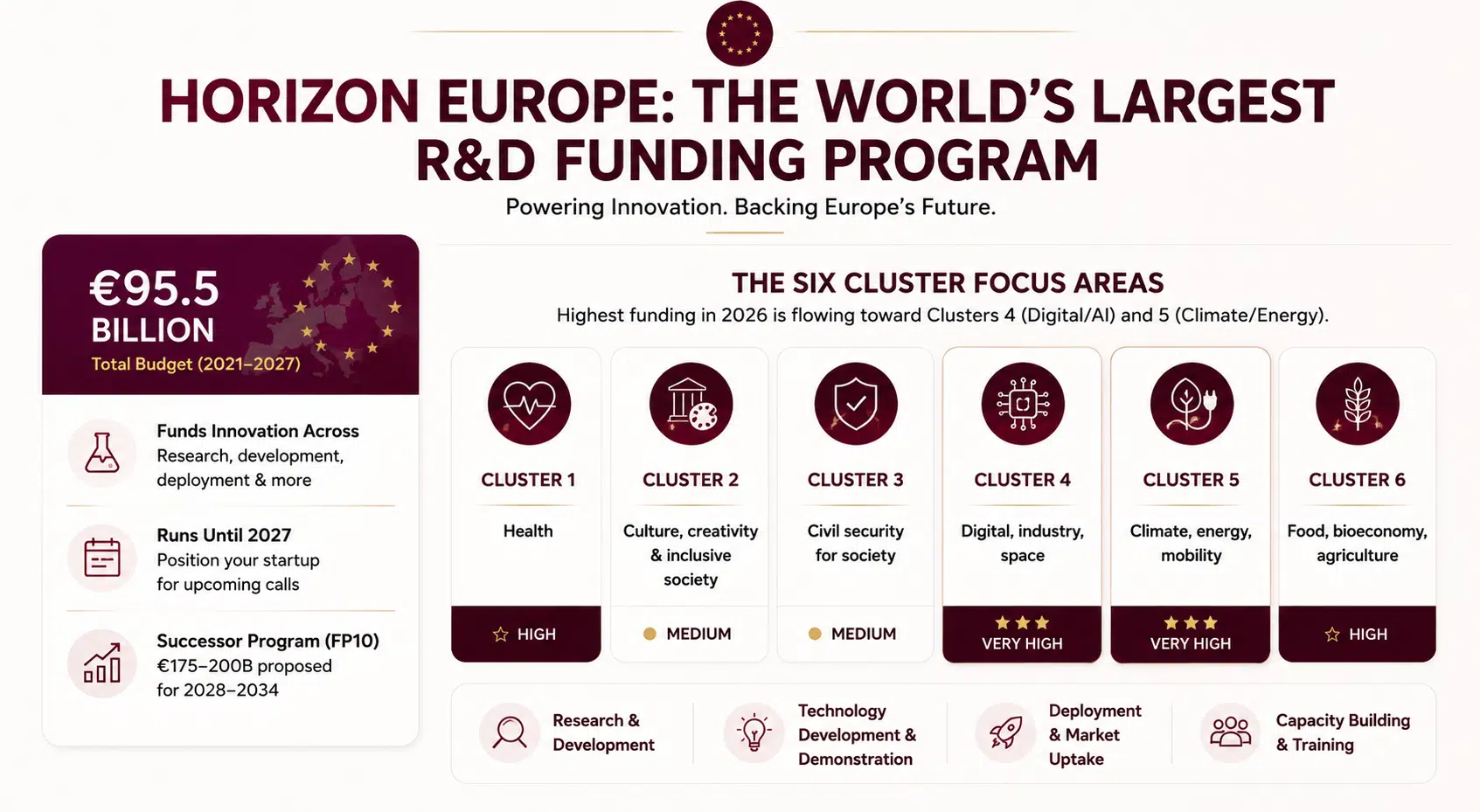
Horizon Europe is the EU’s flagship research and innovation program running from 2021 to 2027, with a total budget of €95.5 billion. It remains the largest single R&D program on the planet.
Looking further ahead: The European Commission has proposed €175 billion for FP10, the successor program running from 2028–2034. The European Parliament is pushing for €200 billion. Either way, this signals a major step up in R&D investment for the next decade, and founders building now should position themselves for it.
What Horizon Europe Funds
Horizon Europe covers a wide range of activities:
- Research and development (R&D)
- Technology development and product demonstration
- Deployment and market uptake
- Capacity building and training
The Six Cluster Focus Areas
Horizon Europe organizes funding into six thematic clusters. The highest funding volumes in 2026 are flowing toward Clusters 4 (Digital/AI) and 5 (Climate/Energy).
| Cluster | Focus | 2026 Priority Level |
|---|---|---|
| Cluster 1 | Health | High |
| Cluster 2 | Culture, creativity, inclusive society | Medium |
| Cluster 3 | Civil security for society | Medium |
| Cluster 4 | Digital, industry, space | Very High |
| Cluster 5 | Climate, energy, mobility | Very High |
| Cluster 6 | Food, bioeconomy, agriculture | High |
The European Innovation Council (EIC): Major Updates for 2026
The EIC is the part of Horizon Europe designed specifically for high-growth, innovative startups. In 2026, it has been significantly overhauled.
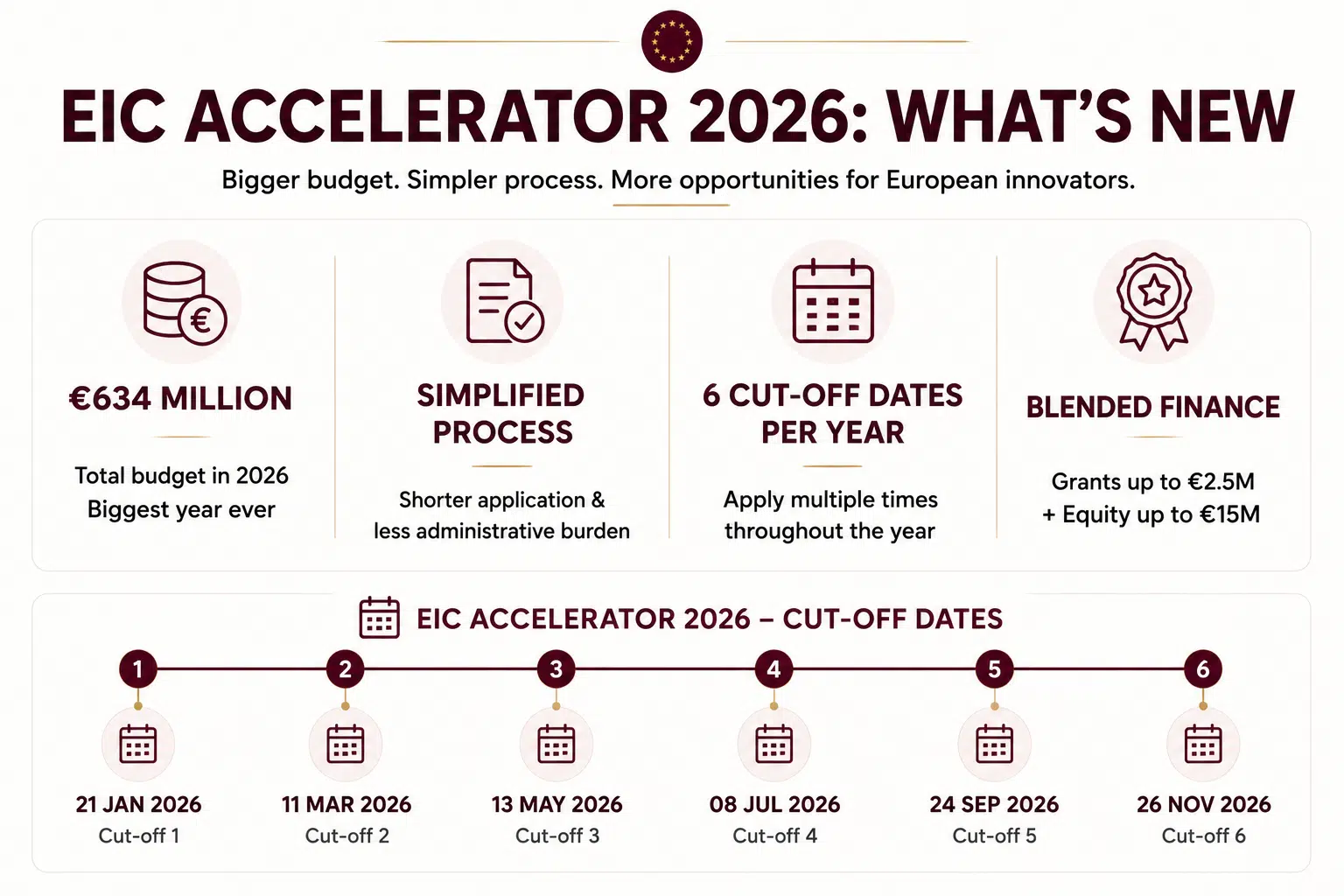
2026 EIC Accelerator What’s New
- Total budget: €634 million (up from €384 million), the largest EIC budget to date
- Open Call: €414M (any technology or sector)
- Challenge Calls: €220M (focused on five strategic themes)
- 6 cut-off dates per year instead of 2, giving founders far more flexibility (Jan 7, Mar 4, May 6, Jul 8, Sep 2, Nov 4)
- Shorter proposals, full applications now 20 pages instead of 50
- Minimum blended finance investment raised from €500K to €1M
- Three-submission rule: after 3 unsuccessful applications at any stage, you cannot reapply under Horizon Europe
- Foreign-owned companies, excluding applicants controlled by non-EU/non-associated holding companies (e.g. Delaware flips) are no longer eligible
- New Advanced Innovation Challenges (AIC), a pilot inspired by the US ARPA model, targeting high-risk deep tech
2026 EIC Accelerator Challenge themes
- Advanced materials for renewable energy and energy storage
- Fusion power plant technologies
- Biotechnology
- Critical raw materials
- Climate adaptation
Key grant facts (unchanged)
- Up to €2.5M in non-dilutive grant funding
- Up to €10M in equity investment via the EIC Fund
- Success rate: approximately 5.9% overall; roughly 50% for companies that reach the jury interview stage
- Timeline: 9–12 months from application to first payment
What Does the Application Process Look Like in 2026?
The simplified 2026 process has three main stages:
- Short proposal, concise written application; evaluated remotely
- Full proposal 20-page form, pitch deck, implementation plan, financial information, Letters of Intent, FTO analysis, and a 3-minute video pitch
- Interview with EIC Jury live pitch with Q&A, held three times per year
Each stage has elimination. A dedicated Technology Expert Evaluator now reviews full proposals, a new addition in 2026, before the jury interview.
Total timeline from application to first funding: 12–18 months. Slightly faster than previous years due to process improvements.
Is It Worth It?
A grant of €2.5M plus up to €10M in equity is significant, but the real cost is time. Expect to spend 2–4 months writing a competitive proposal (slightly less than before, thanks to shorter page requirements). Factor in ongoing compliance, financial auditing, quarterly reports, and result dissemination obligations.
The ROI is generally positive if you win. A rejection still means sunk cost. Use the six annual cut-off dates strategically if you’re rejected, you can reapply sooner than in previous years (but remember: three strikes and you’re out under Horizon Europe).
New in 2026: STEP Scale-Up Programme
One of the most significant additions for 2026 is the STEP (Strategic Technologies for Europe Platform) Scale-Up scheme. This fills a gap that has long frustrated European founders: late-stage growth capital.
- Budget: €300M for 2026, projected to reach €900M by 2027
- Investment size: Up to €30M per project, far larger than the standard EIC grant
- Target: Scale-ups ready for significant expansion in strategic technology sectors
- Focus: Reducing EU strategic dependencies in tech, manufacturing, and critical industries
If you’re a post-Series A deeptech company, STEP Scale-Up is worth a serious look.
National Startup Funding Programs by Country
These programs are more accessible than Horizon Europe, with faster approvals, lower minimums, and more practical for early-stage companies. Many can also be stacked with EU grants, subject to state aid rules.
Germany
KfW ERP Starter Loan
- Up to €1M at low interest rates
- Requires a business plan and feasibility study
- Approval in 2–4 weeks
High-Tech Gründerfonds (HTGF)
- Equity investment of €100K–€2M at seed stage
- Focus on tech-based companies
- The German government’s €1 billion large VC fund is being extended from 2026, targeting scale-ups that have outgrown seed instruments
INVEST Tax Incentive
- 20% tax credit for angel investors in startups
- Indirectly helps startups attract German angels
France
Bpifrance Loans & Grants
- Innovation Loan: €10K–€10M
- Growth Loan: €300K–€10M
- Innovation Grant: €30K–€300K
- France’s France 2030 plan earmarks €1.5 billion annually in startup-focused calls, with Bpifrance as the primary delivery vehicle
- Bpifrance’s 2026–2030 strategy dedicates €10 billion to AI and disruptive technology investments across all instruments
French Tech Visa
- Fast-track residency permit (4 years) for startup founders
- Simplifies hiring international talent
Spain
ENISA Startup Loans
- Up to €1M with flexible terms, no collateral required
- Participation loans that align repayment with growth
NEOTEC Grant (2026)
- Flagship non-repayable grant for early-stage technology startups
- Focus areas for 2026: deeptech, biotech, medtech, energy, advanced materials, and AI with strong R&D content
- Does not take equity
Italy
CDP Venture Capital / National Innovation Fund
- Italy channels startup funding primarily through CDP Venture Capital, which manages several direct and fund-of-funds instruments
- Italy Domani (PNRR) financing: Digital Transition Fund agreements must be signed by June 30, 2026, to access the €400M in resources time-sensitive for Italian founders
- Tax deduction of 19% for investors in registered startups
Netherlands
SBIR (Small Business Innovation Research)
- Grants for tech-based SMEs: €50K–€1M in phases
- Relatively high funding rate among eligible applicants
WBSO R&D Tax Credit (2026 update)
- For 2026, WBSO starters receive a 40% tax credit on the first €380,000 of qualifying R&D labour costs (up from 32% for established companies)
- One of the most underused instruments for early-stage Dutch startups
Belgium
Innoviris (Brussels Region)
- Innovation grants covering up to 50% of project costs
- Priority sectors: biotech, cleantech, and digital
Portugal
Portugal 2030 / IAPMEI
- Successor to PT2020 under the ERDF envelope
- IAPMEI handles business support and national R&D funding
- Portugal Ventures provides venture capital for scale-ups with strategic co-investment
Poland
European Funds for a Modern Economy (FENG)
- One of Europe’s largest EU co-financed innovation programs at €2 billion for 2021–2027
- Accessible for Polish startups and SMEs with strong R&D components
National Programs at a Glance
| Country | Program | Type | Max Amount | Approval Time |
|---|---|---|---|---|
| Germany | KfW ERP Starter Loan | Loan | €1M | 2–4 weeks |
| Germany | High-Tech Gründerfonds | Equity | €2M | 2–3 months |
| France | Bpifrance Innovation Loan | Loan | €10M | 4–8 weeks |
| France | Bpifrance Innovation Grant | Grant | €300K | 2–4 months |
| Spain | ENISA Startup Loan | Loan | €1M | 4–8 weeks |
| Spain | NEOTEC | Grant | Variable | 3–6 months |
| Italy | CDP / PNRR (deadline Jun 2026) | Grant | €400M pool | 3–6 months |
| Netherlands | SBIR | Grant | €1M | 2–4 months |
| Netherlands | WBSO (2026) | Tax credit | 40% on €380K | Ongoing |
| Belgium | Innoviris | Grant | 50% of costs | 2–3 months |
| Poland | FENG | Grant | Variable | 3–6 months |
European Bank Funding Programs
European Investment Bank (EIB)
The EIB is the EU’s lending arm. It primarily works through partner commercial banks rather than lending directly to startups.
- Loan range: €100M–€1B+ (better for infrastructure and large projects)
- For startups, the EIB’s value comes through InnovFin and similar programs, which back innovative SMEs via intermediary banks
European Bank for Reconstruction and Development (EBRD)
The EBRD focuses primarily on Central and Eastern Europe and offers accessible terms for startups in those regions.
- Up to €5M per company
- Equity and loan options
- Non-collateral lending available for qualifying SMEs
Bpifrance (French Development Bank)
Bpifrance acts as a blended finance institution combining grants, loans, and equity.
- Typical range: €10K–€10M
- Particularly strong for deep tech and innovation-heavy companies
- One of Europe’s most active startup-focused development banks, with €10B committed to AI and disruptive tech through 2030
Sector-Specific Funding in 2026
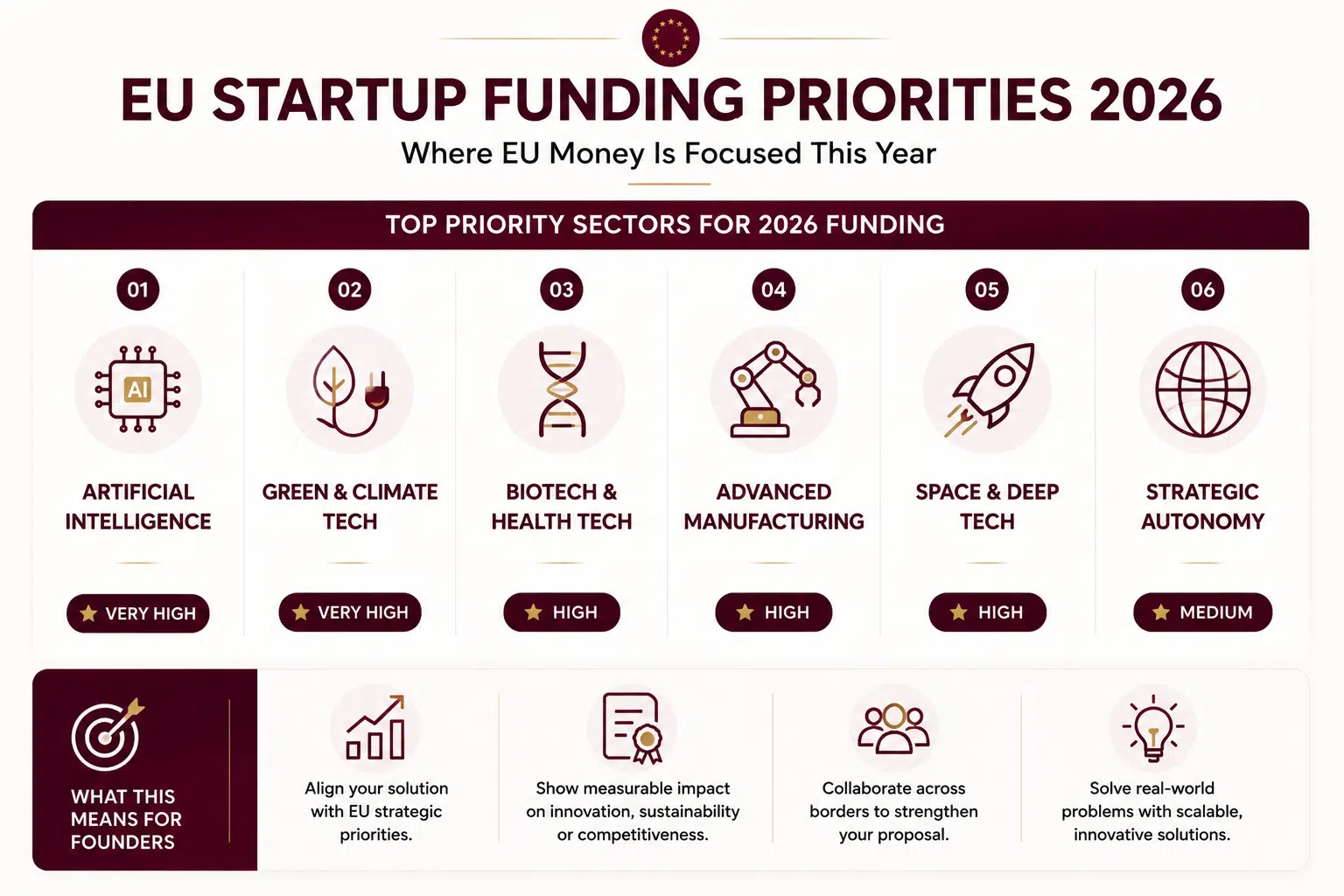
In 2026, not all sectors are equal. Public and private money is clustering in specific themes. If your startup operates in one of these, your funding odds improve significantly.
Tech, AI & Deep Tech
- Digital Europe Programme supercomputing, AI, cybersecurity
- Specific AI and robotics calls under Horizon Cluster 4
- EIC Accelerator Challenge calls with dedicated AI and advanced materials themes
- A €360M deep tech fund and a €160M manufacturing fund are active in 2026
Climate & Sustainability
- Innovation Fund commercializing low-carbon technologies
- European Green Deal funding streams
- Climate adaptation is now one of the five EIC Accelerator Challenge themes for 2026
Space
- European space firms raised €1.4B in 2025 momentum is continuing into 2026
- EIC and Horizon Cluster 4 both have space-specific calls
Health & Biotech
- Cluster 1 of Horizon Europe
- Women TechEU (2026 call supported 40 women-led deep tech health/climate/digital startups)
- EIT Health programme has active open calls for life sciences and health tech scale-ups
Creative & Cultural Industries
- Creative Europe Programme €2.44 billion for 2021–2027
- Variable availability by country; check the national culture ministry programs for local supplements
How to Apply for EU Grants: Step-by-Step
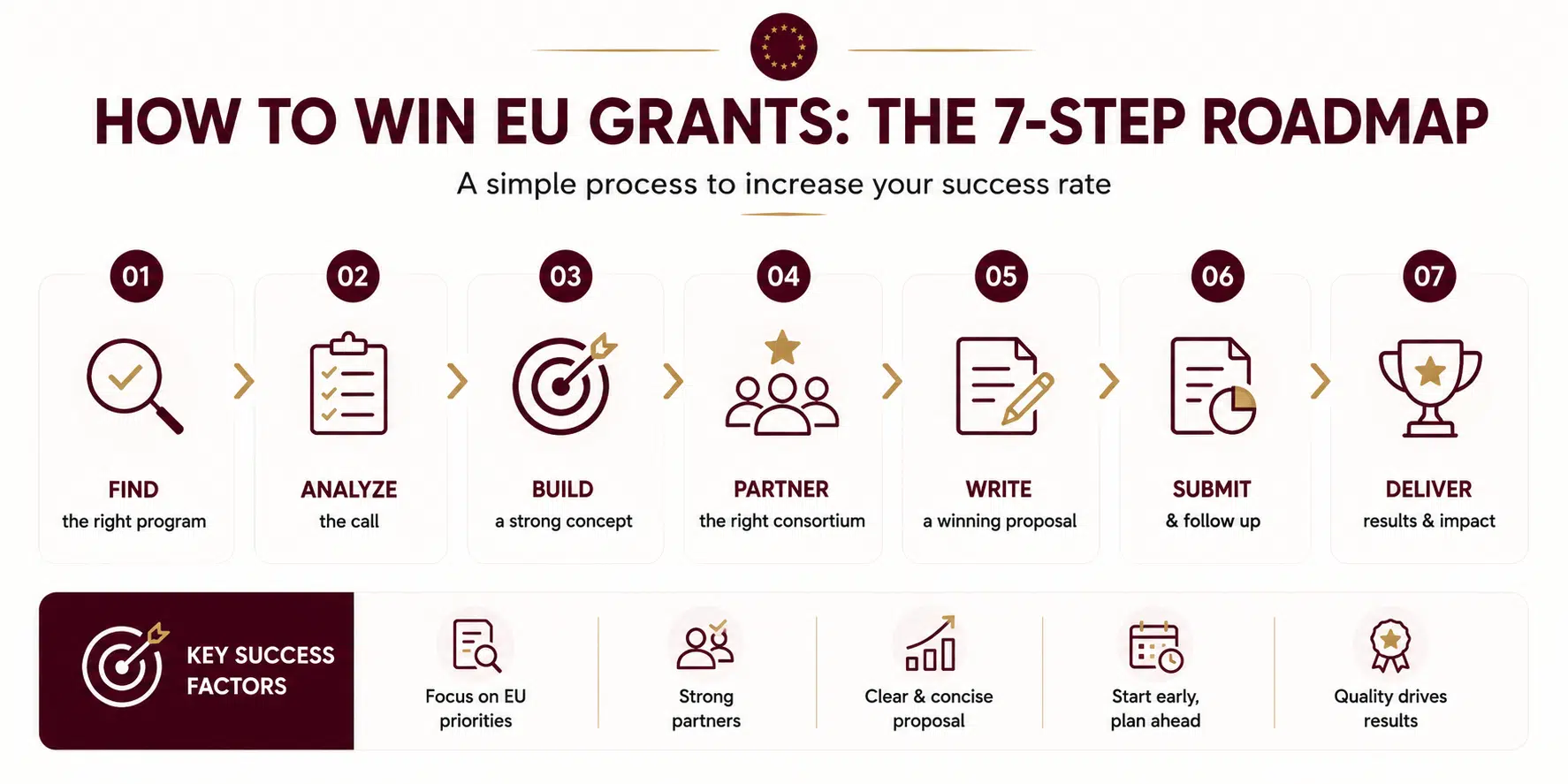
This is where most founders fail, not because they’re ineligible, but because they underestimate the process.
Step 1: Find the Right Program (1–2 weeks)
Start by matching, not writing. Use the EU Funding & Tenders Portal and the EU Funding Portal to browse open calls. Contact your national contact point (NCP) for your country, they offer free pre-application advice on fit.
Check four things before going further: jurisdiction eligibility, startup stage, sector alignment, and application deadline.
Step 2: Write a Compelling Proposal (3–8 weeks)
In 2026, EIC proposals are shorter, 20 pages vs. 50 previously. But shorter does not mean easier. A strong proposal answers six questions clearly:
- What problem are you solving, and why does it matter now?
- What is your solution, and why is it technically feasible?
- How large is the market opportunity?
- What is your competitive advantage?
- Why is your team the right one to execute?
- What measurable outcomes will this funding produce?
Reviewers score against explicit criteria. Read those criteria, the Excellence, Impact, and Risk & Implementation framework, before writing a single word.
Step 3: Build Your Budget (2–4 weeks)
Your budget must be:
- Detailed, with justification for every line item
- Realistic over-ambitious budgets are flagged
- Inclusive of co-funding if required (many programs require 20–50% matched funding)
Separate grant accounts are strongly recommended from day one. VAT is often ineligible for grant-funded expenses; get accounting advice early.
Step 4: Build a Consortium (if required)
Most Horizon Europe collaborative grants require 3+ partners from different EU countries. This is not a formality partner quality matters to reviewers.
Define clearly: who does what, who owns the IP, and how results are shared. A signed partnership agreement before submission significantly strengthens your proposal.
Step 5: Submit and Confirm
Register on the EU Funding & Tenders Portal, also obtain your PIC (Participant Identification Code), and confirm your SME status using the EU SME self-assessment tool. Portals go down under load near deadlines. Always confirm a successful submission, you should receive a reference number.
Step 6–8: Evaluation, Contracting, and Compliance
- Evaluation: 3–5 months, scored by independent experts plus a Technology Expert Evaluator (new in 2026 for EIC)
- Contracting: 2–4 months if funded milestones, payment schedules, and IP terms are finalized here
- Implementation: 2–5 years of quarterly financial tracking, technical reports, and audit readiness
Why Grant Applications Fail (And How to Avoid It)
Based on feedback from EIC and Horizon evaluators, these are the most common reasons proposals get rejected in 2026:
- Scope too ambitious relative to the budget and timeline
- No market validation no customers, no letters of intent, no traction
- Weak team credentials for the proposed technical challenge
- The innovation claim is unclear or the differentiation from competitors is thin
- Writing is dense, jargon-heavy, or doesn’t follow the application structure
New in 2026: Startups controlled by non-EU holding companies are now ineligible. Check your cap table before applying
What separates winning proposals
- A clear, specific problem statement (not “we’re disrupting X”)
- Tangible evidence of demand, pilot customers, LOIs, and revenue
- A team with a relevant track record
- Concrete, measurable KPIs for each milestone
- A realistic budget with visible contingency planning
- Strong alignment with an EU policy priority (green, digital, strategic autonomy)
Managing Grants: What Happens After You Win
Winning is the beginning, not the end. Grant compliance is a real operational burden.
Financial Management
- Open a dedicated bank account for grant funds
- Track every expense against budget lines
- Quarterly reconciliation is typically mandatory
- Prepare for financial audits, keep receipts and documentation for 5–7 years
Note: VAT on grant-funded purchases is usually non-recoverable
Reporting Requirements
Most grants require:
- Quarterly or bi-annual technical progress reports
- Financial expense documentation
- Attendance at program events
- Dissemination activities: publications, conference presentations, press releases
Missed or late reports can trigger payment holds or grant clawbacks.
Project Management
Treat the grant like a product sprint. Use milestone tracking, assign internal ownership for each deliverable, and maintain a risk register. Reviewers compare your actual progress against what you promised in the proposal. In 2026, result dissemination is increasingly tied to EU policy visibility document your outcomes with that audience in mind.
Real-World Case Studies
Case Study 1: SaaS Company Secures Horizon Europe Grant
A B2B SaaS startup in the Netherlands working on supply chain analytics applied for a Horizon Europe Cluster 4 grant. The key to their success: they had two paying enterprise pilots before submitting, which gave reviewers confidence in market validation. They received €2.1M, hired two senior engineers, and used the funding runway to close a Series A. The lesson: apply when you have traction, not before.
Case Study 2: Biotech Startup Stacks Multiple Sources
A Spanish biotech combined a €300K Bpifrance Innovation Loan with a €1.8M EIC Pathfinder grant and a €500K angel round. Managing three sets of reporting obligations simultaneously required a dedicated finance hire. But the blended capital structure meant they reached clinical trial Phase 1 without giving up majority equity. Key lesson: multi-source funding works, but it demands serious operational infrastructure.
Case Study 3: Bootstrapped Startup Grows Without Grants
A Berlin-based creator tools startup skipped grants entirely. Instead, they used revenue-based financing (€150K), a small KfW loan (€200K), and reinvested ARR. They reached €2M in revenue before raising their first round. Lesson: not every startup benefits from grant complexity if you’re growing fast and revenue is predictable, loans and revenue-based financing may offer a better time ROI.
2026 Funding Programs: Quick Comparison
| Program | Level | Max Grant | Equity? | Timeline | Best For |
|---|---|---|---|---|---|
| EIC Accelerator (Open) | EU | €2.5M grant + €10M equity | Optional | 12–18 months | Deep tech SMEs |
| EIC STEP Scale-Up | EU | €30M | Yes | 12–18 months | Post-Series A scale-ups |
| Horizon Europe Clusters | EU | €5M+ | No | 18–24 months | R&D consortia |
| Eurostars | EU/EUREKA | €500K per partner | No | 12 months | Cross-border R&D |
| KfW ERP Loan (DE) | National | €1M | No | 2–4 weeks | Early-stage German startups |
| Bpifrance Grant (FR) | National | €300K | No | 2–4 months | French innovators |
| NEOTEC (ES) | National | Variable | No | 3–6 months | Spanish tech startups |
| WBSO Tax Credit (NL) | National | 40% on €380K | No | Ongoing | Dutch R&D companies |
Conclusion: Building a Smart EU Funding Strategy for 2026
EU funding is one of the most underutilized tools available to European founders. The opportunity in 2026 is larger than it’s ever been, but it’s also more focused. Money is flowing toward deeptech, AI, climate, biotech, and strategic manufacturing. If you’re building in those sectors, the EU funding landscape is genuinely favorable.
The smartest founders don’t choose between grants, loans, and equity. They stack them intentionally. A national innovation grant de-risks early R&D. A development bank loan funds hiring. An EIC grant adds credibility for a private round. STEP Scale-Up capital drives expansion. Equity closes the gaps.
Where to start in 2026
- Browse the EU Funding & Tenders Portal for open calls relevant to your sector
- Check your national contact point for free guidance on program fit. It’s free and often underused
- Confirm your cap table structure is EIC-eligible before investing time in an application
- If you’re pre-revenue, prioritize faster national programs (KfW, ENISA, WBSO, Bpifrance) over Horizon Europe
- If you have traction and a strong deeptech claim, the EIC Accelerator’s 6 annual cut-off dates give you more chances than ever before
- Start building your grant-readiness file now, proof of problem, pilot evidence, IP ownership notes, team credentials so you can move fast when a relevant call opens
The EU has set aside billions to fund the next generation of European companies. The founders who access it are the ones who treat the application process with the same seriousness as building their product.