Expanding into Europe is an exciting milestone, but one of the first decisions every business must make is how to establish its legal presence. Should you open a branch office, create a subsidiary, or register a completely new company? While all three options allow businesses to operate within European markets, they differ significantly in terms of legal status, liability, taxation, setup costs, and operational flexibility.
For businesses testing a new market with limited investment, a branch office is often the quickest and most cost-effective option. Companies planning long-term expansion usually benefit from establishing a subsidiary because it provides greater legal protection and operational independence. Choosing the wrong structure can lead to higher compliance costs, unnecessary tax complications, or increased legal exposure.
In this guide, we’ll compare branches, subsidiaries, and new companies across the key factors that influence European expansion, helping you identify the structure that best aligns with your business goals.
What are the three options?
Before comparing the advantages of each structure, it is important to understand what they are and how they differ.
What Is a branch office in europe?
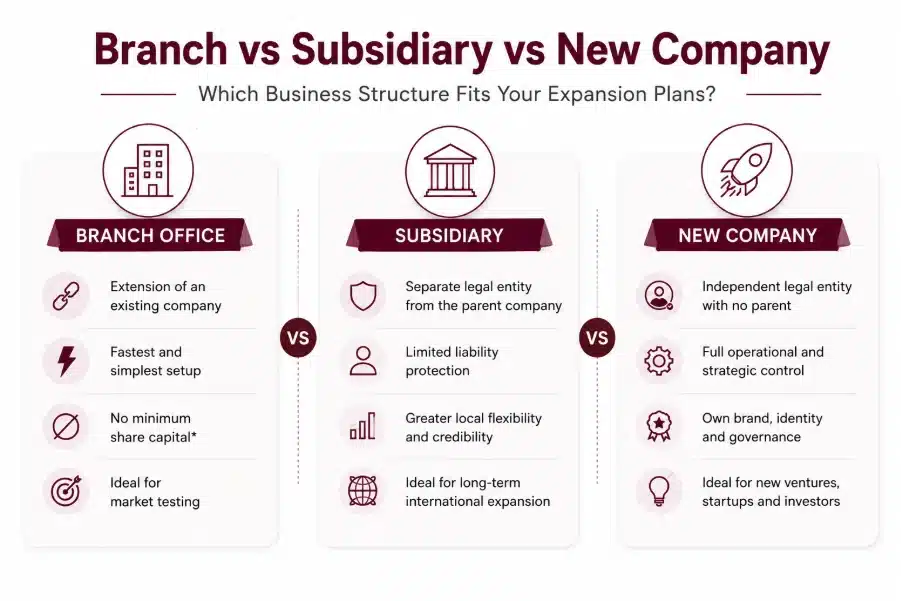
A branch office is an extension of an existing company rather than a separate legal entity. It allows a business to operate in another European country while remaining legally connected to its parent company.
Branches are often chosen by businesses entering a new market because they are generally quicker and less expensive to establish. However, since the branch and parent company are legally the same entity, the parent remains fully responsible for the branch’s obligations and liabilities.
What Is a foreign subsidiary in Europe?
A subsidiary is a separate legal company incorporated within a European country. Although owned by the parent company, it operates as an independent legal entity with its own rights and responsibilities.
Because liability is generally limited to the capital invested, subsidiaries offer greater protection for the parent company. They also provide more flexibility when hiring staff, entering contracts, raising investment, and establishing a local business presence.
What is registering a new company in Europe?
Registering a new company means incorporating an entirely independent business that has no legal relationship with another overseas company. Unlike a subsidiary, there is no parent company controlling its operations or assuming responsibility for its obligations. This option is often selected by entrepreneurs, business relocations, management buyouts, or founders launching directly into the European market through professional company formation services
Legal status and liability explained
One of the biggest differences between these structures is legal responsibility. This affects everything from financial risk to contract obligations and potential legal disputes.
Branch office liability risks
A branch office is not legally separate from its parent company. Any debts, contractual obligations, or legal claims against the branch can ultimately become the responsibility of the parent organisation.
For businesses operating in industries with higher legal or financial risks, this exposure can become a significant concern. If a dispute arises in the European branch, the parent company’s assets may also be affected. For this reason, branches are often better suited to businesses testing new markets with relatively low operational risk.
Subsidiary liability protection
A subsidiary provides a higher level of protection because it exists as its own legal entity. In most cases, the parent company’s financial exposure is limited to the capital invested in the subsidiary. This separation reduces risk while providing greater flexibility for contracts, employment, financing, and local partnerships. Businesses planning significant investment or long-term European operations frequently choose subsidiary structures because they create a stronger legal foundation for future growth.
New company has no parent liability
A newly incorporated company has completed legal independence. There is no parent organisation responsible for its debts, legal obligations, or commercial decisions. This makes it particularly attractive for entrepreneurs launching new ventures or businesses relocating entirely to Europe. Because there are no existing corporate relationships, governance and strategic decisions remain entirely under the control of the new company’s owners.
Tax comparison across the three structures
Tax treatment varies depending on the structure chosen and the country of incorporation. Understanding these differences early can help businesses optimise their expansion strategy and avoid unexpected compliance issues.
| Factor | Branch | Subsidiary | New Company |
| Corporate Tax | Local-source income | Worldwide income | Worldwide income |
| Profit Distribution | Parent company | Dividends | Owner distributions |
| Withholding Tax | May apply | Country dependent | Country dependent |
| Tax Treaties | Usually available | Available | Available |
How branch offices are taxed in Europe?
Branches are generally taxed only on the income generated within the country where they operate. Profits normally flow back to the parent company without dividend procedures, although withholding tax obligations may vary depending on local legislation and applicable double taxation treaties. This relatively straightforward structure makes branches attractive for businesses seeking a lower administrative burden during initial market entry.
How subsidiaries are taxed in Europe?
A subsidiary is usually treated as a tax resident in the country where it is incorporated. It pays corporate tax on its taxable profits under local legislation. Many European countries also provide incentives that make subsidiaries attractive for international expansion. Depending on the jurisdiction, businesses may benefit from participation exemptions, reduced withholding taxes, or favourable corporate tax regimes.
For example, Malta’s tax refund system can reduce the effective corporate tax rate for qualifying companies, while Portugal and Ireland offer competitive tax frameworks for internationally active businesses.
How is a new independent company taxed?
A newly incorporated company is taxed as a resident business within its country of registration. Unlike subsidiaries, there is no parent company relationship to manage, simplifying many aspects of taxation and compliance. For entrepreneurs launching independently, this often creates a straightforward tax structure that is easier to administer during the early stages of growth.
Double taxation treaties
One common misconception is that only subsidiaries benefit from double taxation treaties. In reality, branches, subsidiaries, and newly incorporated companies may all access treaty benefits where the relevant conditions are met. However, the availability and application of relief can vary depending on the jurisdiction, ownership structure, and treaty provisions. Understanding how these agreements apply to your business is an important part of international tax planning.
Setup process, costs, and timeline
The time and cost involved in establishing a business in Europe vary depending on the structure you choose. Branch offices are generally the quickest and most affordable option, while subsidiaries and new companies require additional incorporation procedures and compliance checks. Choosing the right structure should balance speed, budget, operational needs, and long-term business objectives.
Setting up a branch office
A branch office is usually the simplest option because it extends an existing company rather than creating a new legal entity. Most European jurisdictions do not require minimum share capital for a branch. Registration generally involves submitting certified parent company documents, director information, proof of incorporation, and a local registered address. For businesses testing a new market, this structure offers a faster route to becoming operational.
Incorporating a subsidiary
Setting up a subsidiary requires incorporating a separate legal entity under the laws of the chosen European country.
The process typically includes
- Reserving the company name
- Preparing incorporation documents
- Registering with the commercial registry
- Obtaining tax registrations
- Opening a corporate bank account
- Completing beneficial ownership disclosures where required
Capital requirements differ by jurisdiction. For example, Portugal allows an Lda to be established with as little as €1 share capital, while Malta generally requires higher initial capital depending on the company type. Although incorporation takes longer than opening a branch, subsidiaries provide stronger legal protection and greater flexibility for long-term expansion.
Registering a new company
Registering a completely new company follows a similar process to subsidiary incorporation but without requiring documentation from an overseas parent company. Entrepreneurs establish the business directly in their chosen European jurisdiction, making it particularly suitable for founders relocating, launching a new venture, or operating independently. Registration timelines depend on local authorities, banking procedures, and licensing requirements.
Operational control and market flexibility
Beyond legal and tax considerations, businesses should also think about how much operational freedom they want their European presence to have. Some organisations prefer centralised decision-making, while others benefit from empowering local management teams to respond quickly to changing market conditions.
Branch offices mean central control
A branch office operates as part of the parent company. Strategic decisions, financial controls, and operational policies are generally managed from headquarters. This ensures consistency across international operations but can also slow decision-making when local market conditions require quick responses. For businesses delivering standardised products or services, this centralised approach can work well.
Subsidiaries allow local autonomy
Subsidiaries provide greater independence. Local management teams can make operational decisions, recruit employees, negotiate contracts, and develop partnerships without requiring approval for every business activity.
This flexibility allows businesses to adapt more effectively to customer preferences, regulatory changes, and competitive conditions within individual European markets. It also helps establish a stronger local identity while remaining part of the wider corporate group.
New companies have full independence
A newly incorporated company operates entirely on its own. There are no group policies, reporting obligations to a parent company, or restrictions imposed by an overseas headquarters. This independence provides maximum flexibility for entrepreneurs, investors, and joint ventures seeking complete control over strategy, operations, branding, and future growth.
Which structure suits which business scenario?
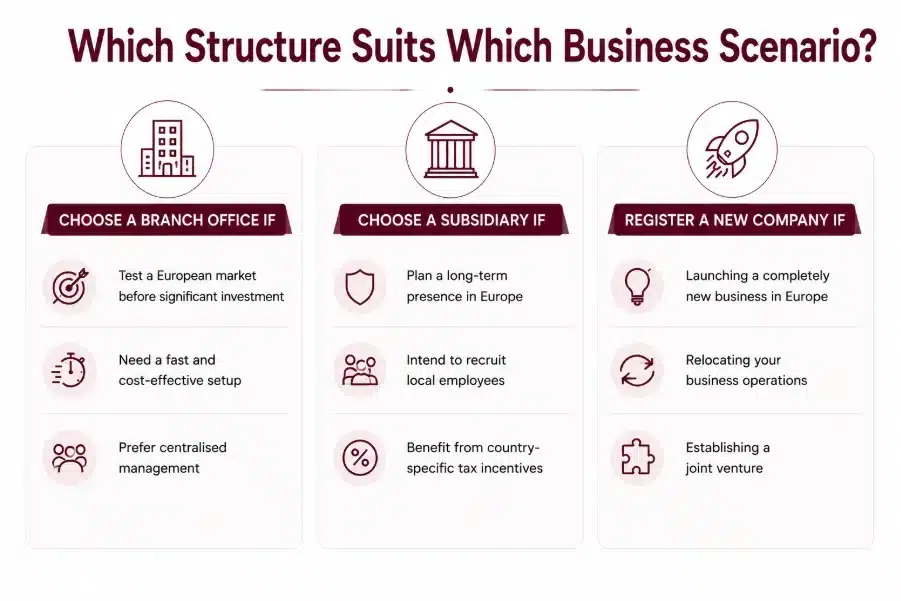
There is no single structure that suits every business. The right choice depends on your expansion strategy, risk profile, investment plans, and long-term objectives.
Choose a branch office If
A branch office is generally the right option if you
- Want to test a European market before making significant investments.
- Need a fast and cost-effective setup.
- Operate in a relatively low-risk industry.
- Prefer centralised management.
- Plan to maintain close control from headquarters.
Branches work particularly well for representative offices, consulting firms, and businesses exploring market demand before committing to permanent operations.
Choose a subsidiary If
A subsidiary is often the better choice if you
- Plan to establish a long-term presence in Europe.
- Need stronger liability protection.
- Intend to recruit local employees.
- Expect to build local partnerships.
- Want to benefit from country-specific tax incentives.
- May seek external investment in the future.
Businesses in manufacturing, technology, financial services, healthcare, and regulated industries frequently choose subsidiaries because of their stronger legal separation and operational flexibility.
Register a new company If
- Registering a new company is often the best solution if you
- Are launching a completely new business in Europe.
- Do not have an existing overseas parent company.
- Are relocating your business operations.
- Are establishing a joint venture.
- Need a standalone company for licensing or regulatory purposes.
This option gives entrepreneurs complete independence while allowing them to build a business specifically for the European market.
Conclusion
Expanding into Europe requires more than choosing a country. Selecting the right legal structure lays the foundation for future growth, operational efficiency, and effective risk management. A branch office offers a fast and cost-effective way to test new markets while maintaining centralised control. A subsidiary provides stronger liability protection, greater operational flexibility, and is often the preferred choice for businesses committed to long-term European expansion.
Registering a new company is ideal for entrepreneurs, independent founders, and organisations establishing a completely standalone presence in Europe. Taking the time to choose the right structure with the help of experts can help reduce costs, simplify compliance, and position your business for sustainable success across European markets.